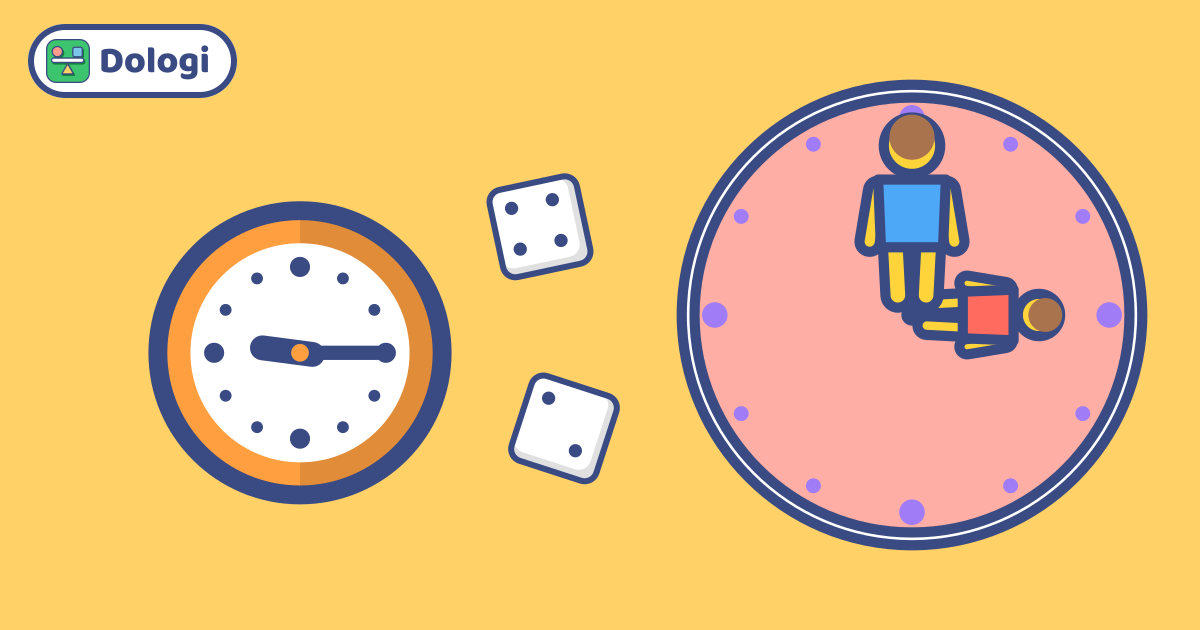
Children aged 6 to 9 learn to read an analog clock at school, but rarely use one at home, since most clocks around them are digital. A homemade paper plate clock and a few games let your child turn the hands themselves again and again, instead of just looking at pictures in a workbook. Here's how to make the clock, plus three games: time bingo, a dice race around the clock, and a human clock on the floor.
Making a paper plate clock
- A paper plate for the face. Fold it in half and then in quarters to find the center and the 12, 3, 6 and 9 positions.
- Write the numbers 1 to 12, starting with 12, 3, 6 and 9 and spacing the rest evenly. Older kids can add minute marks around the edge.
- Two hands cut from card, a short wide one and a long thin one, ideally in different colors.
- Fix the hands at the center with a paper fastener (split pin) so they turn without flopping.
One clock per player is best. Making it is a good time to chat: why is 12 at the top, and why does the short hand move so slowly?
Game 1: Time bingo
- Each player gets a sheet with nine squares (three rows of three). In each square, draw a clock face showing a different time.
- Call out a time: "Half past three!" Anyone with a face showing that time puts a dried bean on it.
- The first to get three in a row (across, down or diagonally) wins.
Swap roles: your child calls the times and you find them. To call correctly, your child has to read every face on their own card.
Game 2: Dice race around the clock
- Each player has a paper plate clock, all set to 12 o'clock.
- On your turn, roll a die and move the minute hand forward that many quarter hours: one dot is fifteen minutes, two is half an hour, four is a whole hour.
- When the minute hand passes 12, nudge the hour hand on yourself to the next number. This is the step kids often forget, and the one most worth learning.
- The first to land on exactly 3 o'clock wins. A roll that would take you past it means you stay put until your next turn.
From 12 to 3 is twelve quarter hours, so everyone needs a few rolls. After each turn, say the new time out loud: "Twelve forty-five," "Half past one."
Game 3: A human clock on the floor
- Make a big circle on the floor with string or tape and put twelve numbered sheets of paper around it.
- Two people lie down as the hands, feet together in the middle: the shorter one is the hour hand, the taller one the minute hand. With just one child and a parent, the parent is the long hand.
- A third person (or one of the two) calls a time: "Six o'clock!", "Nine o'clock!", "Half past two!" The hands have to swivel into place.
- Faster: call several times in a row, and the hands must move clockwise, no shortcuts.
This lets your child feel it with their whole body: the minute hand has to go all the way round before the hour hand moves on by one.
Levels by age
| Age | Times used in the games | Suggestion |
|---|---|---|
| 6 | O'clock and half past | Game 2: each dot is half an hour, target 6 o'clock |
| 7 | Add quarter past and quarter to | Game 2 with the rules above |
| 8–9 | Add five-minute steps | Bingo with times like 4:25 and ten to seven |
For 6-year-olds, with each dot worth half an hour, 12 to 6 o'clock is also twelve steps, so the game stays a good length.
Tips for parents
- Say times both ways: "two forty-five" and "quarter to three" are the same moment. Hearing both at home makes school less confusing.
- Link it to the day: "What will the clock show when we have dinner?" Your child sets the paper clock and then watches the real one.
- Keep the paper clock somewhere visible; kids often pick it up and play with it on their own.
The Math topic in Dologi has a puzzle called What time is it?: "Which clock shows the same time as the big clock?" After turning the hands themselves many times, your child reads clock faces much faster.
In short
- A paper plate, two card hands and a paper fastener are all you need for the clock.
- Time bingo: you call a time, your child finds the face; then swap.
- Dice race: each dot is fifteen minutes, remember to nudge the hour hand, first to exactly 3 o'clock wins.
- Human clock: two people lie down as the hands and swivel to each time called, always clockwise.
Read more: Teaching your child to tell time, How long is a minute?