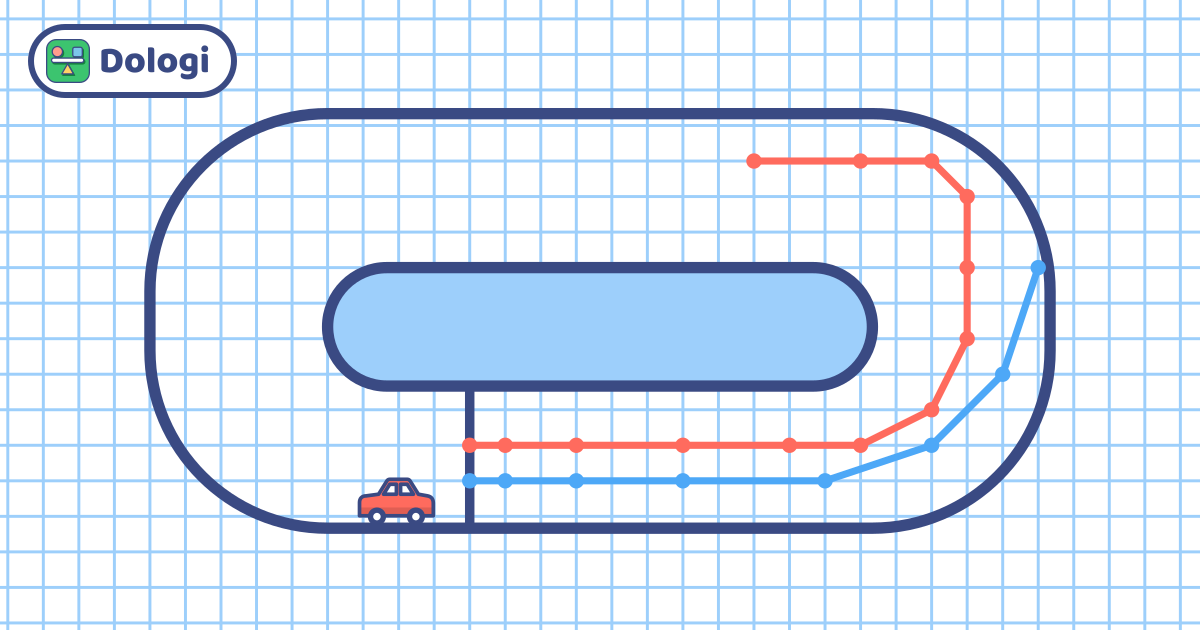
All you need is graph paper, two colored pens and a little math, and two players have a tense car race on their hands. Each car is a dot on a grid point, and each move is a straight line. The catch: a car can't stop instantly. If you went fast last turn, you have to go almost as fast this turn. Reach a corner without braking and you fly off the track.
The game suits kids aged 9 to 12. They have to think several moves ahead, count squares in two directions, and discover something very real for themselves: anything moving fast needs distance to stop.
Drawing the track
- On a sheet of graph paper, draw a closed racetrack with its two edges about 4 to 6 squares apart. Start with an oval or stadium shape; once kids get the hang of it, add tight bends and S-curves.
- Draw a start line across the track. It's also the finish line after one lap.
- Each player picks a grid point on the start line for their car, each with a different colored pen.
How the cars move
- First move: go from the start point to one of the eight grid points right next to it (up, down, left, right or diagonal).
- Every move after that: repeat the move you just made to find your target point. For example, if last turn you went 3 squares right and 1 up, your target is another 3 right and 1 up.
- You can stop on the target point or one of the eight points around it. In other words, in each direction (across and up-down) you can go at most one square faster or slower than last turn.
- Join your old point to your new one with a straight line. The whole line must stay inside the track.
- Crashing: if your line crosses an edge, your car goes back to its last point inside the track, its speed drops to zero (next move only to a neighboring point), and you miss a turn.
- Two cars can't stop on the same point.
- The first car to cross the finish line after one lap wins.
That sounds like a lot of rules, but you only really need to remember one sentence: "Repeat your last move, then shift by one square at most."
Why you have to brake early
Each turn, your speed in each direction can only drop by one square. So if you're moving 4 squares per turn:
- Next turn you'll still move at least 3 squares, then 2, then 1, and only then stop.
- From the moment you start braking, the car rolls on another 3 + 2 + 1 = 6 squares.
At 5 squares per turn, it rolls another 4 + 3 + 2 + 1 = 10 squares. A little more speed means a lot more braking distance. Kids usually crash in their first few games, then work it out for themselves: slow down before the corner, not once you're in it.
It's also a good moment to talk about road safety: why cars on the road can't stop the instant someone runs out in front of them.
Cornering tips
- Count back from the corner: is the bend 6 squares away in the direction you're going? If you're doing 4 per turn, start braking now.
- Go in wide, cut close to the inside edge, come out wide: a wider curve lets you keep more speed.
- Test moves in light pencil: before committing, lightly dot the nine possible points and check which one is safe for the following turn too.
- Speed up on the straights: long straights are where you win back speed lost in the corners.
Variations
- Solo time trial: try to complete a lap in as few moves as possible, write down your record, and beat it next time.
- Oil slicks: shade a few "slippery" squares; a car that stops there drops to zero speed.
- Your child designs the track: whoever draws a track has to drive one lap first, to prove it can be done.
- For 8-year-olds: draw a track 7 to 8 squares wide with gentle bends, and allow a shift of up to two squares per turn.
If your child enjoys graph paper and counting steps, counting paths on a grid has more challenges for kids who love math.
The Space topic in Dologi has a puzzle called Drive the car: "Fill every slot so the car drives over every star." Its hint is also the key skill in paper racing: count the squares in each direction, and avoid the walls.
In short
- Draw a track 4 to 6 squares wide on graph paper; each car is a dot on a grid point, and each move is a straight line.
- Each turn, repeat your last move and shift by at most one square in each direction; leaving the track sends you back with zero speed and a lost turn.
- At 4 squares per turn, a car rolls another 6 squares before stopping, so brake before the corner.
- Go into corners wide, test moves in light pencil and speed up on the straights; older kids can try solo time trials.
Read more: Counting paths on a grid, Reading simple maps with kids