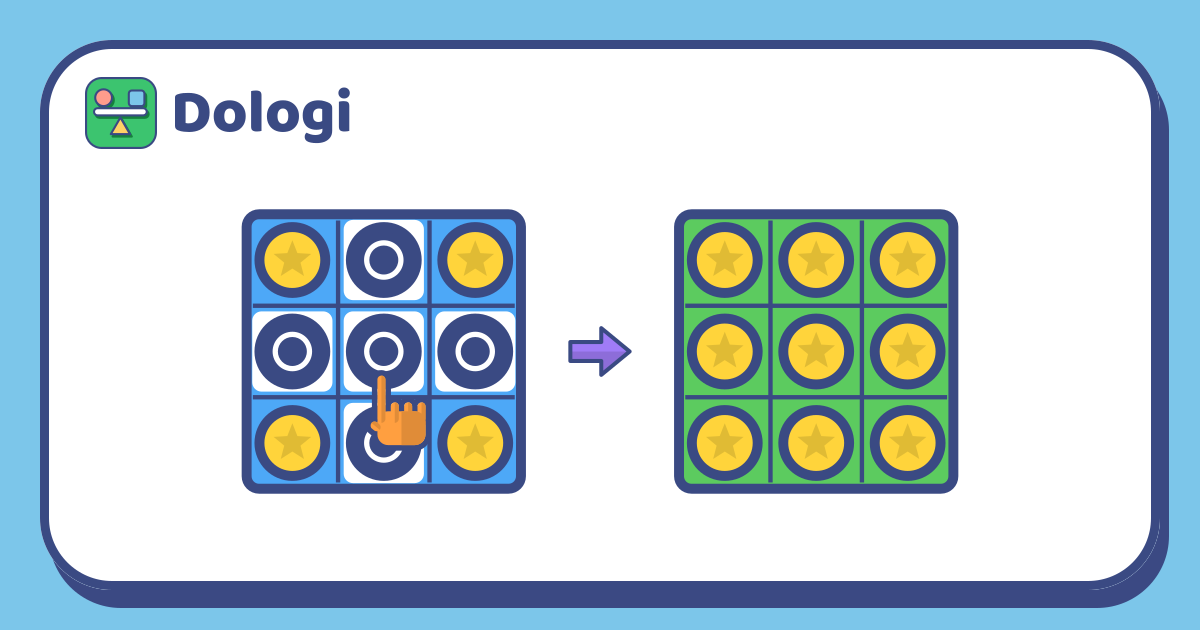
Draw a 3×3 grid on a sheet of paper and put a coin in each square. Now the rule: when you tap a coin, you flip it over, and you also flip every coin directly above, below, left and right of it. Diagonal coins stay as they are. The goal is to make all nine coins show the same side.
It looks like a game of luck, but it isn't. Children around 8 to 12 soon find that random tapping goes in circles, while a little record-keeping and two observations make every puzzle solvable. Below: how to set up the game, six puzzles with answers, and a method that solves any starting position.
How to set up the game
You need nine coins of the same kind, a sheet of paper and a pencil. Draw a grid of three rows and three columns, with squares big enough for a coin.
- A tap means: choose one square, flip that coin, then flip its neighbors. A corner coin has two neighbors, an edge coin has three, and the middle coin has four.
- The goal is all heads or all tails. Either one counts.
- Keep score by counting taps. Fewer taps is better.
In the puzzles below, ○ means heads up and ● means tails up. Each board is written row by row from the top, with a slash between rows: "○●○ / ●●● / ○●○" means the top row is heads, tails, heads, and so on. Set out the coins, then let your child try before looking at the answers.
Six puzzles to try
| Puzzle | Starting board | Challenge |
|---|---|---|
| 1 | ○●○ / ●●● / ○●○ | Make all coins the same in 1 tap |
| 2 | ●●○ / ●○○ / ○○○ | Make all coins the same in 1 tap |
| 3 | ●●○ / ●○● / ○●● | Make all coins the same in 2 taps |
| 4 | ○●○ / ●○● / ○●○ | Make all coins the same in 4 taps |
| 5 | ○○○ / ○●○ / ○○○ | Make all coins heads. How few taps can you manage? |
| 6 | ○●○ / ○○○ / ○○○ | Make all coins the same in as few taps as possible |
Puzzles 1 and 2 are a warm-up. Puzzle 5 looks the easiest, with only one coin wrong, yet it takes the most taps: a surprise worth talking about.
Two discoveries that change everything
After a few rounds, ask your child to tap the same coin twice, then to try two taps in one order and the same two taps in the other order.
- Tapping a coin twice is the same as not tapping it at all. Every coin that flipped on the first tap flips back on the second.
- The order of the taps doesn't matter. Each coin ends up flipped once for every tap that touches it, whatever the order.
Together, these turn a long chain of moves into a simpler question: which squares do I tap, once each? A solution is just a set of squares. This is also why record-keeping helps: if your child marks each tap with a check mark, they can spot a square tapped twice and cross out both check marks.
Answers and explanations
- Tap the middle. The middle coin and its four neighbors flip, and all nine coins are heads.
- Tap the top-left corner. It flips itself and its two neighbors.
- Tap the top-left and bottom-right corners. Each corner tap fixes its own group of three coins. The order doesn't matter.
- Tap the four edge coins (top middle, middle left, middle right, bottom middle). Count how many times each coin flips: each corner is touched by two taps, so it flips twice and stays heads; each edge coin is touched by its own tap only, so it flips once and becomes heads; the middle coin is touched by all four taps, so it flips four times and stays heads.
- 5 taps: the middle coin and its four neighbors, the shape of a plus sign. Check by counting: the middle coin is touched by all 5 taps (odd, so it flips to heads); every other coin is touched by an even number of taps, so it ends up the same as it started.
- 3 taps: the top-left corner, the top-right corner and the bottom middle. All nine coins become tails. Making them all heads takes 4 taps (the middle, plus the three bottom coins), so here the shortest way is to aim for tails. A good reminder to check both goals.
On a 3×3 board, every starting position can be solved, and there is exactly one set of taps that turns everything heads. That is a nice fact for your child to test: they can make up any board and know a solution exists.
A method that always works
Older children often enjoy a method more than a lucky guess. This one works row by row, pushing the problem down the board.
- Look at the top row. For each tails coin there, tap the coin directly below it. The top row is now all heads.
- Look at the middle row. For each tails coin there, tap the coin directly below it. The middle row is now all heads too.
- If the bottom row still has tails, find its pattern in the table below, tap the top-row coins it names, and repeat steps 1 and 2. Everything ends up heads.
| Bottom row left over | Tap these top-row coins, then repeat steps 1 and 2 |
|---|---|
| ○○● | Middle and right |
| ○●○ | All three |
| ○●● | Left |
| ●○○ | Left and middle |
| ●○● | Left and right |
| ●●○ | Right |
| ●●● | Middle |
Why does the table work? A curious 11- or 12-year-old can find out: tap one top-row coin on an all-heads board, sweep it down and see what is left at the bottom.
Make it your own
- Bigger boards: a 4×4 grid with sixteen coins or bottle caps. The sweeping method still works, but you need a new table.
- Your child sets the puzzle: they start from all heads, make three secret taps, and hand you the board. Since the order doesn't matter and two taps cancel, you only need to find their three squares.
In Dologi, the "Lights on" puzzles use the same rule with lamps: a tap switches a lamp and the lamps above, below, left and right of it, until every lamp is lit.
In short
- Each tap flips a coin and the coins directly beside it; the goal is all heads or all tails.
- Tapping a square twice cancels out, and the order of taps doesn't matter, so a solution is just a set of squares.
- Keep a tally of taps: it shows double taps to remove and the shortest solution.
- The row-by-row method plus a small table solves any 3×3 board.
Read more: Classic logic puzzles for 10-to-12-year-olds with step-by-step solutions: mislabeled boxes, three switches and one bulb · Tricky math puzzles for 8-to-12-year-olds with answers: the snail in the well, sawing a log and puzzles you have to draw