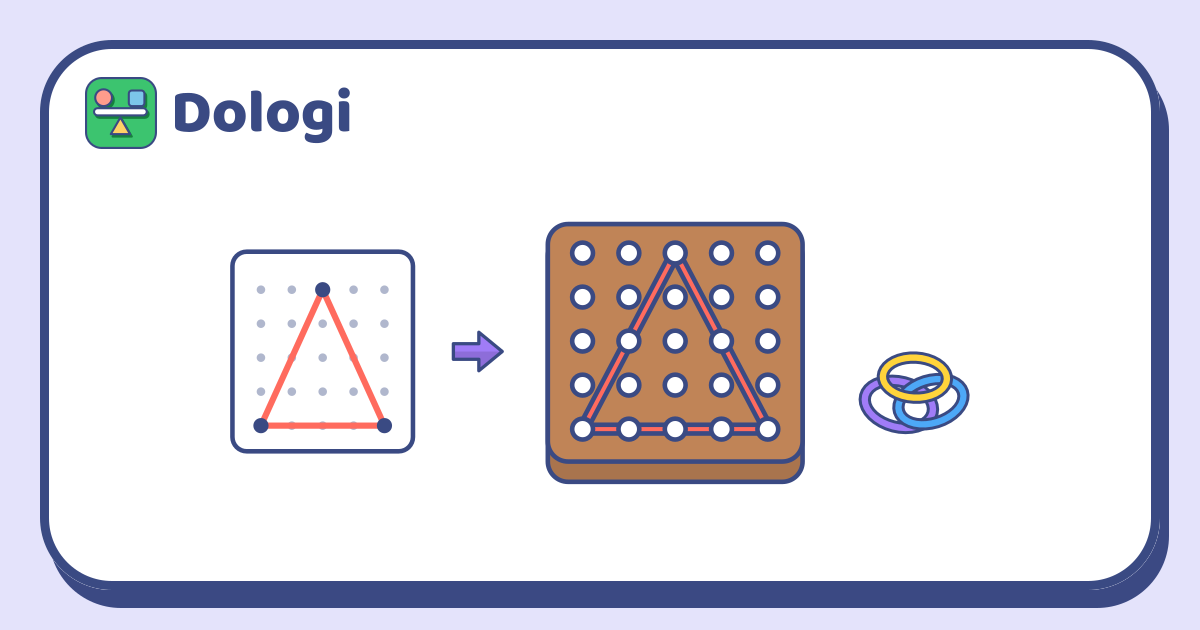
Stretch a rubber band over three pegs and you have a triangle. Move one corner to the next peg and it becomes a different triangle. Add a fourth peg and it turns into a square. A pegboard, a flat board with pegs set out in a grid, lets children build shapes in seconds and change them just as fast, with nothing to erase.
This article shows how to make a simple pegboard at home, how to start with free play, how to copy shapes from a pattern card, and which challenges to try as your child grows, for children aged roughly 4 to 10.
Why a pegboard is good for spatial thinking
Drawing a straight line is hard for young hands. On a pegboard the line is always straight, because the band goes directly from peg to peg. Your child can focus on the shape itself: where its corners are, how long its sides are and how it sits on the board.
The grid also gives children a way to describe and compare: "This side goes across three pegs, that one across two." Counting pegs turns a vague picture into something they can check. And because a band can be moved in a moment, children try more ideas and worry less about getting it wrong.
Make a pegboard at home
You don't need to buy anything special. One simple way:
- Make the board. Glue two or three layers of thick cardboard together, or use a piece of foam board, so it is firm.
- Mark the grid. Draw a square grid of dots with a ruler, five rows of five dots to start with, a finger's width or more apart.
- Add the pegs. An adult cuts short pieces from wooden skewers or toothpicks and pushes them into the dots, pointed end down into the board and flat end up. A dab of glue keeps them steady.
- Find some bands. Small rubber bands or hair elastics in a few colors work well.
No time to make a board? Dot paper and colored pencils work as a stand-in: your child draws lines from dot to dot instead of stretching bands.
Free play first
For younger children, around ages 4 to 6, the first sessions are simply for exploring. Let them stretch bands any way they like and ask about what appears:
- "What shape did you make? How many corners does it have?"
- "Can you make it bigger? Smaller? Taller?"
- "Can you make a house? A boat? A kite?"
Children often discover on their own that moving one corner changes the whole shape. Names like triangle, square and rectangle come up naturally during play.
Copy from a pattern card
Copying a shape exactly is the core pegboard game. Draw a few shapes on cards with the same grid of dots as the board, and ask your child to make the same shape with a band.
| Level | What is on the card | Roughly for |
|---|---|---|
| Easy | A square or rectangle with straight sides | Ages 4–6 |
| Medium | A triangle with one slanted side, a house shape | Ages 5–7 |
| Harder | A shape with several slanted sides, or two bands overlapping | Ages 7–10 |
| Hardest | The card turned around, or a shape to build from memory after a short look | Ages 8–10 |
A few tips help children copy accurately:
- Start from one corner. Find a corner on the card, count which row and column it is in, and put the band on the same peg.
- Count along each side. "On the card, this side goes across four dots. How many pegs does mine cross?"
- Check row by row when it is done, comparing the card and the board.
Then swap roles: your child draws a card and you copy it. Making a clear card is good practice in itself.
Shape challenges for older children
Once copying feels easy, give your child small puzzles to explore. There is no single right answer to most of them, which keeps the game going.
- Squares of every size. How many different sizes of square can you make on the board? Then the surprise: can you make a square that is tilted, with slanted sides? Some children are sure it is impossible until they find one.
- Many triangles. Keep two corners fixed and move only the third. How many different triangles can you make?
- Same on both sides. Choose the middle column as a mirror line and make a shape that looks the same on both sides of it. If your child enjoys this, the grid drawing and symmetry article has more ideas on paper.
- Count the squares inside. Make a rectangle and count the small grid squares inside it. Can you make a different shape with the same number of small squares inside?
- Cut it in half. Make a big square, then use a second band to split it into two parts that are exactly the same.
Ask your child to explain how they know: "How can you be sure it's a square?" Checking with counted pegs is a habit that helps with geometry later on.
Keep it playful
- Short and often works better than one long session. Leave the board where your child can pick it up.
- Praise the method, not only the result: "You counted the pegs on every side, that's why it matches."
- Mistakes are part of it. When a copy doesn't match, ask "Where is it different?" and let your child find the spot.
If your child enjoys working with shapes on a grid, the Space topic in Dologi has puzzles in the same spirit, such as "Mirror painting", where children paint the mirror half of a picture on a grid, and "Shapes inside a figure", where they count the shapes hidden in a drawing.
In short
- A pegboard lets children make shapes with straight sides in seconds and change them without erasing.
- You can make one from layers of cardboard and short wooden pegs, with an adult preparing the pegs.
- Start with free play, then copy shapes from pattern cards, starting from one corner and counting pegs along each side.
- Older children can explore squares of every size, tilted squares, symmetry and counting squares inside a shape.
Read more: Grid drawing and symmetry for children: copy, mirror and fold to check, Stick puzzles for children: move a stick, make a new shape, First shapes: finding circles, squares and triangles around the house