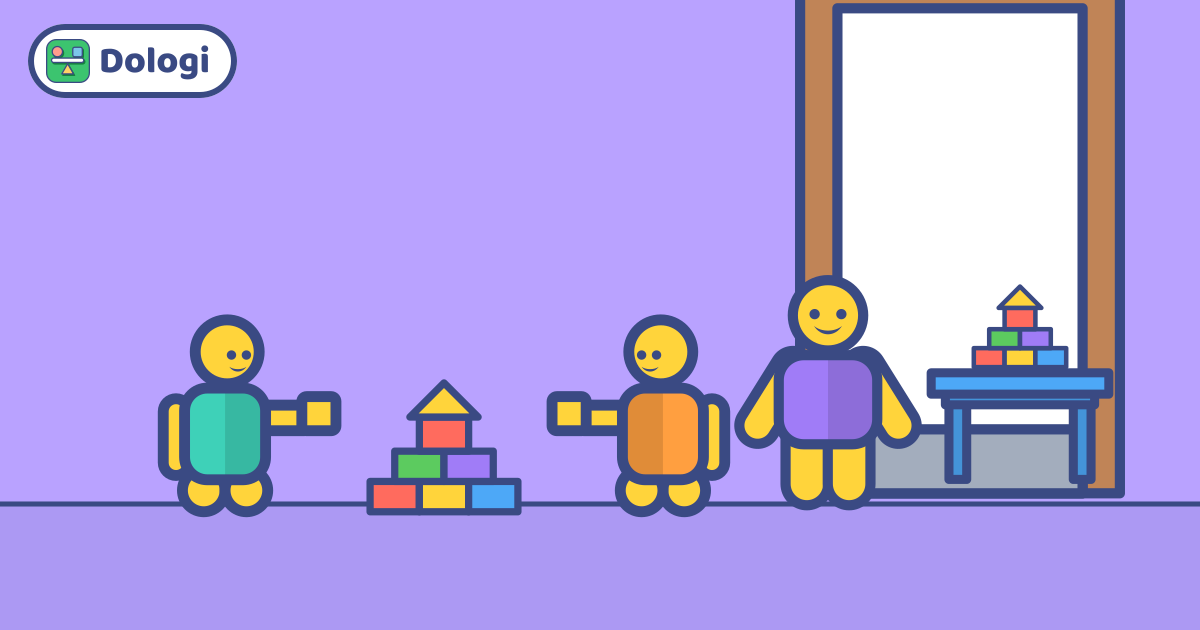
A friend comes over, the first ten minutes are lovely, and then the grabbing starts: who gets the car, whose tower is taller, and someone ends up in tears. It's not that the kids are being naughty. Children aged 5 to 10 turn almost anything into a contest. The simplest fix is to have a few win-together games ready: the whole group shares one goal, and each child holds a piece of the job that the others can't finish without.
Before the friend arrives
- Ask your child first: is there a toy they don't want to share? Put it away beforehand and you've avoided one fight already.
- Prepare two or three of the games below and lay out what they need. Kids are often a bit shy in someone else's home; having a game ready gets them going quickly.
- Let your child be the host: they explain the game and hand out the materials. Kids enjoy that role and grab less when they're the one who invited.
Game 1: Relay build from a hidden model
This one takes memory and describing in words.
- Using wooden or plastic blocks, build a small model on a table in the next room. The kids don't get to see it beforehand.
- The kids sit in the first room with a basket of matching blocks.
- Each turn, one child goes to the next room and looks at the model while counting to ten, without touching it, then runs back.
- The child who looked may only talk, not build: "At the bottom there's a long red block. On top of it, two blue cubes at each end." The others build from the description.
- Next turn, someone else goes to look. When the group thinks they're done, bring the model over and compare.
The rule that "the looker can only talk" is the key: they have to remember carefully and describe clearly, and the builders have to listen and ask questions. No one can do it alone.
Adjusting the level: for 5–6-year-olds, a model of about five blocks in two colors. For 8–10-year-olds, ten to twelve blocks, including some set at an angle or sticking out.
Game 2: The cut-up treasure map
- Draw a map of your home or yard and mark where the "treasure" is hidden.
- Cut the map into as many pieces as there are children, one piece each. Nobody snatches anyone else's piece.
- The kids have to put the pieces together and read the map as a team: "My piece has the fridge!" "Mine has the X right next to it!"
- The treasure is something for the whole group: a packet of cookies that splits evenly, a sheet of stickers with enough for everyone.
For older kids: add a few small riddles along the way, each one leading to the next hidden piece of the map.
Game 3: A story built together with toys
- Each child picks two toys as characters: a dinosaur, a car, a doll, a teddy bear.
- Taking turns, each child adds one sentence to the story, using their own characters.
- The shared rules: everyone's characters must appear, and by the end every character has to be okay.
- You can write down each sentence and read the whole story aloud at the end. Kids often fall about laughing when they hear it back.
Choosing a game for the group
| Game | Ages | Number of kids | How long | What you need |
|---|---|---|---|---|
| Relay build from a model | 5–10 | 2–4 | 20–30 minutes | Two matching sets of blocks |
| Cut-up treasure map | 5–10 | 2–4 | 20 minutes | Paper, pen, scissors, a treasure |
| Story with toys | 5–9 | 2–3 | 10–15 minutes | Toys you already have |
Set the rules, then step back
- Explain the rules once at the start, play one practice round with them, then step back and do something else within sight.
- Only step in when someone is genuinely upset. Let small disagreements get sorted out by the kids.
- When you do step in, ask the group: "What's getting in the way? How do you want to fix it?" Let them come up with the solution, like swapping turns or splitting the jobs differently.
- Got a child who loves to compete? Let the group race itself: last time the build took this many minutes; can you beat that together?
The Memory topic in Dologi has a puzzle called Put it back: "Remember where each thing is. Then put each one back." Just like the child who goes to look at the block model, your child studies an arrangement for a moment, holds it in their head and then puts it back correctly.
In short
- Have win-together games ready: one shared goal, with each child holding a piece of the job.
- Relay build from a model in the next room: the looker can only describe, the others build from the words.
- A treasure map cut into pieces, one per child; the treasure is shared by the whole group.
- A story built with toys where everyone's characters appear; explain the rules, then step back.
Read more: Helping children make friends and share, A homemade cooperative board game