Some kids cry, sweep the pieces off the table or demand rematches until they win every time they lose. It puts you in a bind: lose on purpose and your child learns nothing, play for real and the evening ends in tears. Cooperative games offer a gentler way through. The whole family is on one team, playing against the game itself. You win together, you lose together, and nobody is "the one who beat me."
This post walks you through a simple cooperative game for kids roughly 4 to 10, "Home before the rain," made with paper, pens, bottle caps and a single die. It also covers how to decide moves together so everyone gets heard, and how to make the game harder as your child grows.
Who cooperative games are good for
- Kids who aren't used to losing: losing to a game stings far less than losing to a person. Your child still practices the feeling of "not this time," with the whole family right there.
- Siblings of different ages: the older one doesn't win every time, and both have to think together.
- Quiet kids and kids who talk over everyone: every turn is a family discussion, so the quiet one gets invited to speak and the chatty one has to practice listening.
Learning to lose in competitive games still matters; when kids cry after losing covers that in depth. Cooperative games are a stepping stone, not a replacement.
Making the "Home before the rain" board
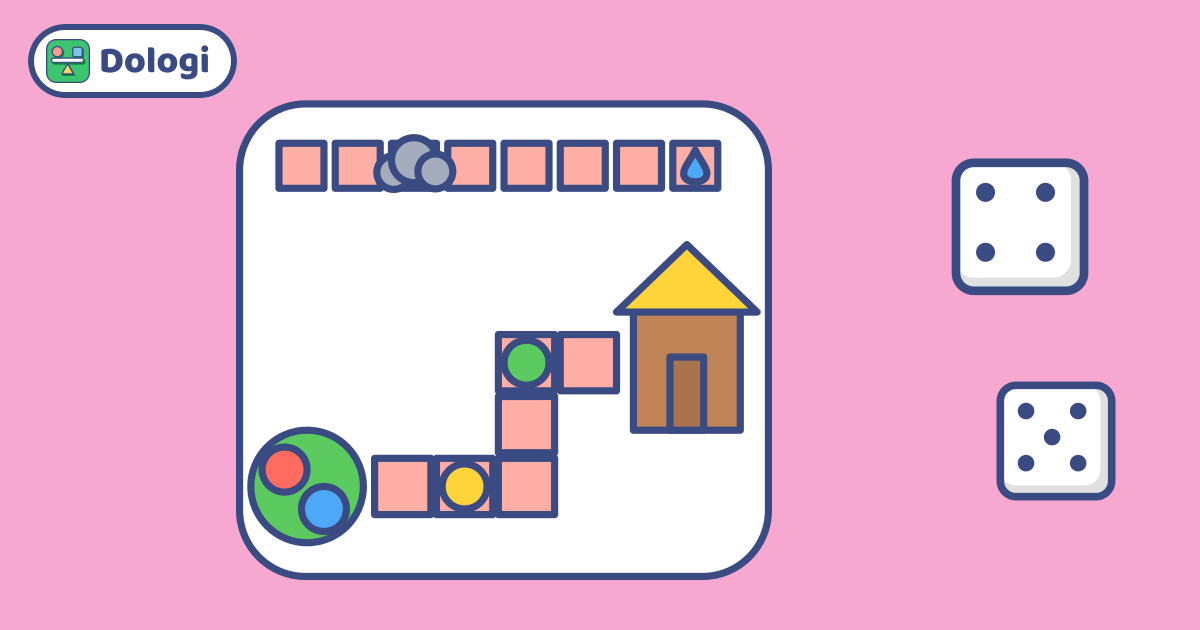
You'll need: a large sheet of paper or the inside of a cardboard box lid, colored markers, four bottle caps in different colors (the four animals), a gray bottle cap or a coin (the cloud), and one die.
- In the bottom-left corner, draw a round meadow. All four animals start here.
- From the meadow, draw a winding path of 6 squares to a barn on the right.
- Along the top edge of the paper, draw a row of 8 squares for the cloud. Draw a raindrop in the last one: when the cloud gets there, it rains.
- Let your child color the board and name the four animals. Kids care more about a board they drew themselves.
How to play
Players take turns rolling the die, but the whole family decides each move together.
- Roll a 1, 2 or 3: pick one animal and move it exactly that many squares. If it reaches the barn with squares to spare, that's fine.
- Roll a 4: pick two different animals and move each one square.
- Roll a 5 or 6: the cloud moves forward one square.
If all four animals reach the barn before the cloud reaches the last square, everybody wins. If the cloud gets there first, it rains, everybody loses, and you put the animals back in the meadow for a new game.
With a 6-square path and an 8-square cloud track, families usually win more games than they lose, which suits kids around 4 to 6. If it feels too easy, take one square off the cloud track.
Deciding together without one person running the show
Cooperative games have one trap: an adult or the oldest kid makes every decision while everyone else just watches. A few small rules keep everyone involved:
- The youngest speaks first, then the next oldest. Parents go last.
- Give a reason: "I think we should move the bunny, because it's still in the meadow."
- Whoever rolled makes the final call, after hearing everyone. Nobody moves someone else's piece for them.
- Repeat the last person's idea before sharing your own: "You said move the chick, and I think…" It's great listening practice.
- Parents ask questions instead of giving answers: "What happens if we roll a 5?"
A question worth discussing: which animal?
After a few games, a fun question comes up: when you roll a 3, should you push the animal that's almost home or one still in the meadow?
- An animal with only one or two squares left wastes the rest of the 3.
- An animal still in the meadow uses all three squares.
Don't hand your child the answer. Suggest an experiment instead: a few games where you always move the animal farthest from the barn, a few where you always move the one closest, and keep track of wins and losses. Your child will see for themselves which way wastes fewer steps, and practice testing, recording and comparing along the way.
When kids get older: invent new rules
Kids around 7 to 10 often outgrow the easy version quickly. Let them make it harder themselves:
- Exact count home: an animal must reach the barn with the exact number; if the roll is too big, it can't move.
- Mud puddle: one square on the path where an animal has to stop and wait a turn.
- Wind cards: a few face-down cards; on a 6, flip one. Some push the cloud back a square, some push it forward two.
- Longer path, shorter cloud track: adjust until the family wins about half the time.
Each time you change a rule, play a few games and ask, "Too hard, too easy or just right?" Design a board game with your child has more on testing and tweaking rules.
When your child wants to play solo, Dologi's puzzles have no opponent and no leaderboard either: your child "plays against" only the puzzle in front of them, and a wrong answer just means changing it and trying again, with no red to signal a loss.
In short
- Cooperative games put the whole family on one team against the game, which is great for kids who hate losing and for siblings of different ages.
- "Home before the rain": a 6-square path, an 8-square cloud track, and a die that decides whether an animal moves or the cloud does.
- The youngest speaks first, everyone gives a reason, the roller decides, and parents ask rather than tell.
- As kids grow, let them invent harder rules, test them and adjust.
Read more: First board games for 4 and 5 year olds, When kids cry after losing