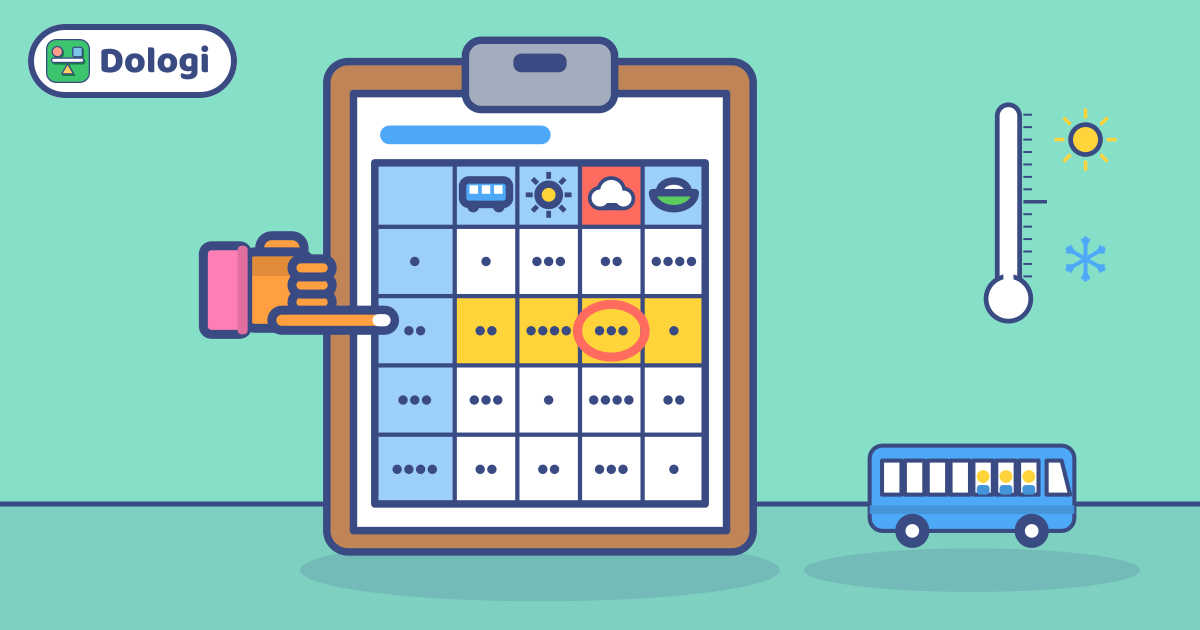
A table in a math workbook is tidy: three rows, three columns, one question. Real tables are not. A bus schedule has a dozen stops and twenty departures. A menu has prices, sizes and extras. A weather forecast has highs, lows and a chance of rain, all crammed into one strip. Many kids aged 8 to 12 can do the workbook page and still get lost the moment you hand them the real thing: they read the row below by mistake, take the low temperature instead of the high, or answer a question nobody asked.
The good news: reading a table is a habit, and habits grow with small daily practice. Here is a simple routine you can start this week.
Why real tables trip kids up
A real table asks your child to hold several things in mind at once:
- Which row? The eye slides to the neighboring line, especially when rows look alike.
- Which column? Headings sit far above the number your child is looking at.
- What does the question want? "Which bus" wants a bus, not a time. "How much change" wants money left over, not the price.
- The small print. "Weekdays only," "a.m. / p.m.," "price per person," "°F."
None of this is about being bad at math. It's about attention: keeping your place and checking your answer against the question. That can be practiced.
Find the row, find the column, circle the cell
Teach the same three moves every time:
- Find the row. Put a finger, or slide a strip of paper or a ruler, under the row you need. The strip hides the rows below so the eye can't wander.
- Find the column. Put a finger of the other hand on the column heading and slide it down.
- Circle the cell where the two fingers meet. On paper, really circle it with a pencil.
Then one more step that kids skip most often: reread the question and say the answer as a full sentence. "The 9:10 bus gets to the library at 9:25, so we'll be there before 9:30." If the sentence sounds wrong, go back to step 1.
One question a day from one real table
Pick a table you already have: a bus or train schedule, a takeout menu, the forecast on your phone. Ask one question, no more. Here are three examples to copy.
A bus schedule (times in each column belong to the same bus):
| Stop | Bus A | Bus B | Bus C |
|---|---|---|---|
| Maple St | 8:40 | 9:10 | 9:40 |
| Library | 8:55 | 9:25 | 9:55 |
| Park | 9:05 | 9:35 | 10:05 |
"We need to be at the library by 9:30. What's the latest bus we can catch at Maple Street?" Bus B: it leaves at 9:10 and arrives at 9:25. Bus C would arrive at 9:55, too late. Notice the trap: your child has to go down a column (one bus), not across a row.
A menu with prices:
| Item | Price |
|---|---|
| Grilled cheese | $5.50 |
| Chicken tenders | $6.25 |
| Mac and cheese | $4.75 |
| Fries | $2.50 |
| Side salad | $3.00 |
"What's the cheapest main dish?" Mac and cheese. "You have $10. Can you get a grilled cheese and fries? How much is left?" $5.50 + $2.50 = $8.00, so yes, with $2.00 left.
A weather forecast:
| Mon | Tue | Wed | Thu | Fri | |
|---|---|---|---|---|---|
| High | 72 °F | 75 °F | 68 °F | 64 °F | 70 °F |
| Low | 58 °F | 60 °F | 55 °F | 50 °F | 54 °F |
"Which day is warmest?" Tuesday. "Which morning will be the coldest, so we need a jacket?" Thursday, with a low of 50. For an older child: "Which day has the biggest gap between high and low?" Friday: 70 − 54 = 16 degrees. US forecasts use Fahrenheit and UK ones use Celsius; if you travel, that's a great conversation in itself.
Mistakes to watch for
| What happens | What helps |
|---|---|
| Reads the row above or below | A paper strip under the row |
| Mixes up high and low | Say the row heading out loud before reading the number |
| Answers with a number when the question asks "which" | Reread the question and answer in a full sentence |
| Misses "weekdays only" or a.m./p.m. | Before the question, ask: "What does the small print say?" |
| Gives up because the table is huge | Cover everything except the rows and columns you need |
Now your child asks the questions
After a week or two, switch roles. Hand your child the menu and ask them to make up a question for you. Making a good question is harder than answering one: they have to know which row and column hold the answer. Answer wrong on purpose now and then and let them catch it.
Then build a table together from things at home:
- The temperature on a thermometer outside the window every morning for a week.
- How many minutes each person spends on chores, day by day.
- The prices of five favorite snacks at the grocery store.
Use a ruler to draw rows and columns, write the headings first, then fill in the cells. Once the table is done, each of you asks the other one question about it.
The Patterns topic in Dologi has a puzzle called Pattern grid: a grid of pictures with a question mark in one cell. To pick the right picture, your child looks along the question mark's row, then down its column, the same habit as reading a bus schedule.
In short
- Real tables are harder than workbook tables because of size, headings far away and small print.
- Teach three moves: find the row, find the column, circle the cell. Then reread the question and answer in a full sentence.
- One question a day from one real table is enough: a bus schedule, a menu, the forecast.
- Let your child write questions for you and build their own table from things at home.
Read more: Word problems: helping your child understand what the question is asking, Teaching your child to read a calendar