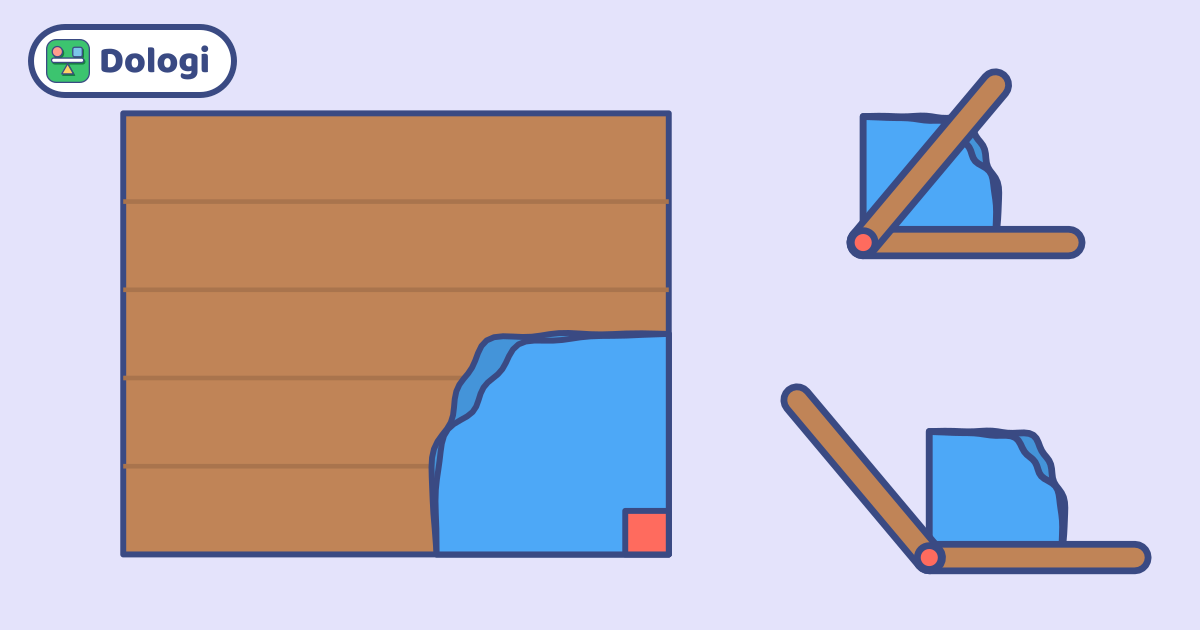
Ask a child what an angle is and you'll often get a shrug, or "a corner." That's actually a good start. The tricky part is what comes next: an angle isn't about how long the sides are, it's about how wide the opening is. You don't need any special tools to teach this. One scrap of paper, folded twice, gives your child a right-angle checker they can carry around the house.
What an angle is, in kid words
An angle is made by two straight lines that start from the same point. The point is the corner (mathematicians call it the vertex) and the two lines are the sides. The angle tells you how far apart the sides have opened.
Show it with your arms. Ask your child to put their palms together with arms straight out in front, then slowly open their arms like a big mouth. Their arms don't get longer, but the angle keeps growing. Close them again and it shrinks.
Then compare the corner of a big picture book with the corner of a sticky note. One book is much bigger, but the two corners are exactly the same. That's the key idea: the size of an angle doesn't depend on the length of its sides.
Make a right-angle checker in two folds
You need one piece of scrap paper, any shape at all. A torn corner of an old envelope works well.
- Fold it once, anywhere. Press the crease flat. The fold is a perfectly straight line, even if the paper's edges are ragged.
- Fold it again so the first crease lies exactly on top of itself. Line up the two ends of the crease carefully, then press.
The corner where the two creases meet is a right angle: a "square corner," like the corner of a book. If your child unfolds the paper, they'll see two creases crossing in the middle, making four right angles around one point.
Why does it work? A straight line is like half a turn. The second fold splits that half turn into two equal parts, so each part is a quarter turn, which is exactly a right angle. Older children can go one step further: fold the checker in half again, laying one crease on the other, and they get half a right angle.
Why a scrap and not a sheet of printer paper, which already has square corners? Because it shows that the right angle comes from the folding.
Go on a right-angle hunt
Now take the checker around the house. The rule is simple: put the corner of the checker into the corner you're testing, with one fold running along one side. Then look at the other side. There are three possible results:
- It fits exactly: a right angle.
- The paper sticks out past the side: the angle is smaller than a right angle.
- There's a gap between the paper and the side: the angle is bigger than a right angle.
| Where to look | What you'll usually find |
|---|---|
| Corner of a book, a door, a window pane, a floor tile | Fits exactly |
| Corner of a table or a cereal box | Fits exactly (unless the corner is rounded) |
| Tip of a pizza cut into 4 equal slices | Fits exactly |
| Tip of a pizza cut into 8 slices | Paper sticks out: smaller |
| A sandwich cut corner to corner | One corner fits, the two pointy ones are smaller |
| A door opened wide, measured against the wall | Gap: bigger |
Let your child guess before each test: "Will it fit, stick out or leave a gap?"
Acute and obtuse: smaller or bigger
Once your child can sort angles into three groups, give them the names:
- An angle smaller than a right angle is acute. Many kids remember it as "a cute little angle."
- An angle bigger than a right angle (but not yet a straight line) is obtuse.
- When the two sides form one straight line, it's a straight angle, the same as two right angles side by side.
Two craft sticks make a great angle maker. Hold them together at one end, closed like a pair of scissors, and open them slowly. Ask your child to say "acute" while it's narrow, hold the paper checker in place to catch the exact moment it becomes a right angle, then call "obtuse" as it opens wider, all the way to straight.
A clock with hands works too. At 3:00 the hands make a right angle, and the same at 9:00. At 1:00 and 2:00 the angle is acute; at 4:00 and 5:00 it's obtuse. At 6:00 the hands form a straight line.
Mix-ups children often make
- Longer sides, bigger angle. Draw two angles with the same opening, one with short sides and one with very long sides. Many children say the long one is bigger. Check both with the paper: they fit the same way.
- "It's not a right angle because it's tilted." A right angle can point in any direction. Turn the checker around and test a corner that points down or sideways.
- Testing rounded corners. Many tables and phone screens have rounded corners. Test the straight sides where they meet, or choose another object.
What to try at each age
- Ages 4 to 6: the words "square corner," "fits" and "doesn't fit." Hunt for square corners and sort objects into "fits" and "doesn't fit."
- Ages 6 to 8: make the checker together, sort angles into three groups (fits, smaller, bigger), then add the words acute and obtuse.
- Ages 8 to 12: a right angle is 90 degrees, half of it is 45, a straight angle is 180. In England, right angles usually come up in Year 3 and acute and obtuse angles in Year 4; in the US, these are typically 4th-grade topics.
The Space topic in Dologi has a puzzle called Fold and punch: a sheet of paper is folded, a hole is punched through every layer, and your child picks the sheet that shows what it looks like opened up. It practices the same thing your child does with the checker: picturing where a fold falls and what happens on each side of it.
In short
- An angle is how wide two sides open from a corner, not how long the sides are.
- Fold any scrap of paper twice, crease on crease, and you have a right-angle checker.
- Test corners at home: fits means a right angle, sticking out means acute, a gap means obtuse.
- Two craft sticks and a clock with hands show angles growing from acute to obtuse to straight.
Read more: First shapes: finding circles, squares and triangles around the house, Coordinates and turning angles: the math children use when they program a character to move