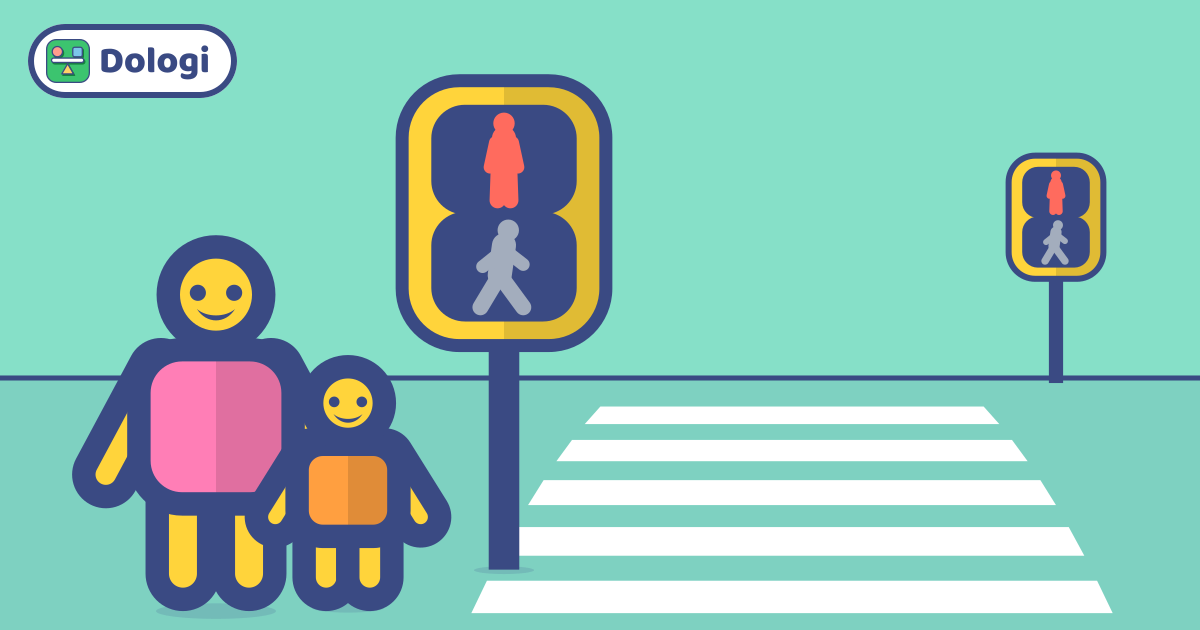
You're walking down the sidewalk when a ball bounces into the street, and your child is off the curb before you can say a word. Or it's school pickup, cars are pulling in and out, and your child lets go of your hand to run to a friend. Moments like these show that young children don't yet understand how dangerous streets are: they have trouble judging how fast a car is coming, forget everything when they're excited, and are too short to see over parked cars.
Pedestrian safety doesn't start with memorizing road signs. It starts with a few habits repeated every time you're out together: hold hands, stop at the curb, look and listen, wait for the signal, walk straight across. Here's how to teach each one, some of it right at home.
Rule number one: walk with a grown-up and hold hands
- Near traffic, we hold hands, especially in parking lots, at school pickup and on busy streets. If your child won't hold hands, let them hold your bag strap or the stroller.
- Your child walks on the inside, away from the street; you walk on the outside.
- Parking lots count as streets. Drivers backing out often can't see a small child; stay together until you reach the door or the car.
- When can a child cross alone? There's no single age that fits every child. It depends on local laws, the particular street and how mature your child is. Ask your school or local police, and practice together many times before your child ever tries it alone.
Two kinds of lights: car signals and walk signals
Many kids know "red means stop, green means go" without knowing who the light is for.
| Signal | What it means for someone walking |
|---|---|
| Car signal: red, yellow, green | It's for drivers; watch it to know whether cars are about to stop or go |
| Walking person (usually white) | You may start crossing, but keep looking for cars |
| Flashing hand or countdown numbers | Don't start crossing; if you're already in the street, keep going |
| Steady raised hand (usually orange) | Wait at the curb |
- In the US the "don't walk" signal is usually a raised hand. In many other countries, and in picture books, it's a red standing person and a green walking person. Point out whichever one your town uses.
- A walk signal doesn't mean no cars. In many places drivers may turn right on red, and turning cars can cross the crosswalk while the walk signal is on. Teach: even on the walking person, look first.
- Many crosswalks have a push button. Let your child press it and then wait.
- No signal? Cross at a marked crosswalk or a corner, where drivers expect people and you can see far in both directions.
The steps: stop, look, listen, walk straight across
In the US cars drive on the right, so traffic in the nearest lane comes from your left.
- Stop at the curb, toes behind the edge. The curb is your child's stop line.
- Look left, look right, then look left again. The nearest lane comes from the left, so check it once more before stepping out.
- Listen for engines and horns. Earbuds out, phones away.
- Wait until cars have stopped or the street is clear. When you can, make eye contact with the driver to be sure they see you.
- Walk straight across, don't run, don't stop in the middle, and keep looking as you go.
Places not to cross: between parked cars, right at a curve, in front of a bus that just stopped. Your child is shorter than the hood of many cars, so drivers may not see them, and they can't see the cars either.
Driveways, bikes and turning cars
- Driveways and parking-lot exits are where cars back up without warning. Stop and look before walking past, even on the sidewalk.
- Turning cars at intersections are a common surprise; watch the cars waiting to turn, not just the ones going straight.
- Bikes and scooters move fast and quietly on sidewalks and in bike lanes. Look for them too before stepping off the curb.
- Near schools, cross where a crossing guard is helping and follow their signals.
- Riding a bike or scooter means wearing a helmet, buckled, every time.
Practice through play, at home and on walks
- Red light, green light: hold up a red card and everyone freezes, a green card and everyone walks. Add a rule: "flashing means don't start." More ideas are in stop-and-go games.
- Draw a crosswalk with sidewalk chalk in the driveway or at the park and practice each step: stop at the edge, left, right, left, walk straight.
- Let your child be the "crossing leader" on the way to school: they say each step out loud, and you only prompt when they skip one. Remembering a short sequence in order is a skill in itself, as in games for following two-step and three-step instructions.
- Be the example. Wait for the signal even when the street is empty, and keep your phone in your pocket while crossing. Kids copy what we do more than what we say.
In Dologi's Focus topic, the Follow the cup puzzle hides something under a cup, the cups swap places, and your child has to keep their eyes on the right cup until the end. A round or two is a fun game at home that practices keeping track of something that moves, but it doesn't replace practicing real crossings together.
In short
- Near traffic, hold hands with a grown-up; when a child can cross alone depends on local laws and their maturity, so ask your school or local police.
- Know the difference between car signals and walk signals; look even on the walking person, and don't start on a flashing hand.
- Stop at the curb, look left, right, left, listen, then walk straight across without running; watch driveways and turning cars.
- Practice through play, let your child lead the steps, and model safe crossing every time.
Read more: Stop-and-go games: building self-control through play, Listened, then forgot? Games for following two-step and three-step instructions