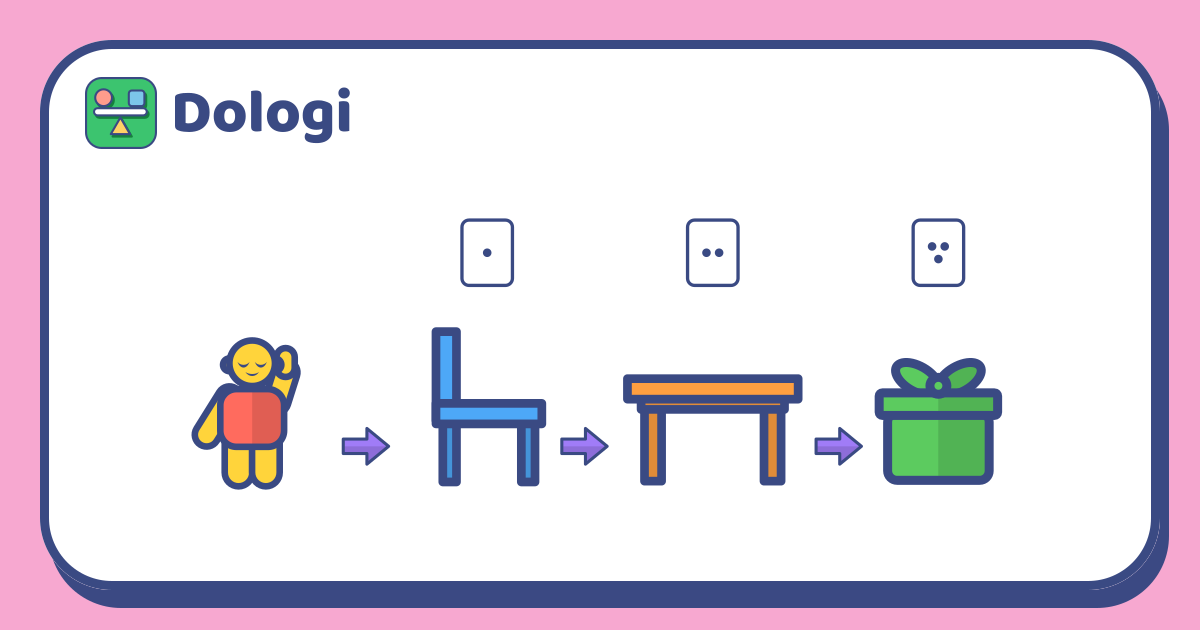
"Put your shoes by the door, then bring me your water bottle." Your child heads off, puts the shoes away and comes back empty-handed. Or they stand in the hall, clearly sure there was a second part, with no idea what it was.
This is very common. Holding two or three steps in mind while your body is busy doing the first one takes practice, and children get better at it gradually. The good news is that it can be practiced through play. This article explains why multi-step instructions are tricky, gives a rough guide to how many steps suit each age, and offers games you can play at home with a chair, a cushion and a small toy.
Why the second step goes missing
To follow "go to the chair, then look under the cushion", your child has to do three things at once: listen to the whole sentence, keep the steps in the right order, and remember the later steps while walking, looking and maybe getting distracted on the way. The part of the mind that holds information for a few seconds while you use it is often called working memory. It is a bit like a small notepad, and in young children the notepad is small.
That is why a child who understands every word can still lose the middle step. It usually isn't about not caring or not listening. The steps simply slipped off the notepad. Games help because they make listening worth the effort: if you remember all three steps, you find the treasure.
How many steps for each age?
The table below is only a rough guide. Children vary a lot, and the same child can manage three steps on a calm morning and one step when tired or excited.
| Rough age | Instructions that often work | Example |
|---|---|---|
| About 4–5 | Two steps that belong together | "Pick up the teddy and put it on the bed." |
| About 5–6 | Two steps that don't belong together, sometimes three | "Touch the door, then clap your hands." |
| About 7–8 | Three steps, with order words | "First get a spoon, then a cup, and last a napkin." |
| About 9–12 | Three or four steps, or steps with a condition | "Before you sit down, close the window, and if the light is on, turn it off." |
Start where your child succeeds easily, then add one step at a time. Getting it right two or three times in a row is a good sign that they're ready for the next level.
Five games to play at home
1. The treasure trail. Hide a small toy or a treat somewhere in the room. Give the route as one instruction: "Go to the armchair, then look under the green cushion." Older children can get three stops: "Go to the table, touch the fruit bowl, then look behind the curtain." Say it once, then let them go.
2. Robot errands. Your child is a robot who only moves when the command is complete. You give the program: "Robot, walk to the kitchen, bring a spoon, put it on the sofa." The robot repeats the program aloud in a robot voice, then carries it out. Saying it back is a useful habit in itself.
3. The silly chain. Body actions only, no walking around: "Touch your nose, jump once, then turn around." Mix up the order on purpose ("Turn around, touch your nose, jump") so your child has to listen rather than guess.
4. Swap roles. Your child gives you a two- or three-step instruction. Now and then, do one step wrong or skip one: "You said sit on the chair first!" Catching your mistake means they had to remember the whole sequence too.
5. Picture the route. Before setting off, ask your child to close their eyes and picture each step: "Can you see yourself at the chair? Now where do you go?" This works well for children who forget halfway, because a picture often stays longer than words.
Help the instruction stick
How you give an instruction matters as much as how many steps it has.
- Get attention first. Say your child's name, wait until they look at you, then speak. An instruction given across the room while they're playing is easily lost.
- Use order words. "First", "then" and "last" act like hooks that keep the steps in line.
- Count on fingers. Hold up one finger per step as you say it. Your child can count on their own fingers too: "Three things. What was the third?"
- Ask for it back. "Tell me what you're going to do" lets you both check before they start.
- Praise the remembering. "You remembered all three, even the curtain!" is more useful than a general "Well done."
In everyday life, outside the game, it's fine to give one step at a time when you're in a hurry. The games are where you stretch; ordinary mornings don't need to be a test.
If your child often finds even simple one-step instructions hard, or something else worries you, talk to their teacher or doctor. They know your child and can tell you whether it's worth looking into.
If your child enjoys these games, the Listening topic in Dologi has a puzzle called "Listen and play back", where your child hears a short sequence of notes and plays them back in the same order. It practices the same habit of holding a sequence in mind, with sounds instead of words.
In short
- Losing the second or third step is common: young children can hold only a few things in mind while they act.
- Start with steps your child manages easily and add one step at a time; age guides are only rough.
- Treasure trails, robot errands, silly chains and swapping roles make listening to a sequence fun.
- Get attention first, use "first, then, last", count on fingers and ask your child to say the steps back.
Read more: What is working memory? When your child forgets what they were doing halfway through, and how to help, My child doesn't listen: how to talk so children hear you, Stop-and-go games: building self-control through play