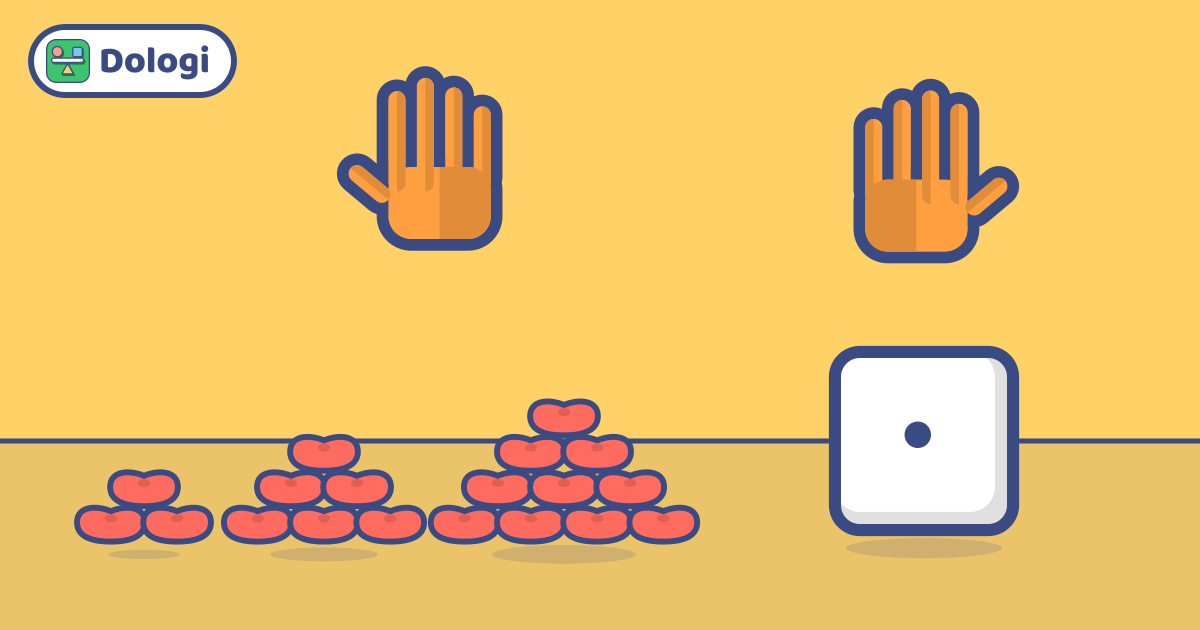
All you need is one die, a pencil, some paper, and one question asked over and over: roll again, or stop? On your turn you can roll as many times as you like, adding up the points. But the moment you roll a one, everything you collected that turn disappears. Get greedy and you lose it; stop too early and you crawl along.
The game suits kids around 7 to 12, and 5 and 6 year olds can play a short version with beans. Besides the nail-biting fun, it teaches something few games do: making a decision when you can't know the outcome, then looking back at that decision calmly.
What you need
- One six-sided die.
- Paper and a pencil for scores, or a jar of dried beans and a bowl for each player (little-kid version).
- Two or more players.
How to play
- On your turn, roll the die and add the number to your turn total.
- After each roll, choose: roll again, or stop.
- If you stop, your turn total goes into your banked score, safe forever.
- If you roll a one, your turn total drops to zero and play passes to the next person.
- The first player to bank 50 points wins.
Example: your child rolls a 4, then a 6, then a 3, so the turn is worth 13. Stopping banks 13 for sure. Rolling again could bring a 5 and make it 18, or a one and wipe out all 13.
Little-kid version: beans and a target of 20
For 5 and 6 year olds, skip the paper and play to 20:
- Each roll, take that many beans from the jar and make a pile in the middle of the table. The middle pile is the turn total.
- To stop, your child sweeps the pile into their own bowl.
- Roll a one, and the middle pile goes back in the jar.
- The first bowl to reach 20 beans wins.
Watching the middle pile grow, kids feel "I have a lot to lose" long before they need numbers for it. A game to 20 usually takes three or four turns each, about right for a young child's patience.
Every turn is a decision
Most dice games are just roll and move. This one makes kids ask themselves before every roll: "How much do I have? Would I mind losing it? How far am I from the finish?" It's a great time to use words like certain, possible, and likely:
- Rolling a one next is possible, but not likely: one chance in six.
- Rolling several times in a row without a one gets harder and harder:
| Rolls in a row | Chance of no one |
|---|---|
| 1 roll | about 8 in 10 |
| 2 rolls | about 7 in 10 |
| 3 rolls | almost 6 in 10 |
| 4 rolls | about half |
| 6 rolls | about 1 in 3 |
There's no need to teach how to work out this table. After a few games, just ask: "Do you think it's easy to roll four times without getting a one?" Your child will remember every turn they lost.
A family experiment: where should you stop?
This is the best part. Everyone picks a stopping rule and sticks to it. For example: Dad stops once the turn reaches 6, Mom stops at 12, your child stops at 20, and big brother pushes on to 30. Each person plays 10 turns, adds up the total, and you compare.
With only 10 turns, luck still swings things a lot. Combine results over a few sessions, or do it as a whole class, and the picture gets clearer. We ran a very large number of turns on a computer, and the averages came out like this:
| Stop when the turn reaches | Average per turn | Turns lost |
|---|---|---|
| 6 points | about 5 | 3 in 10 |
| 10 points | about 7 | 4 in 10 |
| 20 points | about 8 | 6 in 10 |
| 30 points | about 7.5 | 3 in 4 |
The surprise for kids: the player who stops at 20 loses more turns than the one who stops at 6, and still scores more. In a race to 50, stopping at 20 beats stopping at 6 about four games out of five. Waiting too long (30), though, makes things worse again.
For little kids playing to 20, "stop at about 10" beats "stop as soon as you have 6" about seven games in ten, and beats "go for all 20 in one turn" about two games in three.
The secret of 20 (for older kids)
Kids 10 to 12 can work out for themselves why 20 is the balance point:
- Every time you roll again, five faces help you (2, 3, 4, 5, 6), adding 4 points on average.
- One face hurts you: you lose the whole turn.
- Picture six rolls: about five of them add points, roughly 5 × 4 = 20 in total; about one of them costs you exactly what you have.
So with less than 20 in your turn, what you stand to gain outweighs what you stand to lose, and you should keep rolling. With more than 20, it's the other way round. At exactly 20 it's even. Near the finish things change: if you need only 5 more points to win, keep rolling until you get there; no need to wait for 20.
A follow-up puzzle for older kids: if you change the rules so that a one or a two ends the turn, should you stop above 20 or below? (Try the same reasoning: now four faces help, worth 4.5 on average, and two faces hurt. The balance point drops to about 9.)
When your child loses a big turn
Sitting on 25 points and then rolling a one stings, and some kids burst into tears. A few things help:
- Separate the decision from the result: "Rolling again at 8 was a smart choice. This time you were just unlucky." A good decision can still turn out badly, and a bad one can turn out fine.
- Show them how you handle it: "Argh, so close! But I'll still roll again when I only have 10."
- Talk about it after the game, not in the middle of the upset: "Which time did you stop that felt most right?"
- Don't bend the rules so your child wins. This game teaches living with luck; let them lose a few and adjust on their own.
Variations
- Call your rolls: at the start of the turn you must say "I'll roll 3 times" and can't stop early. Four or five rolls per turn gives the highest average, almost as good as stopping at 20.
- Two dice: a one on either die loses the turn; two ones together wipe out your banked score too. Much more tense.
- Team play: two players per team must agree before every roll, a great way to get kids explaining their reasons out loud.
- Change the target: play to 100 with older kids for longer games and clearer strategy.
In Dologi, the Math topic's puzzles, like Fruit numbers, always have one certain answer you can reason out step by step. This dice game is different: there's no sure win, only smarter choices. Kids need both kinds of thinking.
In short
- Roll as many times as you like, adding up the points; a one loses the whole turn; first to bank 50 wins (little kids: 20, with beans).
- Every roll is a decision, a perfect chance to talk about "certain", "possible", and "likely".
- Run a family experiment: stopping around 20 scores the most even though you lose more turns; little kids playing to 20 should stop around 10.
- When your child loses a big turn, praise the decision rather than judging by the result, and don't change the rules to let them win.
Read more: Probability for young children, Dice games for children