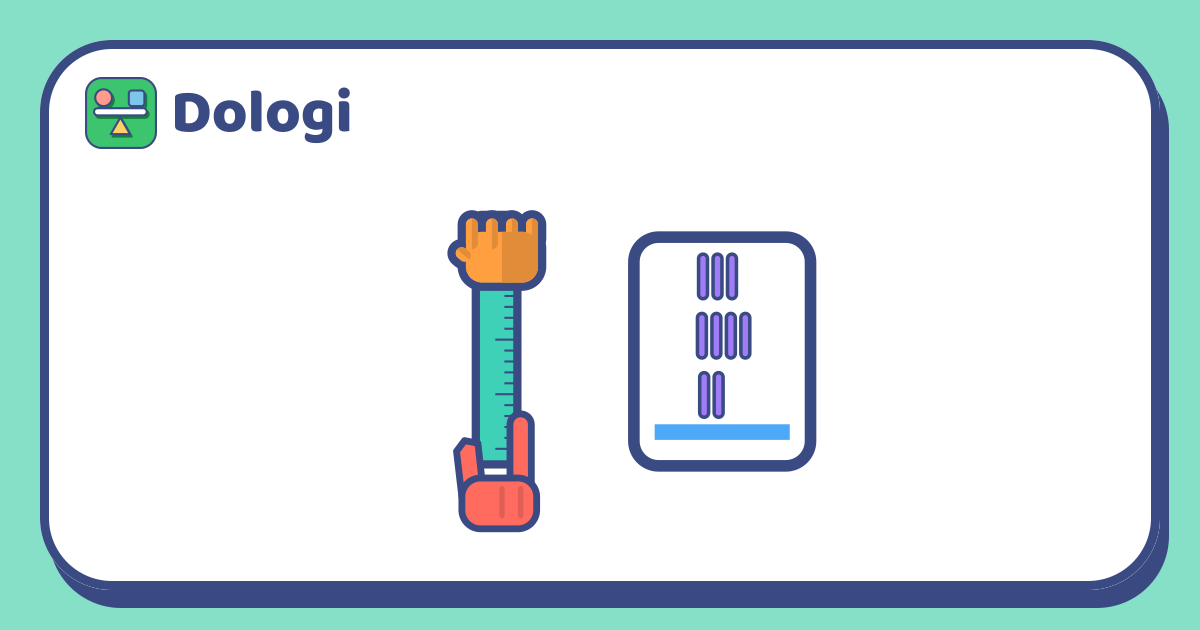
How quickly can you react when something suddenly moves? With a ruler and two fingers, children can measure it themselves. One person lets the ruler fall without warning, the other catches it as fast as they can, and the number where their fingers close tells you how far it fell. The shorter the fall, the faster the reaction.
The test takes a minute to learn, and it turns into a real experiment for children aged about 7 to 12: measuring, repeating, writing results in a table, and comparing one situation with another. It also has an important rule: your child compares their results with their own, not with anyone else's.
What you need and how to do it
- A straight ruler, 30 cm long, with clear centimetre marks. A plastic or wooden one is best.
- A table edge for the catcher to rest their arm on, so only the fingers move.
- Paper and a pencil to record the results.
Steps:
- The catcher sits with their forearm on the table and their hand just over the edge, thumb and index finger open about two fingers' width apart.
- The dropper holds the ruler at the top end so that it hangs straight down, with the 0 mark level with the top of the catcher's thumb. The fingers must not touch the ruler.
- The catcher watches the ruler, not the dropper's face.
- Without any warning, the dropper lets go. The catcher pinches the ruler as fast as possible.
- Read the mark just above the catcher's thumb. That number of centimetres is the result.
Keep faces back from the falling ruler and catch with fingers only, never a whole fist.
Reading the result
A smaller number means a faster catch. Because a falling ruler speeds up as it drops, the distance can be turned into an approximate time. This comes from the way all objects fall, so it is the same for every ruler:
| Caught at | Approximate reaction time |
|---|---|
| 5 cm | 0.10 seconds |
| 10 cm | 0.14 seconds |
| 15 cm | 0.17 seconds |
| 20 cm | 0.20 seconds |
| 25 cm | 0.23 seconds |
| 30 cm | 0.25 seconds |
Notice that the gaps between the times shrink as the distance grows. Older children can think about why: in the first tenth of a second the ruler is still slow, so it only falls about 5 cm; in the next few hundredths it is moving much faster and covers more ground. If the ruler slips through completely, write "missed" rather than a number.
Making the test fair
Results jump around from one try to the next, so a single catch says very little. A few habits make the test fair:
- Same start every time: the 0 mark level with the top of the thumb, the same gap between the fingers, the same arm position.
- No warning: the dropper waits a different length of time before each drop, sometimes short, sometimes long. If the catcher can guess the moment, they are not reacting any more, they are predicting.
- Three tries for each situation, then take the middle one: put the three numbers in order and keep the one in the middle. One lucky or unlucky catch then doesn't change the answer.
- Only change one thing at a time. If you compare the left hand with the right, keep the same dropper, the same chair and the same time of day.
Questions to test
Here are some questions your child can answer with the ruler. Ask them to guess the answer first, with a reason, and write the guess down before starting.
- Right hand or left hand: is there a difference? Is it the same for everyone in the family?
- Just woken up or after playing: test once soon after waking and once after some active play.
- Practice: compare the first three tries with three tries after ten practice catches.
- Looking at the ruler or at the dropper's hand: does it matter where your eyes are?
A difference of one or two centimetres may just be chance. Only a clear difference that shows up again when you repeat the test tells you something. Learning to say "we can't tell yet" is part of doing science.
Recording and comparing
A simple table is enough. Here is how one page might look:
| Try | Right hand | Left hand |
|---|---|---|
| 1 | 14 cm | 16 cm |
| 2 | 11 cm | 13 cm |
| 3 | 12 cm | 15 cm |
| Middle value | 12 cm | 15 cm |
In this example the right hand caught the ruler about 3 cm sooner, roughly 0.16 seconds against 0.17. Your child can then write one sentence: "My right hand was a little faster today. Next time I will test again to see if it happens again."
Keep the comparisons between your child and themselves: today against last week, one hand against the other, before and after practice. Reaction speed varies from person to person and day to day, and it is not a measure of how clever anyone is. Racing a friend or a sibling quickly turns an experiment into a contest someone has to lose.
In Dologi, the Focus topic has "Follow the cup" puzzles, where cups move around and your child keeps their eyes on the one hiding the object. Like the ruler test, it rewards watching closely until the very last moment.
In short
- One person drops a 30 cm ruler without warning; the other catches it between two fingers, and the mark above the thumb is the result.
- A smaller number means a faster reaction; 10 cm is about 0.14 seconds and 20 cm about 0.20 seconds.
- Keep the start the same, give no warning, take three tries and keep the middle value, and change only one thing at a time.
- Compare your child only with themselves, and treat small differences as "not sure yet" until the test is repeated.
Read more: Fair test experiments for ages 7–11: change only one thing at a time