Write the word "red" with a blue pen and ask your child what color the ink is. Many children who read well blurt out "red!" first, then laugh and correct themselves. That little stumble is what makes this game worth playing: your child has to stop the answer that jumps out and give the one the rule asks for.
This article shows you how to make the cards in five minutes, how to play, a version for younger children who can't read yet, and how to make it harder little by little so your child can see their own progress.
Why such a simple game is hard
Once a child reads fluently, reading happens by itself. You see a word and you have read it before you decide to. That is a good thing at school, but in this game it gets in the way: the word says one color, the ink shows another, and the word is quicker.
To answer correctly, your child has to:
- look at the right thing, the ink rather than the letters,
- hold back the quick answer, the word that comes to mind first,
- keep the rule in mind, even after a few cards in a row.
These are the same skills children use when they read a question to the end before answering, or check their work instead of writing the first number that comes to mind. The game is just a short, playful way to practice them.
Make the cards
You need paper or index cards and four or five markers in colors that are easy to tell apart, such as red, blue, green, yellow and purple. Avoid pale colors that are hard to see on white paper.
- Cut paper into cards about the size of a playing card, or draw a grid of boxes on one sheet.
- On each card, write one color name in a different color of ink: "red" in green, "blue" in yellow, "green" in red, and so on.
- Make a few matching cards too, such as "blue" written in blue. They are the easy ones, and they stop your child from simply saying "anything but the word".
- Write in large, thick letters so the ink color is clear.
Twelve to sixteen cards are plenty to start with. Older children often enjoy making a set themselves to test their parents.
How to play
- Lay the cards in a row or hold them up one at a time.
- Your child points at each card and says the color of the ink, not the word.
- Play a round yourself first, slowly, so your child sees that adults stumble too.
- If they make a mistake, just say "Ink!" and let them try that card again. No points lost.
A round should take a minute or two. Three or four rounds are enough; stop while your child still wants one more go.
A day-and-night version for younger children
Children who can't read yet, roughly ages 4 to 6, can play the same idea with pictures:
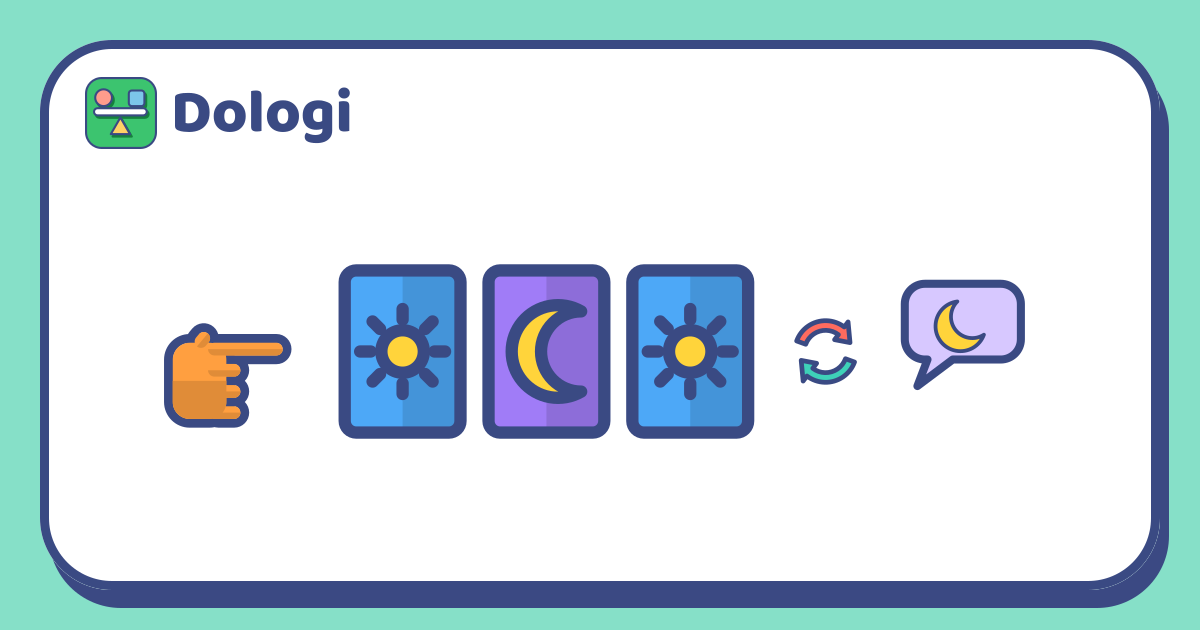
- Draw a sun on some cards and a moon on others.
- The rule: see the sun, say "night"; see the moon, say "day".
- Start with four cards and go slowly. When that is easy, add more cards or speed up a little.
Here too, your child has to hold back the word that comes first and say the opposite. Other pairs work as well: a big circle means "small", a small circle means "big".
Make it harder, little by little
Only move on when the current level feels easy. Change one thing at a time.
| Step | What changes | Example |
|---|---|---|
| 1 | More cards | From one row of 8 cards to two or three rows |
| 2 | Fewer matching cards | Every card has a "wrong" color |
| 3 | Switch the rule halfway | When you clap, your child reads the word instead of the ink |
| 4 | Two rules at once | Cards with a border: read the word; cards without: say the ink |
| 5 | Time a full sheet | Your child tries to beat their own time from last time |
When you time it, compare your child only with themselves, not with a brother, sister or classmate. Write the time on the back of the sheet so you can look at it together next week. If a time gets slower on a tired day, that's normal; just say "We'll try again another day."
Keep it fun
- Short and often works better than long and rare: a few minutes before dinner or while waiting is enough.
- Laugh at the mix-ups, including your own. Stumbling is part of the game, not a sign your child isn't trying.
- Swap roles. Let your child make the cards and hold the timer while you play.
- Pick colors your child can tell apart. If your child often mixes up two colors, such as red and green, leave one of them out or play the sun-and-moon version.
In Dologi, the Focus topic has short puzzles where your child looks carefully and follows a rule before tapping, a quiet way to practice the same pause.
In short
- Write color names in a different ink color; your child says the ink color, not the word.
- The game practices looking at the right thing, holding back the quick answer and keeping a rule in mind.
- Younger children can play with pictures: see the sun, say "night"; see the moon, say "day".
- Make it harder one step at a time, and compare your child only with their own last try.
Read more: Stop-and-go games: building self-control through play · Flexible thinking: when the rules change halfway through