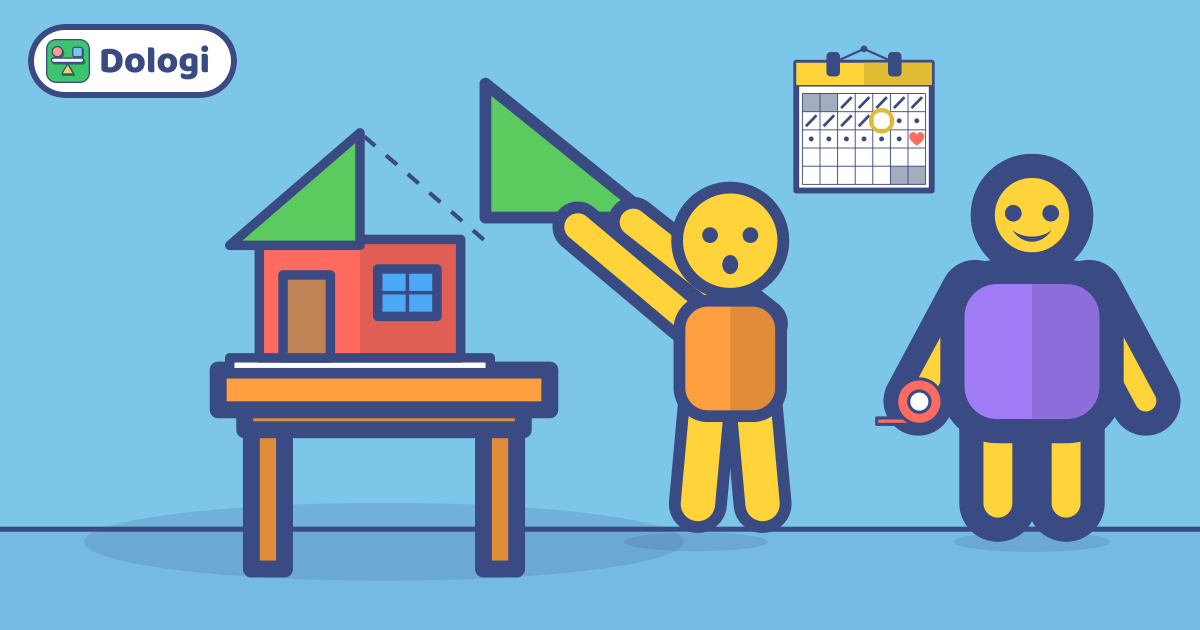
"Oh, I need to build a model house out of recycled stuff. It's due Friday." The Friday in question is, of course, tomorrow, and it's 8:30 p.m. You know the rest: a late-night hunt for empty boxes, a parent wielding the hot glue gun, a child yawning at the kitchen table. The model turns out nicely. Your child learned very little from it.
A school project (a model, a diorama, a poster, a science fair board) is meant to teach more than the topic. It's practice for things adults do every day: understanding what's being asked, breaking a big job into small ones and meeting a deadline. Here's a simple approach for kids around 7 to 12: read the assignment together, plan backward from the due date, and let your child do the real work.
Read the assignment together before buying anything
Before anyone heads to the craft store, sit down for ten minutes with the assignment sheet or the teacher's message. Let your child read it and underline the key parts. You just ask:
- What exactly are you making? "A model house" and "a model house made from recycled materials" are different projects.
- What do you turn in? Just the model, or also a written paragraph or a short talk in front of the class?
- Any size or material rules? Is there a maximum size? Are store-bought kits allowed?
- When is it due? Write it on the calendar right now.
- How will it be graded? If there's a rubric (on topic, neat, creative, own work), read each line out loud.
Then ask your child to explain it back in their own words: "I need to build a house out of boxes and milk cartons, with a door and a window, and say three sentences about it in class on Friday the 14th." If they can say that, they understand the job.
Plan backward from the due date
To a child, two weeks feels like forever. The easiest way to make time visible is to count backward: start at the due date and walk back to today, giving each day one job.
Say the project is due on Friday of next week:
| Day | Job |
|---|---|
| Friday (next week) | Bring it to school |
| Thursday | Nothing new. Put the model in a box by the backpack |
| Wednesday | Catch-up day: finish anything that's behind |
| Monday and Tuesday | Paint, add details, practice the three sentences |
| Weekend | Build the main parts: the walls, the roof, the door |
| Wednesday to Friday (this week) | Collect boxes and cartons; sketch the plan; measure and cut pieces |
| Today | Read the assignment, choose an idea, make the calendar |
Two rules make this work: the day before it's due has no new tasks, and there is always one catch-up day. Plans slip. Someone gets sick, the paint doesn't dry, grandma visits. With a buffer day, one slip is no big deal.
Write the plan on a sheet taped to the wall or on the family calendar, and let your child cross off each day's job. Watching the empty boxes shrink teaches what "two weeks" really means.
Break it into small, doable steps
"Build the model" is too big to start. "Cut four matching walls out of the box" is something your child can do right now. When you plan, make each step small enough to finish in about 20 to 30 minutes for a 7- to 9-year-old, a bit longer for older kids.
Do one or two steps per session and then stop, even if your child wants to keep going. A three-hour marathon tends to burn kids out halfway through the project. The same idea works for everyday homework, too: see breaking study time into short blocks.
Your child builds it. So what's your job?
Teachers can usually spot a model a parent built. More important, your child only learns from the parts they do with their own hands. Here's one way to split it:
| Your child | You |
|---|---|
| Comes up with the idea and sketches it | Asks questions that sharpen it: "Where's the door? What will the roof be made of?" |
| Measures, draws and cuts with scissors | Gathers supplies and sets up a work space |
| Glues, assembles, paints and decorates | Handles or closely supervises the craft knife and hot glue gun |
| Crosses off finished jobs on the calendar | Mentions the plan once each evening, without taking over |
| Practices the short presentation | Plays the audience and asks one question a teacher might ask |
When your child gets stuck, resist the urge to grab it and fix it. Try: "What have you tried so far?" or "The roof keeps falling in. What could hold it up?" If you need to demonstrate, do it on a scrap piece, then hand it back so your child can do the real one.
When it doesn't look perfect
An eight-year-old's model looks like an eight-year-old made it: crooked walls, paint outside the lines, a roof that leans. That's a sign your child did the work, not a sign of failure. Praise what they figured out: "You came up with a way to make the door open. That's clever."
If the plan falls behind, sit down together and adjust: which steps can be dropped (fewer decorations), which can be simpler (tape instead of waiting for glue to dry)? That's a lesson too: plans can change as long as the project gets turned in on time. If the assignment seems far beyond your child, or they're very worried about it, it's fine to check with the teacher about what's expected.
For group projects, add one step: decide who does which part and pick a day to put the pieces together. Our post on group work at school has more ideas.
In Dologi's Space topic, the Move the tower puzzle asks your child to move a stack of disks to the peg with the flag, never putting a big disk on a smaller one. To move the biggest disk, they have to think backward: first clear all the smaller disks onto the other peg. It's the same kind of thinking as planning backward from a due date.
In short
- Read the assignment together before buying supplies: what to make, what to turn in, size rules, due date, how it's graded.
- Plan backward from the due date with one small job per day, a free day before it's due and one catch-up day.
- Your child builds the main parts; you handle supplies, the risky steps and good questions instead of doing it for them.
- A slightly crooked model your child made is worth more than a perfect one an adult built.
Read more: Setting small learning goals with your child, Group work at school, Breaking study time into short blocks