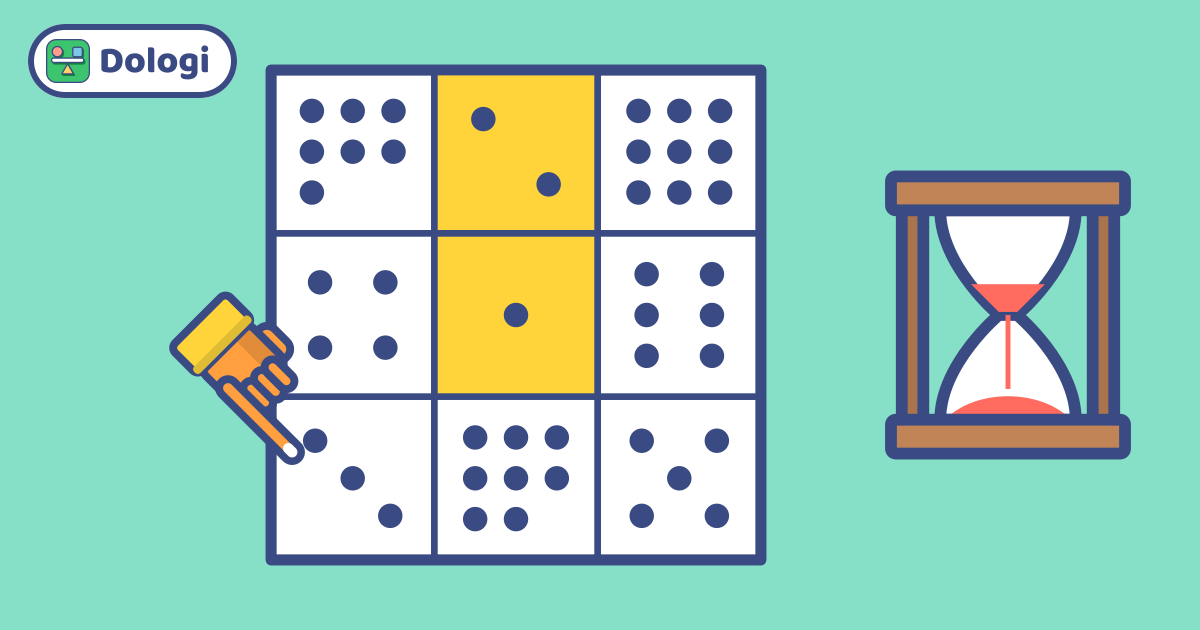
A sheet of paper, a pen and a few minutes: a scrambled number grid is about the simplest eye-training game you can make at home. Numbers are written in jumbled order inside a grid of squares, and your child points to 1, then 2, then 3, all the way to the end. It sounds easy, but once the grid has 25 squares, kids discover their eyes really have to work.
This post covers how to draw grids for kids roughly 6 to 12, how to play, how to time it so your child competes only with themselves, how to scan the grid in an organized way, and a few variations to keep it fresh.
Draw a grid for each age
| Age (roughly) | Grid size | Numbers |
|---|---|---|
| 6 | 3 × 3 | 1–9 |
| 7–8 | 4 × 4 | 1–16 |
| 9–12 | 5 × 5 | 1–25 |
- Big squares, clear numbers: about 1¼ to 1½ inches per square, written large with a marker.
- Truly random order: write the numbers on small slips of paper, put them in a cup, draw them one at a time and fill in the squares in the order you draw. Kids love doing the drawing.
- Make several grids of the same size: replaying the same grid means your child remembers where things are, and it stops being a search.
- Slip the grids into clear sheet protectors so they last.
How to play
- Put the grid in front of your child, about a forearm's length away.
- On "Go," your child points to 1, then 2, then 3… saying each number quietly.
- Time it with an hourglass or by counting silently. Stop when your child reaches the last number.
- Write down the time and the date.
- Next time, use a different grid of the same size.
Six-year-olds don't need a timer yet: finding 1 through 9 correctly is already great.
Compete with yourself, not with others
- One time sheet per person. Older siblings will naturally be faster; comparing just discourages the younger one.
- Accuracy first, speed second: if your child points to the wrong number, they go back and find the right one, and that's not "losing." Being fast while skipping numbers means nothing.
- Look at the trend, not each try: on tired days, a slower time is perfectly normal.
- Five minutes is plenty: two or three grids at a time, a few times a week.
If your child enjoys beat-the-clock games, one-minute challenges for families has more short, timed fun.
Tips for scanning in an organized way
When they're stuck, kids tend to dart their eyes all over the grid. A few tips help them search methodically:
- Scan row by row: look left to right across each row, like reading. If the number isn't there, move down a row.
- Remember numbers you spotted along the way: while looking for 4, your child might have seen where 5 is. Ask, "When you were looking for 4, did you see 5?"
- Look at the middle of the grid before you start, to take in the whole thing at once.
- No wild guessing: only point once you've actually seen the number.
Variations to keep it fresh
- Count down: from the biggest number back to 1.
- Two alternating colors (for kids 9 to 12): the grid has red numbers 1 to 12 and black numbers 1 to 12. Your child goes up in red and down in black, alternating: red 1, black 12, red 2, black 11… Much harder, since there are two sequences to keep in mind.
- Letters: use letters instead of numbers and find them in alphabetical order.
- Count by twos: find only the even numbers, or only the odd ones.
- Dot grids for 4 and 5 year olds: replace numbers with groups of one to six dots, like on dice, and find them from one dot to six.
Prefer searching for words? A homemade word search is a close cousin of this game.
The Focus topic in Dologi has a puzzle called Tap in order, such as "Tap only the numbers in order, from smallest to largest," sometimes with pictures or dice mixed in to ignore. It's the same one-number-at-a-time search as the paper grid, just on a screen.
In short
- Draw a 3×3, 4×4 or 5×5 grid by age, scramble the numbers by drawing slips from a cup, and make several grids of the same size.
- Your child points from 1 to the end while you time it and write it down; accuracy first, speed second.
- Everyone compares with their own last try on their own sheet, never with siblings.
- Teach scanning row by row and remembering numbers spotted along the way; mix it up with counting down, two colors, letters or dot grids.
Read more: A homemade word search, One-minute challenges for families