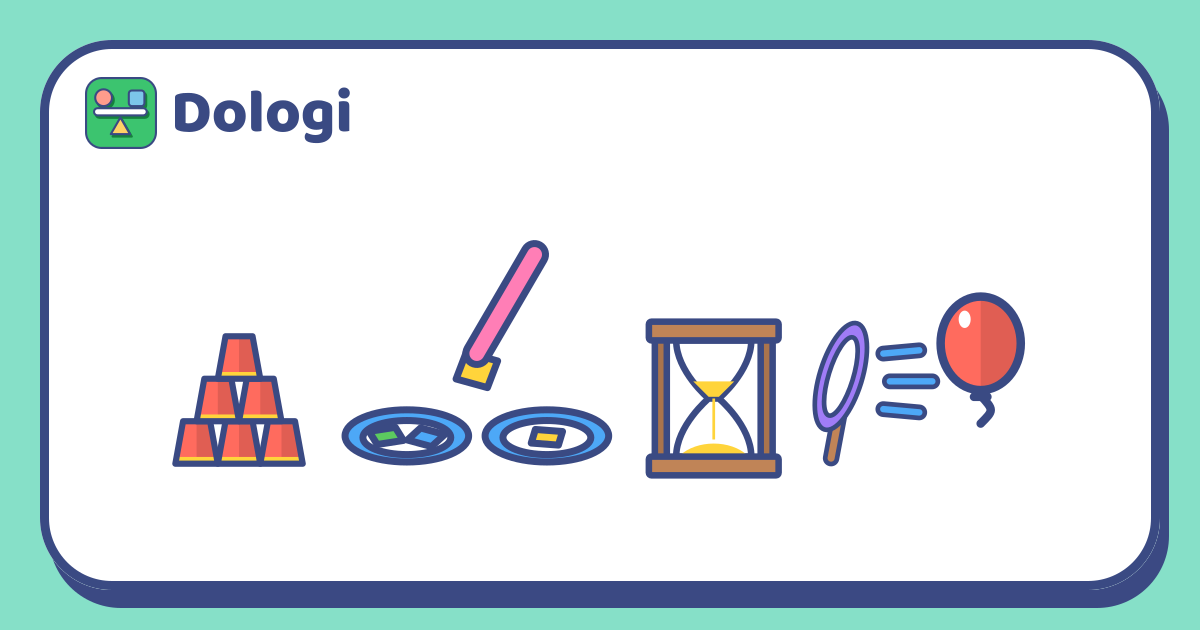
It is evening, your child wants one more game, and you have about fifteen minutes left. One-minute challenges fit that gap perfectly. Each game lasts one minute, the equipment is cups, straws, paper plates and a balloon, and the rules are simple enough for a five-year-old to pick up straight away.
A minute is short enough for your child to stay focused from start to finish, and tight enough to feel exciting.
Why one minute works
For most young children, staying focused on something tricky for ten minutes is a lot. One minute is different: they know for certain it will end, so it is easier to pour all their attention into their hands and eyes.
During that minute, your child has to do several things at once: remember the rules, keep their hands slow and steady, ignore the cheering around them, and keep going after a slip. That is focus, just wrapped up in a game that starts with "Go!".
What you need and the basic rules
- A timer: a sand timer, a kitchen timer, or a phone placed face down so only the alarm is heard.
- Plastic or paper cups: six to ten of the same size.
- Straws (one per player), two paper plates, and a sheet of colored paper cut into about ten squares the size of a postage stamp.
- One balloon, one more paper plate to use as a fan, and some masking tape for lines on the floor.
- A score sheet stuck to the fridge door.
The rules for every game: a grown-up calls "Go!" and "Time!". The player plays, everyone else cheers but does not touch anything. When time is up, hands stop straight away and the family counts the result together.
Challenge 1: Straw transfer
Put two paper plates about a hand's span apart, with ten paper squares on the left plate. Your child sucks gently through the straw so a square sticks to the end, lifts it, carries it over to the right plate and stops sucking to drop it. No hands allowed. After one minute, count how many squares made it across.
- Cut the squares much bigger than the opening of the straw, so the paper only sticks to the end and cannot be sucked inside.
- This game suits children from about 6. For younger children, or a child who still puts things in their mouth, swap the straw for a clothes peg and move the squares across one at a time.
- Your child will soon notice that sucking too hard makes the square spin and fall, while a steady breath and a slow hand drop fewer. Nobody has to explain that faster is not always more.
Challenge 2: One-handed cup stacking
Stack the cups upside down in a single pile. Within one minute, your child builds them into a triangle tower (three cups on the bottom, two in the middle, one on top), then gathers them back into a single stack. The other hand stays behind their back. Each build and restack counts as one round.
- Ages 5–6: use both hands, or build a three-cup tower only.
- Older children: a ten-cup tower (four, three, two, one), or use the non-dominant hand.
- If the tower falls halfway, that is fine: carry on from where it fell. Staying calm and rebuilding is part of the game.
For longer cup play, try paper cup towers.
Challenge 3: Fan the balloon over the line
Tape two lines on the floor three to four meters apart. Your child waves a paper plate to push the balloon from one line to the other, without touching the balloon with a hand or the plate. Count how many times they get it over the line in one minute, or time a single run.
- Wave too hard and the balloon veers off; wave gently and steadily and it travels straighter. Your child has to keep watching the balloon and adjust their hand.
- A grown-up blows up and ties the balloon. When young children play, an adult stays close by, and if the balloon pops, pick up every piece and put it away at once.
- If your child loves balloons, also try keep the balloon up.
Beat your own score, easier rules for little ones
One-minute challenges can quickly turn into a contest between siblings, where the youngest always loses. To keep it fun for everyone, each player only competes against their own last result.
On the fridge sheet, draw a small table: player, game, last score, this score. Anyone who beats their own score draws another star. Parents who play write their scores down too.
| Age (roughly) | Rule ideas |
|---|---|
| 5–6 | Clothes peg instead of a straw, both hands, a closer finish line, maybe a minute and a half |
| 7–9 | Rules as above, then add cups or paper squares after a few tries |
| 10–12 | Non-dominant hand, a ten-cup tower, a balloon route around the chair legs |
| Parents | Play with your non-dominant hand, or take harder rules than your child |
Every child is different, so watch the first round before adjusting. The right rule is one your child can partly manage and still wants to try again.
Make up new challenges together
After a few evenings, invite your child to invent a challenge. A one-minute challenge only needs three things: a task done with the hands, something to count, and a rule that makes it harder (one hand only, no touching, eyes closed). For example: pairing socks from the laundry basket, clipping clothes pegs onto the rim of a box with one hand, or moving cotton balls from one bowl to another with a spoon.
After each round, ask one question: "What did you do differently this time?" Your child might say "I went slower" or "I held the cup by the edge". That answer is worth more than the number on the sheet.
In Dologi, the Focus topic has puzzles such as "Follow the cup": cups move around, and your child keeps their eyes on the one that hides the object. It is another short moment of keeping your eyes on one thing until the end, just like a one-minute challenge.
In short
- Each challenge lasts one minute: short enough to stay focused until the end, tight enough to be fun.
- Three games with things you already have: straw transfer, one-handed cup stacking, fanning a balloon over a line.
- Everyone competes against their own last score; younger children get easier rules, parents take harder ones.
- An adult stays close when young children play with balloons; for a child who still puts things in their mouth, use a clothes peg instead of a straw.
Read more: How long is a minute? Helping children get a feel for time