"Why is it cold today?" "When will it be summer?" Children ask about the weather all the time, because it decides what they wear, whether they can play outside and whether the trip to the park is on. Seasons are harder to grasp: they change so slowly that a young child barely remembers what last winter was like.
This article turns those questions into small experiments for children aged about 4 to 10: telling weather from seasons, why seasons depend on where you live, a flashlight-and-ball model, and things to watch at home across the year.
Weather or season?
The two words get mixed up, so start by separating them:
- Weather is what the sky and the air are doing right now: sunny or cloudy, rain or no rain, windy or still, hot or cold. It can change from morning to afternoon.
- A season is a long stretch of the year when the weather tends to be similar, and it comes back every year in the same order.
A good test question: "It rained this morning. Is that the weather or the season?" Then: "Every year at this time it rains a lot. Is that the weather or the season?" A child who can answer both has understood the difference. For the youngest, simply say: weather is today, a season is many months.
Four seasons, or a rainy and a dry season?
The four seasons in many picture books (spring, summer, fall, winter) are not the same everywhere. Ask your child: "What are the seasons like where we live?" and look at a world map or globe together.
| Where | What the year looks like |
|---|---|
| Far from the equator | Four seasons: a warm summer, a cold winter, and spring and fall in between |
| Near the equator | Warm all year long; many places have a rainy season and a dry season instead |
| The southern half of the world | Seasons are the other way around: when it is summer in the north, it is winter in the south |
| Near the poles | Very long days in summer and very long nights in winter |
The surprising row is the third one. If you have family or friends in the other half of the world, your child can ask them what they are wearing today: someone in a T-shirt while your child wears a coat is a clue that is hard to forget.
Why do seasons happen? A model with a flashlight and a ball
Many children, and quite a few adults, think summer happens because the Earth is closer to the Sun. A good question to test that idea: "If being closer made it summer, could it be summer and winter at the same time in two different places?" It can, so being closer is not the reason.
The real reason is that the Earth is tilted. You can show it with a flashlight and a ball (an orange works too):
- In a darkened room, put the flashlight on a pile of books so it shines sideways. The flashlight is the Sun.
- Stick a small sticker on the ball to mark where you live. Tilt the ball slightly and keep it tilted towards the same wall the whole time.
- Walk the ball slowly in a big circle around the flashlight. At one side of the circle, the sticker's half of the ball leans towards the light. At the other side, it leans away.
When your half of the Earth leans towards the Sun, the Sun climbs higher in the sky, days are longer and it is warmer: summer. Half a year later your half leans away: the Sun stays lower, days are shorter and it is colder: winter.
To see why a low Sun warms less, shine the flashlight straight down onto a sheet of paper and draw around the bright patch. Then tilt the flashlight and draw again. The tilted patch is bigger and dimmer: the same light is spread over more paper, so each part gets less of it.
Remind your child never to look straight at the real Sun, even for a moment.
Watching the seasons change at home
Seasons are slow, so the best experiments last a whole year, with a few minutes each week:
- A weather chart. Draw a grid with one box per day. Each day your child draws a symbol: sun, cloud, raindrop, wind. At the end of the month, count each symbol and compare months. Younger children can stick on ready-made picture cards.
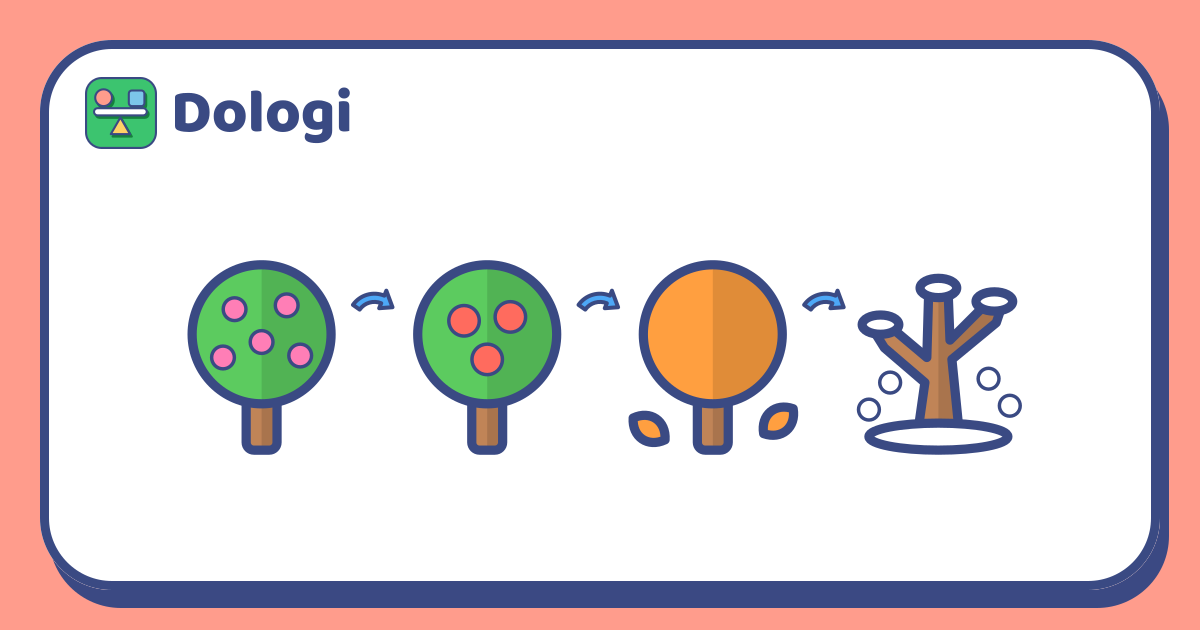
- The same tree, every month. Choose one tree you pass often. Once a month, your child draws it or you take a photo from the same spot. After a year, lay the pictures in a row: buds, full leaves, color, bare branches, or new leaves after the rains, depending on where you live.
- A noon shadow. Stand a stick upright in a flowerpot on a sunny spot and mark the tip of its shadow at the same clock time, once a month. Far from the equator, the shadow is short in summer and long in winter, because the Sun is higher or lower.
Games for younger children
Children aged about 4 to 6 learn seasons best through things they touch and wear:
- Sort the clothes. Tip a basket of clothes on the floor and sort them into piles: for a hot day, a rainy day, a cold day. Some items go in two piles, which is a good discussion: "Can you wear a cap when it's cold?"
- Pack the suitcase. "We're going somewhere very cold. What do we pack?" Then the same for a beach in the hot season or a week of heavy rain.
Draw a season wheel
To bring it all together, draw a big circle and divide it into as many parts as your seasons: four, or two for a rainy and a dry season. In each part, your child draws the weather, the clothes, the food, what the trees look like and family events that happen then, such as birthdays or holidays. Draw an arrow around the outside.
Then ask: "What comes after the last season?" The wheel makes it clear that the first one comes back, and the whole year starts again.
A season wheel is a pattern that repeats: once you reach the end, it starts over. In Dologi, "Repeating patterns" puzzles in the Patterns topic ask children to find the part that repeats and choose what comes next.
In short
- Weather is what the sky is doing today; a season is a long stretch of similar weather that comes back every year.
- Seasons depend on where you live: four seasons far from the equator, often a rainy and a dry season near it, and reversed seasons in the southern half of the world.
- A flashlight and a tilted ball show why: when your half of the Earth leans towards the Sun, it is summer.
- Keep a weather chart, draw the same tree every month and finish with a season wheel.
Read more: Patterns in nature: snail shells, honeycombs and sunflowers