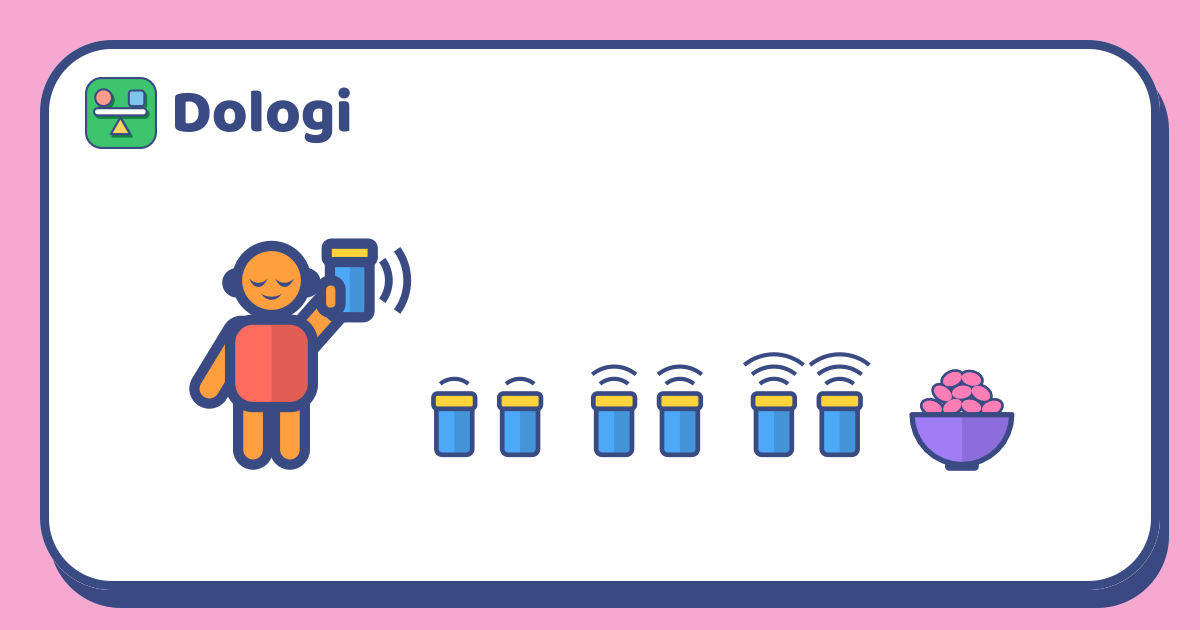
Most matching games are played with the eyes: two cards with the same picture, two socks with the same stripes. This one is played with the ears. You fill a few identical boxes in pairs, close them up, and your child shakes them one by one to find the two that sound alike. Nothing on the outside gives the answer away.
It takes ten minutes to make from things you already have, and it works well for children aged roughly 4 to 8. Along the way your child practices holding a sound in mind, comparing it with the next one and changing their guess when the evidence says so.
What you need
- Six to ten identical small boxes with lids: small plastic tubs, empty spice pots, plastic eggs or small cardboard boxes. They should be the same size and material, and you should not be able to see inside.
- Fillings that sound different: uncooked rice, dried beans, paper clips, a little water, a few buttons. One pair can be left empty.
- A spoon to put the same amount in both boxes of a pair.
- Tape and small stickers or a marker to seal the lids and mark the bottoms.
Close every lid tightly and tape it shut. Play with an adult nearby and put everything away when the game is over.
| Filling | What it tends to sound like |
|---|---|
| Rice | a soft swish, like a whisper |
| Dried beans | a clear, knocking rattle |
| Paper clips | a light metallic jingle |
| A little water | a slosh with no clicks |
| Nothing | almost silence, just a tiny knock of the box |
Setting up the boxes
- Make pairs. Put the same filling into two boxes, using the same number of spoonfuls in each. If the amounts differ, the two boxes will not sound quite the same.
- Seal them. Press the lids on and wrap them with tape.
- Mark the bottoms. Give each pair a matching sticker or dot underneath, a different color for each pair. This is the answer key.
- Mix them up and stand them in a row with the marks hidden.
Older children enjoy doing the filling themselves. It makes the game theirs, and they can then set the puzzle for a parent or a sibling.
Finding the pairs by ear
Start small. For a four-year-old, two or three pairs with very different fillings (rice and paper clips, for example) are plenty. Add more pairs as the game gets easy.
- Shake the same way every time. Same strength, same speed, held near the ear. If one box is shaken hard and the other gently, they will sound different even when they hold the same thing. Changing only one thing at a time is a real piece of scientific thinking.
- Compare two at a time. One box in each hand, shake left, shake right, then decide: "same" or "different". Matching boxes go side by side.
- Allow a "not sure yet" spot. Boxes your child cannot decide about wait to one side and get another listen at the end.
- Check together. When all the boxes are paired, turn them over and look at the marks. If two do not match, shake them again: what did your ears miss?
Ask your child to describe what they hear rather than just pointing. "It sounds like rain", "it clicks", "it's very quiet". Putting a sound into words helps children remember it while they listen to the next box.
From soft to loud: putting the pairs in order
Once the pairs are found, line them up from the softest to the loudest. Children often disagree with adults here, and that is a good conversation to have. Is the jingle of paper clips louder than the rattle of beans, or just sharper? Sounds differ in more than one way, and noticing that is part of the fun.
A few variations keep the game fresh:
- Odd one out: three boxes, two the same and one different. Which one does not belong?
- A few or a lot: fill a pair with three beans and another pair with a full spoon of beans. Does more always mean louder?
- Take-turns pairs: lay the boxes out, take turns to shake two, and keep them if they match, like the card game but with sounds.
Open them and guess what is inside
Before you open anything, ask your child to guess what is in each pair. Hard little things or soft ones? Many tiny pieces or a few big ones? Something that rolls or something that flows? Then an adult opens one pair and you check together. Talk about why: hard objects knock against the walls, lots of tiny grains slide and swish, water moves all at once.
| Age (rough guide) | What to try |
|---|---|
| 4–5 | Two or three pairs with very different fillings; just "same" or "different" |
| 6–7 | Four or five pairs; order them from soft to loud; guess what is inside |
| 8 and up | Fillings that sound close (rice and lentils, few beans and many beans); make a set for someone else |
In Dologi, the Listening topic has a puzzle type called Sound pairs: children tap face-down cards to hear a note and find the two cards that sound the same, and cards that do not match turn back over. It practices the same skill as the shaker boxes, keeping one sound in mind while you listen for its partner.
In short
- Fill identical, opaque boxes in pairs with the same amount of rice, beans, paper clips or water, seal them well and mark the pairs underneath.
- Your child finds the pairs only by shaking and listening, comparing two boxes at a time and shaking them the same way each time.
- Then put the pairs in order from soft to loud and talk about the ways sounds differ.
- Guess what is inside before opening, and let older children make a set for the rest of the family.
Read more: Listening skills for children: sound games to play at home, Homemade instruments from recycling: a drum, a shaker and a rubber band guitar