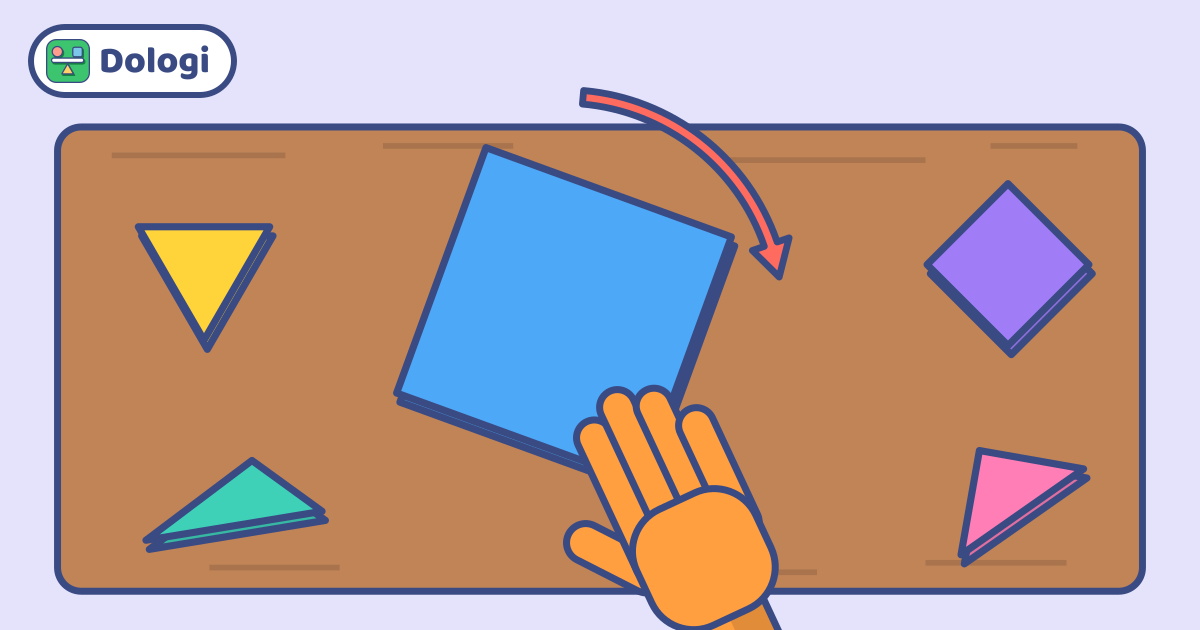
Put a paper square on the table, turn it so it stands on one corner, and ask a five-year-old what it is. Many will say "a diamond." Turn a triangle so its point faces down and some children will tell you it's "not a triangle anymore." Nothing is wrong with your child. They have learned what a shape usually looks like, and they haven't yet learned what makes it that shape.
This article explains why the tilted shape is so confusing, what stays the same when a shape turns, and how to help your child check for themselves with paper shapes, a pencil and things around the house.
Why a turned shape looks like a new shape
Most picture books, posters and worksheets draw shapes in the same way: the triangle sits on its flat side with its point up, the square sits flat on the bottom edge. After seeing that picture a hundred times, a child stores the picture, not the rule. When the shape turns, the picture no longer matches, so in your child's eyes it must be something else.
This is very common between roughly ages 4 and 7, and every child moves past it at their own pace. The way out is not to drill the right answer. It's to give your child a way to check: count, compare and test, instead of trusting the first glance.
A note on the word "diamond": it's a fine everyday word for that look, and you don't need to ban it. You can say, "It looks like a diamond, and it's still a square. Let's see why."
What changes and what stays the same
When you turn a shape flat on the table, some things change and some never do.
| Changes when you turn it | Stays the same |
|---|---|
| Which way it points | How many straight sides it has |
| Which side is at the bottom | How many corners it has |
| How it looks at first glance | How long each side is |
| Where it sits on the table | How wide each corner is (square corners stay square) |
That right-hand column is your child's toolkit. For a triangle, the test is "three straight sides and three corners." For a square, it's "four straight sides, all the same length, and four square corners."
The trace-and-fit game
This is the simplest way to show that turning doesn't change a shape.
- Cut shapes from colored paper: a square, a rectangle and two or three triangles.
- Trace the square on a sheet of paper while it sits flat. Name it together, and touch and count the sides and corners.
- Turn it. Your child closes their eyes while you turn the square onto its corner somewhere else on the table. "What is it now?"
- Check, don't argue. Count the sides and corners again. Then slide and turn the paper back onto the traced outline. It fits exactly, so it's the same square.
- Swap roles. Your child turns a shape and you name it. Now and then say, "Hmm, that's not a square anymore," and let your child prove you wrong. Explaining it to you is where the idea really sticks.
To check sides and corners without a ruler, give your child two easy tools: a strip of paper to compare side lengths (mark one side, then hold the strip against the others), and the corner of a sticky note or index card to test square corners. If the card corner fits snugly, it's a square corner, whichever way the shape is facing.
Triangles that don't look like triangles
Children who only know the "pointing up" triangle often reject other triangles too. Mix things up:
- Long and thin, short and wide. A triangle can be stretched in any direction.
- A right triangle, like half a square cut corner to corner, lying on its long side.
- Upside down or on its side. Same three sides, same three corners.
Then play a sorting game with some trick shapes mixed in: a shape with one curved side, a "triangle" with a gap where two sides don't meet, a four-sided shape. Your child sorts them into "triangle" and "not a triangle" and says why. "This one has a curved side, so it's not a triangle" is exactly the kind of reasoning you want to hear.
Hunting for shapes at every angle
Look for shapes that show up turned in everyday life:
- A napkin or square cracker turned on the plate.
- Floor tiles laid diagonally, or a square picture frame hanging crooked.
- Road signs on a walk. Many yellow warning signs are squares standing on a corner, and the yield sign is a triangle pointing down.
- Your child's own head. Tilt your head while looking at a window. Did the window change shape, or just your view?
Keep it to shapes lying flat or seen straight on for young children. Looking at a tabletop from the side makes a square look squashed, which is a different idea and can wait.
Matching activities to age
Every child is different, so treat these ages as rough guides.
| Around age | What to try |
|---|---|
| 4–5 | Naming a square and triangle in different positions, trace and fit |
| 5–6 | Counting sides and corners, sorting odd triangles and trick shapes |
| 6–7 | Testing equal sides with a paper strip and square corners with a card |
| 7 and up | Drawing tilted squares on grid paper, turning versus flipping |
In Dologi, the "Turned block" puzzles in the Space topic show a block built from small squares and ask which choice is the same block after a turn. One choice is often a flipped look-alike, so children learn to check square by square instead of trusting the first glance.
In short
- Children often learn the usual picture of a shape, not what makes it that shape, so a turned shape looks new.
- Turning changes the position, never the number of sides and corners, the side lengths or the corner sizes.
- Trace and fit, a paper strip and a card corner let your child check for themselves.
- Odd triangles, trick shapes and tilted shapes around the house build the habit of looking past first glance.
Read more: First shapes: finding circles, squares and triangles around the house, Turning shapes in your head: building children's spatial thinking