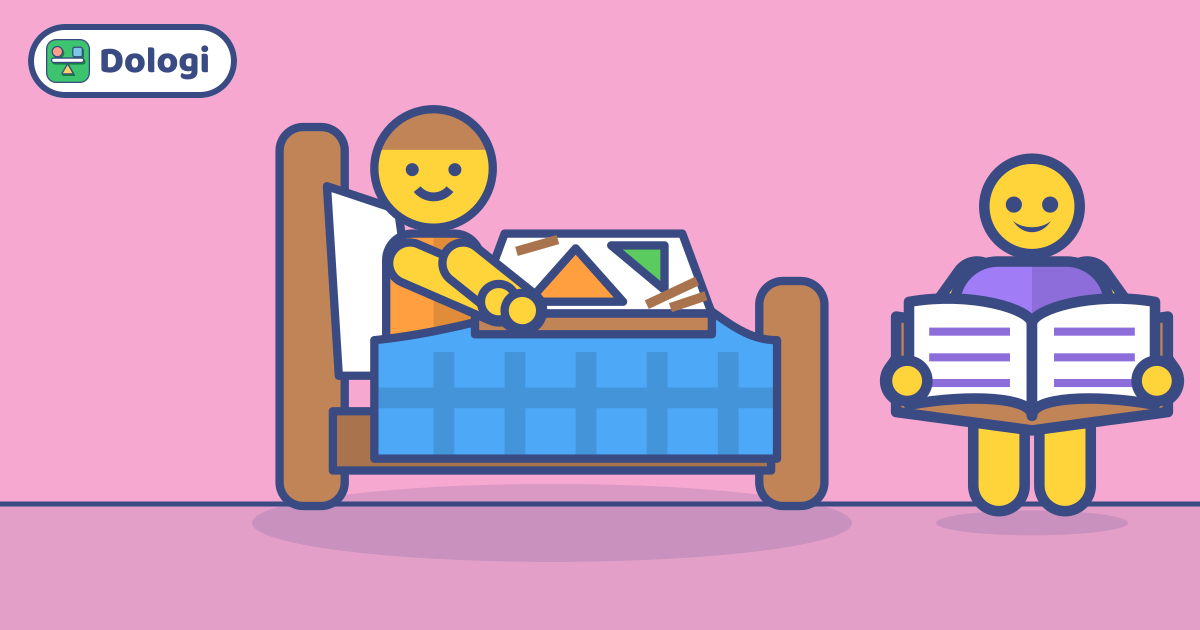
When your child has to stay home in bed, everyone runs low: your child is uncomfortable and bored, and you'd like them to rest without a screen on all day. Here are a few gentle games you can play right in bed, sorted by how much energy your child has that day: when they only want to lie still, when they can sit up, and when they're feeling brighter. They suit children aged 4 to 10.
Two rules before you start
- Your child picks. Offer two or three options and let them choose one. Choosing nothing is fine too.
- Stop any time. If they close their eyes, turn away or say "enough," you stop, no questions asked. Each game lasts five or ten minutes at most.
No winners, no points. The aim is to make the time pass more gently, not to squeeze in extra learning.
When they only want to lie still: listening games
These work even with eyes closed. Speak softly and slowly.
- Guess the thing in the room. Give one clue at a time: "It hangs on the wall... it's round... it ticks." Your child guesses after each clue. Start with a hard clue and end with a very easy one so they always get there. Then swap: your child describes, you guess.
- Spot the mistake in the story. Tell a story they know by heart and change one detail on purpose: "Goldilocks walked into the house of the three cats..." When they hear the slip, they raise a finger or wink; no talking needed. On a tired day change just one thing; on a better day change two or three.
- Guess the sound. Stand by the door and make an everyday sound: pouring water into a glass, tearing paper, jingling keys, tapping a spoon on a bowl, flicking a light switch. Your child listens from the pillow and guesses.
- Count the taps. Tap lightly on the bed frame three or four times. Your child counts silently and holds up fingers. Harder: tap two runs and ask which one had more taps.
When they can sit up: a tray on the bed
Put a tray, a big chopping board or a piece of stiff cardboard on the blanket as a table, so small pieces don't vanish into the covers.
- Tangram. Cut seven pieces from a square of card and suggest a shape: a cat, a house, a boat. On a tired day, just build freely without a model.
- Toothpicks. Copy a shape you've drawn: two squares sharing a side, a house, an arrow. On a better day, try "move one toothpick to make a different shape."
- Draw what I describe. Look at a simple picture hidden behind a book and describe it: "Draw a big circle in the middle. Put two small triangles on top. Underneath, a curved line." Your child draws, then you reveal the picture and compare. Then swap: your child describes, you draw.
Matching games to energy
| Your child's energy | Good games | What you need | How long |
|---|---|---|---|
| Wants to lie still, eyes closed | Guess the thing in the room, guess the sound | Nothing | A few rounds |
| Lying down but alert | Mistake in the story, count the taps | A familiar story | 5–10 minutes |
| Can sit up | Tangram, toothpicks | Tray, card, toothpicks | 10 minutes |
| Feeling brighter, a bit bored | Draw what I describe, swap roles | Paper, pencil | 10–15 minutes |
Energy changes through the day: maybe tangram in the morning and only listening in the afternoon. Watch your child and pick the level that fits; there's no set order.
A "stay-home bag"
Some families keep a bag that only comes out on stay-home days: a tangram set, a box of toothpicks, some paper, pencils and a new storybook nobody has read yet. Because it only appears on those days, everything inside feels new, and you don't have to hunt for things when you're already stretched.
When your child is feeling better and wants a short turn on a device, the Listening topic in Dologi has a puzzle called High or low: "Which card sounds highest, like a bird singing?" Your child taps each card to hear it and then chooses. With the volume low it works fine in bed, and each puzzle takes only a moment.
In short
- Pick games to match your child's energy that day; your child chooses and can stop any time.
- Lying still: guess the thing in the room, mistake in the story, guess the sound, count the taps.
- Sitting up: a tray on the blanket for tangram, toothpicks and drawing from a description.
- Keep each game short with no winners; a bag kept just for stay-home days keeps everything fresh.
Read more: Screen-free bedtime games, Spot the wrong note