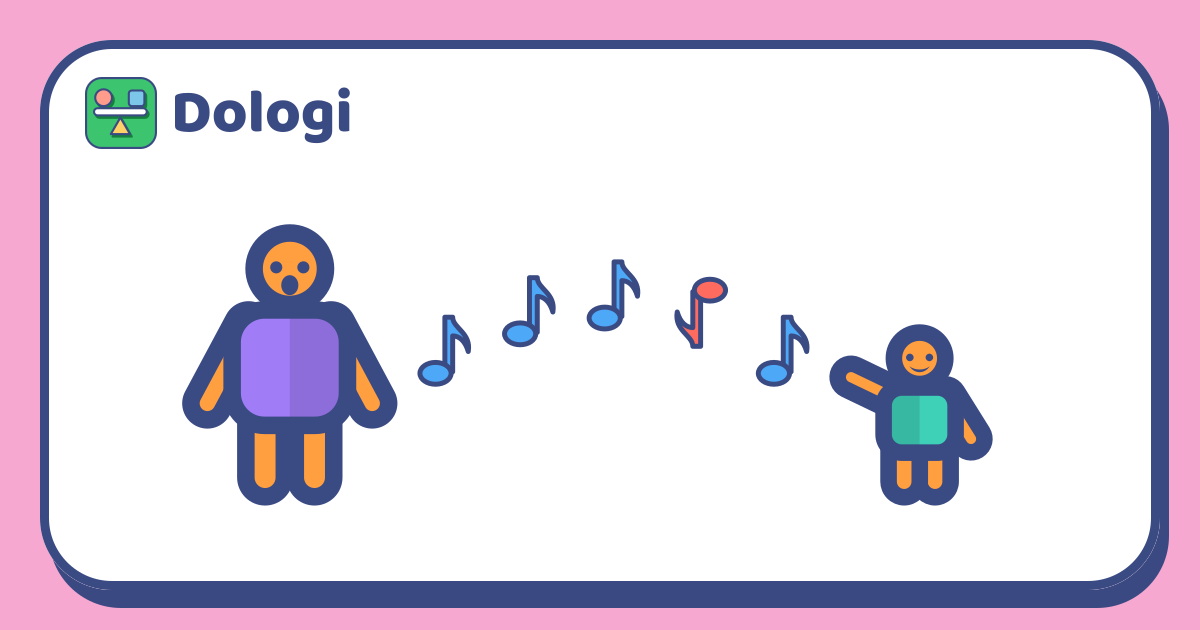
Most children know a few songs by heart. They have heard them in the car, at bedtime and at preschool so often that the words come out on their own. That is exactly what makes those songs perfect for a listening game: when something in a well-known song is wrong, the ear notices before the head has time to think.
The game is simple. You sing a familiar song but change one small thing. Your child listens, raises a hand the moment something sounds odd, and then tells you what was different. It needs no materials, works for children from about 4 to 10, and fits into a bath, a walk or a wait at the doctor's.
How to play
- Choose a song your child knows well. A short one with clear words is best at first. If your child cannot sing it from memory, they will not hear a change.
- Agree on the signal. "When you hear something wrong, put your hand up straight away."
- Sing with one change. Keep your face calm and your voice natural, so the change is something to hear, not something to see.
- Stop when the hand goes up. Ask: "What did you hear?" Let your child say or sing the right version.
- Sing the line again, the right way, together. This settles the original in their memory and ends each round on a success.
If the hand goes up when nothing was changed, that is fine. Sing the line again and ask your child to listen once more. Checking is part of the game.
What you can change
Not all changes are equally easy to hear. Start at the top of this list and move down over the weeks.
| Change | Example | How hard |
|---|---|---|
| A word swapped for a silly one | "the duck swims in the pond" becomes "the duck swims in the soup" | Easy |
| A word swapped for one that sounds similar | "pond" becomes "bond" | Medium |
| A word left out | You simply skip one word and carry on | Medium |
| One note higher or lower | Sing the words right, but one note goes up where it should go down | Harder |
| The rhythm | Hold one note far too long, or rush two notes together | Harder |
| Two changes in one song | A word early on, a note near the end | Hardest |
To practice hearing the tune rather than the words, hum the song on "la la la" instead. Then the only clue left is the melody itself.
Making it harder step by step
Every child develops at their own pace, so treat these ages as a rough guide only.
- Around 4–5: use funny word swaps and only ask for the hand signal. Laughing at "the duck swims in the soup" is part of the fun.
- Around 6–7: ask your child to say exactly which word changed and what it should be. Try similar-sounding words and missing words.
- Around 8–10: change notes and rhythm, hum without words, or hide two changes and ask "How many did you hear?" before you reveal anything.
A useful habit at every age: after your child spots a change, ask "How did you know?" Answers like "it went up instead of down" or "that bit was too slow" show that your child is starting to describe what they hear, not just react to it.
Swap roles: your child sets the trap
Once your child is good at catching changes, let them sing the song with a change for you to find. This turns listening into planning:
- They must know the original exactly, or they cannot be sure what counts as wrong.
- They have to choose a change and remember where they put it.
- They have to keep a straight face while singing, which is harder than it sounds.
Miss a change now and then on purpose, and let your child explain what you missed. Explaining a difference out loud is good practice for careful thinking.
When your child doesn't hear it
Some changes are simply too small at first. If your child misses one several times, make it easier rather than repeating the same round:
- Sing the original line first, then the changed line straight after, so the two are side by side.
- Slow down and make the change bigger: a sillier word, a note that jumps further.
- Go back to a song your child knows even better.
- Keep rounds short. Five or six rounds is plenty; stop while it is still fun.
Avoid "You weren't listening!" Hearing small differences is a skill that grows with practice, not a test of effort. Praise the noticing: "You caught that the note went up. That was a tiny change!" If you notice that your child often seems to have trouble hearing in everyday life, mention it to a doctor.
In Dologi, the Listening topic has a puzzle called "Which note changed?": your child hears two short tunes, where the second is the first with one note changed, and taps the note that is different. It is the same idea as this game, played with notes only.
In short
- Sing a song your child knows by heart, change one thing, and let them raise a hand when they hear it.
- Start with silly word swaps, then move on to similar words, missing words, notes and rhythm.
- Ask "How did you know?" so your child learns to describe what they hear.
- Let your child set the trap too: changing a song on purpose takes memory, planning and a straight face.
Read more: Clap it back: rhythm echo games for children, Listening skills for children: sound games to play at home