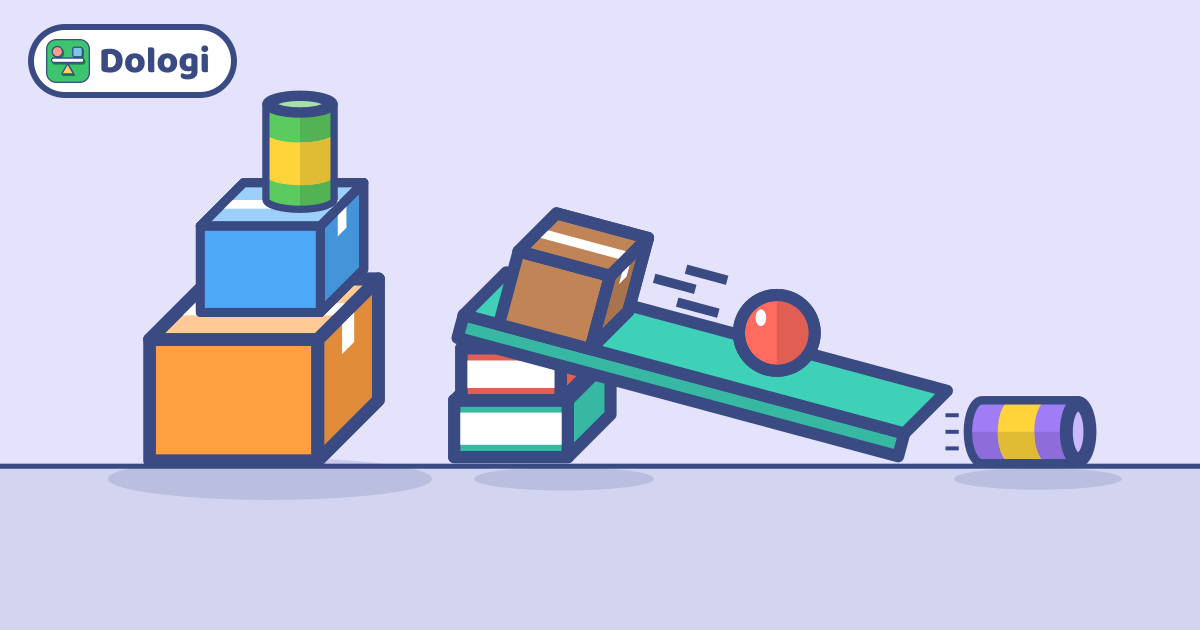
Children usually learn flat shapes first: circle, square, triangle. But the things they actually hold every day are not flat. A cereal box, an orange and a can of soup are solid shapes (also called 3D shapes), and your kitchen already has a full set. This post shows simple ways to explore boxes, balls and cylinders at home: what rolls, what stacks, and how solid shapes connect to the flat shapes your child already knows.
Flat shapes and solid shapes
A flat shape is something you can draw on paper. A solid shape takes up space: you can pick it up, turn it around and look at it from every side. The flat parts on the outside of a solid are called faces, and they are flat shapes. A cereal box has rectangle faces. The two ends of a can are circles.
A fun way to see this: press each object into a slab of play dough, or dip it lightly in paint and stamp it on paper. The box leaves a rectangle, a dice leaves a square, the end of a can leaves a circle. The ball leaves only a small dot, because it has no flat face at all.
| Everyday name | Math name | In the kitchen |
|---|---|---|
| Box | rectangular prism (cuboid) | cereal box, milk carton, a stick of butter |
| Dice shape | cube | a sugar cube, an ice cube |
| Ball | sphere | orange, grape, meatball |
| Can | cylinder | soup can, paper towel roll, oatmeal canister |
| Party hat | cone | ice cream cone, funnel |
For children around 4 to 6, the everyday names are plenty. From about 7, they can start using the math names, and older children can count faces, edges (where two faces meet) and vertices (corners). A box has 6 faces, 12 edges and 8 vertices; a sphere has none of those, just one curved surface.
A kitchen shape hunt
Clear a corner of the table and give your child a few minutes to collect objects from the kitchen (with a "no knives, no glass jars" rule). Then sort them into piles: box shapes, ball shapes, can shapes and "none of these."
The last pile is the interesting one. A banana, a fork or a bunch of grapes doesn't fit, and that's fine. An egg is close to a ball but not quite. Talking about why something doesn't fit is where the thinking happens. Ask:
- "Which pile is the biggest?"
- "Can you find two things that are the same shape but very different sizes?" (a cereal box and a sugar cube are both box shapes)
- "Close your eyes. I'll hand you something. Which pile does it go in?"
Does it roll? A ramp test
Prop one end of a cutting board or a tray on two books to make a gentle slope. Before each test, ask your child to guess first: "Will it roll, slide, or stay put?" Then place the object at the top and watch.
| Object | What usually happens | Why |
|---|---|---|
| Ball, orange | rolls straight down | curved all over, no flat face to rest on |
| Can on its side | rolls down in a straight line | curved around the middle |
| Can standing on its end | stays put | it rests on a flat circle |
| Small box | stays put, or slides if the ramp is steep | only flat faces, nothing curved |
| Ice cream cone or paper cup on its side | rolls in a circle | one end is wider than the other |
Two things are worth pointing out. First, the same can rolls or stays put depending on which way it lies, so "rolls" depends on the face touching the board. Second, sliding is not rolling: a box that slips down the board isn't turning over. If the box slides, lower the ramp and try again.
Does it stack?
Now build a tower. Most children find out quickly that boxes stack well, cans stack well when they stand on their ends, and a ball can only go at the very top. Try a few challenges:
- Build the tallest tower you can with three boxes and two cans.
- Where can the orange go so the tower doesn't fall?
- Can you balance a box on top of a can? (Yes, if the can is standing up.)
Then ask the big question: "Why do grocery stores stack cans on their ends and keep the oranges in a crate?" Your child now knows the answer: flat faces stack, curved surfaces roll.
A shape walk outside
Solid shapes are just as easy to spot outdoors. On a walk, look for:
- Box shapes: most houses, apartment buildings, mailboxes on posts, shipping boxes on a porch.
- Cylinders: grain silos, tree trunks, water pipes, the columns in front of a library or a courthouse.
- Spheres and half spheres: the dome on a city hall or a state capitol, round bushes, the globe lamps along a path.
- Cones: traffic cones, pointed roofs on towers, a pine tree from a distance.
Afterward, your child can draw one building and label its shapes, or build it again at home from boxes and tubes.
In Dologi, the Space topic has "Seen from each side" puzzles: children look at a stack of cubes and pick the picture that shows it from above or from the front. It's a good next step once your child is comfortable turning real boxes around in their hands.
In short
- Solid shapes take up space; their flat faces are the flat shapes your child already knows.
- Start with a kitchen hunt: box shapes, ball shapes, can shapes and "none of these."
- A ramp test shows that curved surfaces roll and flat faces stay put or slide.
- Flat faces stack; balls go on top. Then look for the same shapes on a neighborhood walk.
Read more: First shapes: finding circles, squares and triangles around the house, From flat shape to box: cube nets for children