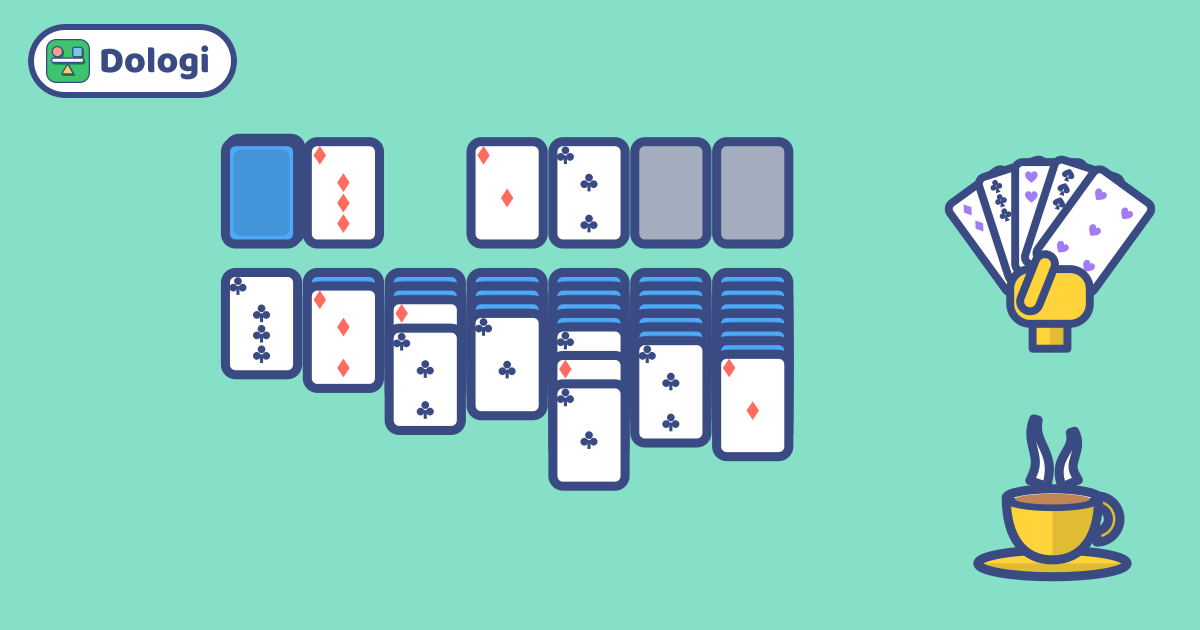
Sometimes your child needs a game to play alone: a sibling is at practice, you're cooking dinner, it's raining outside. Solitaire is made for those moments. All it takes is a deck of cards and a table. There's no opponent and no noise, and every game asks your child to look carefully and think a few steps ahead before placing a card.
Here are two games for kids roughly 7 to 12: a "four piles" warm-up for kids who are new to cards, and the familiar seven-column game for older kids. You'll also find how to teach your child to play thoughtfully instead of flipping cards at random, and what to say when a game gets stuck.
What you need and what to know about the deck
- A standard 52-card deck, jokers removed. A table wide enough for seven columns, or the floor.
- Four suits: hearts and diamonds are red, clubs and spades are black.
- Card order: the ace counts as 1, then 2, 3… 10, jack, queen, king. If your child isn't used to the face cards yet, stick small notes saying 11, 12 and 13 on them for the first few games.
- Flipping cards: turn cards toward yourself so you don't peek at the ones nearby.
Warm-up: four piles
This one suits kids around 7 or 8, or anyone who's never played cards. At first, use only the ace through 7 of all four suits (28 cards) so games are short and easier to win; move to the full deck once it clicks.
- Shuffle and hold the deck face down.
- Turn over one card at a time. When an ace shows up, place it in the middle of the table to start a pile for that suit.
- If the card you turn is the next one for a pile (2 of diamonds on the ace of diamonds, 3 of diamonds on the 2…), put it there.
- Cards that can't go anywhere make a face-up discard pile. The top card of the discard pile can be played any time.
- When you run out of cards, flip the discard pile over without shuffling and keep going. You get three passes.
- Build all four piles in order and you win.
This game trains your child to watch two things at once: the right suit and the right next number. Every time a card is turned, they have to check all four piles and the top of the discard pile.
Seven-column solitaire: alternating colors
This is the classic version most people picture, and it suits kids about 9 to 12, or younger kids who've mastered four piles.
Setup: deal seven columns from left to right. The first column gets 1 card, the second 2… the seventh 7. All cards face down except the bottom card of each column, which is face up. The rest of the deck goes face down as the stock.
Goal: move every card to four foundation piles, one per suit, from ace up to king.
How cards move:
- In the columns, place a card on one that is exactly one higher and the opposite color: a black 6 on a red 7, a red 5 on a black 6.
- You can move a whole run of correctly stacked face-up cards from one column to another.
- When the last face-up card leaves a column, flip the face-down card underneath.
- Only a king (or a run starting with a king) can go into an empty column.
- Any ace that appears goes to a foundation, followed by the 2, 3 and so on of the same suit.
- When you're stuck, draw a card from the stock and place it face up on the discard pile; the top card of the discard pile is playable.
An easier version for first games: draw one card at a time, go through the stock as many times as you like, and allow one take-back. Once your child is confident, they can switch to drawing three at a time, the way many adults play.
Teaching your child to think, not just flip
Solitaire can easily turn into "flip cards as fast as possible." A few small habits help your child actually plan:
- Look at everything before moving: before each move, your child runs a finger across all seven columns and the discard pile, counting how many moves are possible.
- Uncover face-down cards first: between two moves, pick the one that reveals a face-down card. Hidden cards are information your child doesn't have yet.
- Big columns first: the right-hand columns hold the most face-down cards, and freeing them opens up the most chances.
- Don't empty a column too early if no king is ready to go into it.
- Ask "If I move this, what gets uncovered?" before moving a run, just like thinking one move ahead in chess.
Sit beside your child for the first few games. Don't point out moves; just ask, "Is there another move?" Once your child counts the options on their own before placing a card, let them play solo.
When a game can't be won
Some deals can't be won no matter what you do, because a key card is buried at the bottom. Tell your child this up front so they don't decide they're bad at it:
- When there's truly no move left, count how many cards made it to the foundations, then shuffle and deal a new game.
- Keep a score sheet with the number of foundation cards each game. Compare with your own last week, not with anyone else.
- Now and then, look back at a lost game: "What if I'd uncovered that other column first?"
Losing, reshuffling and calmly starting over is exactly the patience this game builds.
If your child enjoys "figure out the order before you move" puzzles, the Space topic in Dologi has a puzzle called Move the tower: stack all the discs on the flag peg, lifting only the top disc each time and never putting a big disc on a smaller one. Just like solitaire, random moves get you stuck, and thinking a few steps ahead shows the way.
In short
- Solitaire is a quiet game for times your child plays alone, and all it needs is a deck of cards.
- Start with four piles using ace through 7, then move up to seven columns with alternating colors.
- Teach your child to look at every possible move first, uncover face-down cards, and not empty columns too early.
- Some games can't be won; count the foundation cards, reshuffle and start again.
Read more: First board games for 4 and 5 year olds, Math magic tricks for kids