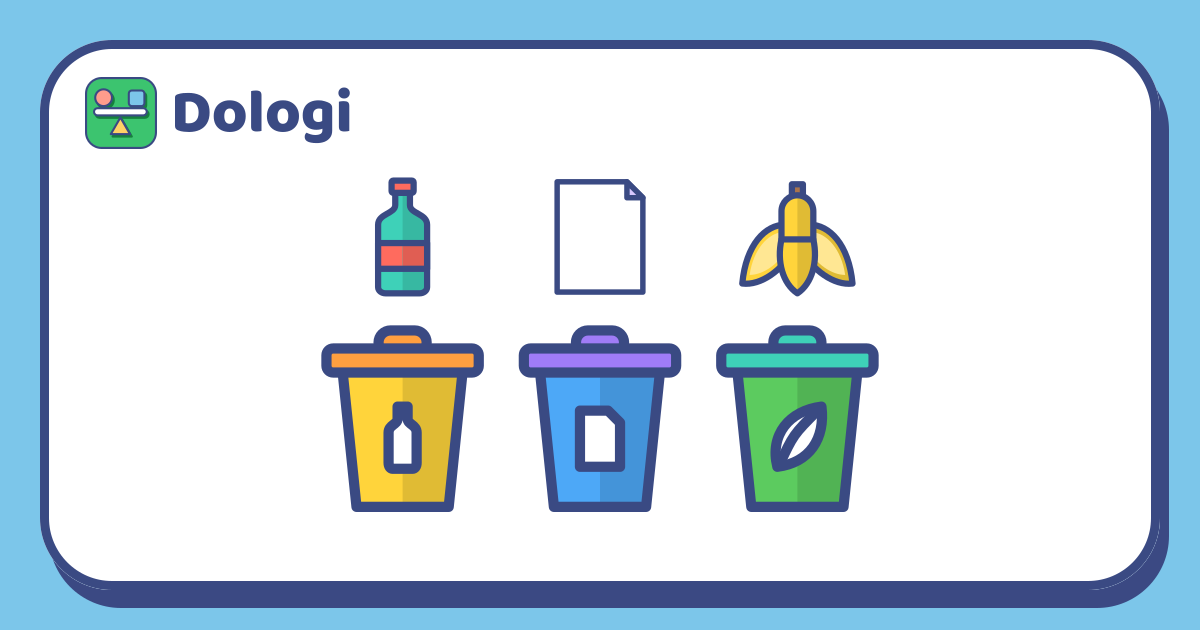
Every home throws something away each day: a milk carton, a scrap of paper, some fruit peel. For adults it is a chore. For a child it can be a real lesson: look at an object and ask what it is made of, where it should go, and whether it could be used again.
This article shows how to turn taking out the trash into a sorting game, help your child understand why people recycle, and start a few small saving habits they can manage right away.
Why sorting waste is a good lesson
- It is real sorting. Your child has to look at what an object is made of (paper, plastic, metal, food) and put it in the right group. It is the same thinking they use to tidy toys or solve a grouping puzzle.
- There is a reason to think carefully. A paper milk carton has a coating inside: does it still count as paper? Questions like that slow children down and make them look closely.
- Children can see that their work matters. A tidy trash can and a bag of paper ready for recycling are results they can see.
- It leads to bigger questions. From your own trash can, children start asking where things come from and where they go once we throw them away.
First, find out how sorting works where you live
Every area sorts waste differently. Some have two bins, some have four or five; some collect glass, batteries or food waste separately. So check your local guidelines first, then make labels for each bin together.
- Picture labels: your child draws or sticks a newspaper on the paper bin, a bottle on the plastic bin and a fruit peel on the food bin. Children who cannot read yet can still sort on their own.
- One color per bin: if you can, use bins or bags in different colors so they are easy to remember.
- Things only adults handle: broken glass, batteries, anything with sharp edges, light bulbs. Tell your child clearly that they leave these alone and call you.
Sorting games by age
| Age (roughly) | Game | What your child practices |
|---|---|---|
| 4–5 | Lay out five or six clean items (a cardboard box, a rinsed plastic bottle, a toilet paper tube, a banana peel on a plate) and ask "Which home does this one go to?" | Recognizing materials by sight and touch |
| 6–7 | Race to sort a bag of clean items in one minute, then check the result together | Sorting quickly, checking their own work |
| 8–10 | Hunt for "tricky" items: a drinks carton, a multi-layer snack bag, a plastic-lined paper cup. Guess where each goes, then look it up in your local guidelines | Reasoning, testing a guess |
| 10–12 | Count how many bags of trash the family fills in a week, record it in a table and set a goal of one bag fewer | Collecting data, comparing |
A few rules for these games: only use items that are washed, dry and free of sharp edges, and wash hands afterwards.
Small daily jobs your child can own
- Rinse cartons and bottles before they go in the recycling bin. A five- or six-year-old can do this, and it shows why dirty items are hard to recycle.
- Flatten boxes and bottles. The bin holds more, and your child sees the volume change.
- Keep paper bags and scrap paper with one clean side for drawing and folding.
- Take a water bottle and a lunch box instead of single-use things on outings.
Try not to turn this into a lecture every time something lands in the wrong bin. A light "Which home does this go to?" is enough.
Turn throwaways into toys
Before something goes into the recycling, ask your child: "Could we still use this for something?"
- Toilet paper tubes become binoculars or a marble run.
- Cardboard boxes become a doll's house, a car or a maze.
- Plastic bottles become a watering can or pins for a bowling game.
- Egg boxes become trays for sorting beans or buttons.
Your child comes up with the idea, chooses the materials, tries it out and fixes it. That is a very natural way to learn problem solving.
Saving energy and water, and caring for where you live
Sorting waste is part of something bigger: using just what we need and looking after the place we live. A few habits that are easy to start:
- Switch off the light when leaving a room. Make your child the "switch keeper" for a week, and at the end count together how many times they reminded the family.
- Turn off the faucet while brushing teeth. Fill a cup instead, so your child sees how little water one rinse needs.
- Read the electricity or water meter (if you have one) with your child at the start and end of the month, and compare it with last month.
- Go for a walk and notice which places are clean and which have litter. If the family wants to pick up litter in the park, an adult goes along and everyone wears gloves; your child leaves sharp things, broken pieces or anything unfamiliar alone and calls an adult.
Talk about it in a positive way: "We use just what we need so there is plenty left for everyone", rather than telling frightening stories about the environment.
In short
- Check how waste is sorted where you live, then make picture labels for each bin.
- Turn taking out the trash into a sorting game for your child's age, using only clean, safe items.
- Give your child a few small daily jobs: rinsing cartons, flattening bottles, saving paper that can still be used.
- Link it to saving energy and water and caring for your area, and keep the tone positive.
Sorting things by what they have in common is also what children practice in the "Sort into groups" puzzles in Dologi's Logic topic: the same thinking as choosing the right bin for a bottle.
Read more: Sorting and comparing: the first thinking skill, Homemade instruments from recycling