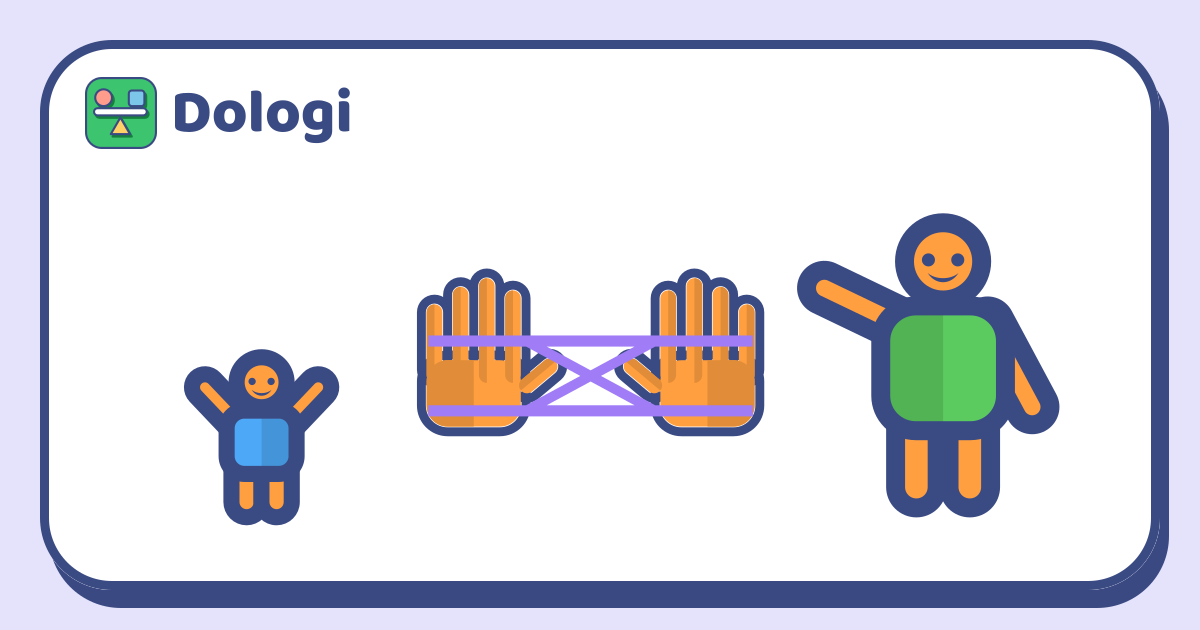
Children in many countries play with a loop of string stretched between their fingers. One person makes a shape, the other picks it off with their own fingers, and suddenly there is a new shape. The game costs nothing, fits in a pocket and can be played on a sofa, on a bus or in a waiting room.
String figures are more than a way to pass the time. To take the string from someone else's hands, your child has to see which strand lies over which, guess what will happen when they pull, and remember a short series of moves in the right order. This post shows how to make the first shape, how to pass it back and forth, and how to adjust the game for children aged roughly 6 to 12.
Getting a loop of string ready
- Yarn or soft cord, about 1.5 to 2 meters long, tied at the ends with a small knot. Thick, smooth yarn in a bright color is easiest to see and does not cut into fingers. Thin thread tangles quickly.
- Two players sitting face to face, close enough for their hands to meet in the middle.
- A rule for little ones: the string goes around hands and fingers only, never around the neck. Put it away when the game is over.
Try the first two shapes on your own before showing your child. When you know the moves, you can watch your child's hands rather than your own.
The first shape: the cradle
- Put both hands inside the loop, thumbs outside it, and pull your hands apart until the string is tight across the backs of your fingers.
- Wrap the string once more around each hand, so that a strand now runs across each palm.
- With the middle finger of your right hand, pick up the strand that crosses your left palm and pull back. Do the same with your left middle finger on the right palm strand.
Pull your hands apart: you now have a long strand along the top, a long strand along the bottom and two strands crossing in an X on each side. Many families call this the cradle, and it is the starting point for the game.
Passing it back and forth: pinch, pull, go around, come up
The second player takes the cradle with one basic movement:
- With thumb and index finger of each hand, pinch the two places where the strings cross.
- Pull them out sideways, past the long side strands.
- Go around the outside of those long strands, then bring both pinched hands into the middle from below.
- Open thumbs and index fingers apart. The first player lets go, and a new, flatter shape appears on the second player's hands.
Most of the next shapes use the same movement with small changes: you pinch the crossings again, but this time go around from above, or hook a strand with the little fingers before you open your hands. Different families and countries give the shapes different names. It does not matter what you call them; what matters is that you play them in the same order, so the sequence becomes something you both remember.
When the string ends up in a knot, that is part of the game. Shake it out, start again from the cradle and try to find the step where it went wrong.
Let your child predict the next shape
Before your child picks up the string, pause and ask:
- "Which crossing are you going to pinch? Show me with your finger first."
- "Will your hands go over that long string or under it?"
- "What do you think the shape will look like when you open your fingers: more crosses or fewer?"
Children have to picture the movement before they make it, which is exactly the kind of thinking used to imagine shapes turning or folding. When the guess is wrong, follow the string slowly with a finger together and find out why.
Once you have learned three or four shapes in order, play the sequence backwards in words: "What came before the flat one?" Then try the sequence without speaking at all, watching each other's hands.
Easier or harder by age
The ages below are only a rough guide. Each child moves at their own pace.
| Age (roughly) | What to try | How you help |
|---|---|---|
| 6–7 | Take the cradle from you with the pinch-and-pull move | Hold your hands still and say each step out loud |
| 8–9 | A sequence of three or four shapes, taking turns | Name the crossing to pinch, but let your child do the moves |
| 10–12 | Long sequences, playing from memory, inventing new pickups | Only watch; ask your child to teach the moves to you |
Younger children who find the passing game too fiddly can start with something simpler: you hold a cradle still and they put a finger through one gap and pull, just to see what changes.
When your child invents a new way to pick up
After a few sessions, set a challenge: "Find a way to take the string that we have never tried." Your child may hook a different strand, use a different finger or turn their hands over. Some attempts collapse, some make a brand-new shape. Draw the new shape together on paper and give it a name, so you can make it again tomorrow.
Children who enjoy guessing what a shape will become may also like the Space topic in Dologi, where the "Fold and punch" puzzles ask them to imagine where the holes will appear once a folded sheet is opened. The string game stays a game for two, though, with your hands and your child's working on the same loop.
In short
- A loop of soft yarn about 1.5 to 2 meters long is all you need; strings go around hands only, never around the neck.
- Start with the cradle, then pass it across with the basic move: pinch the crossings, pull out, go around the side strands, come up through the middle.
- Ask your child to predict which strand to take and what shape will appear, and untangle mistakes together.
- Learn a few shapes in order, then let your child invent new pickups and draw them.
Read more: Hand shadow puppets with a flashlight: make an animal, guess it, tell a story