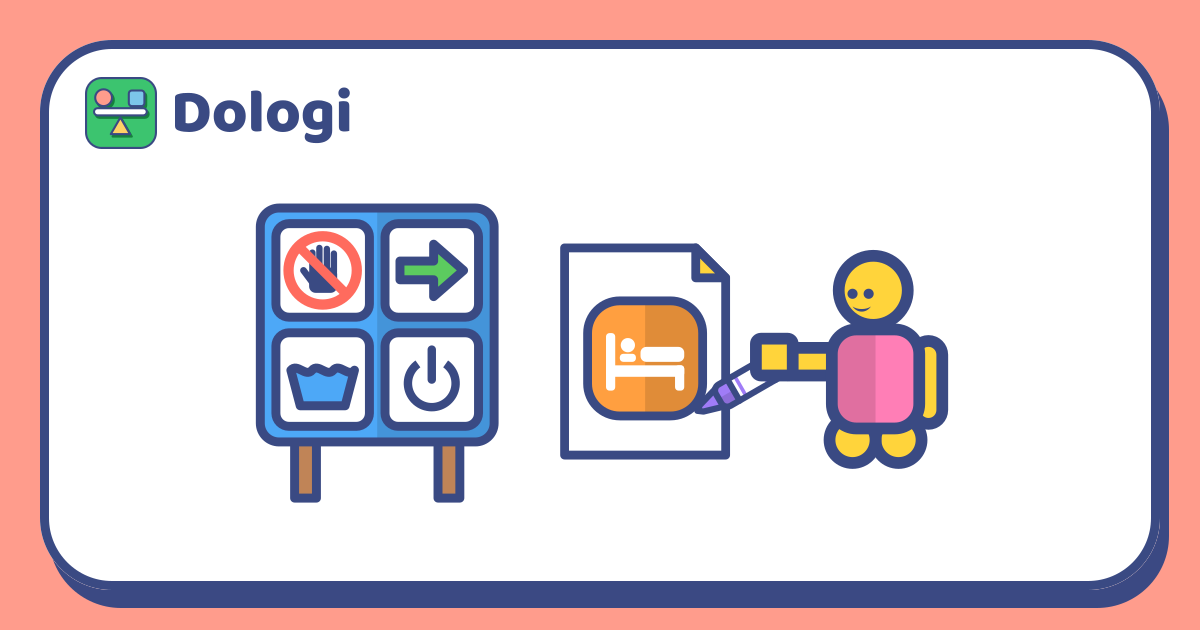
Look around any kitchen and you will find dozens of tiny pictures with no words: a circle with a line on the kettle, a snowflake on the fridge, a little tub of water on the label of a T-shirt. Out on the street there are more: arrows, a walking figure, a trash can with arrows chasing each other. Adults read them in a split second. For a child, each one is a small puzzle.
This article turns those puzzles into a game for children aged roughly 5 to 10: go on a symbol hunt, guess what each picture means, check, notice the rules many symbols share, and finally design a few for your own home. All you need is a pencil and paper.
Why picture symbols are good thinking practice
A symbol packs a whole message into one simple drawing. To read it, your child has to look closely at what is there, link it to something they already know, and make a sensible guess. "There is a hand, and a line goes through it. Maybe it means don't touch."
That is reasoning from clues, and it is also pattern spotting. Once a child notices that a diagonal line through a circle turns up on many "don't" signs, they can read a sign they have never seen before. Going the other way, from an idea to a drawing, is a lesson in leaving out what doesn't matter: a good symbol keeps only the parts that carry the meaning.
There is a practical side too: knowing what the washing machine buttons or the pool signs mean helps children feel at home in the world and confident to ask when something is unclear.
Go on a symbol hunt
Pick one place at a time so the hunt stays short and fun. Your child points, you look together and count your finds.
| Where to look | What you may find |
|---|---|
| Kitchen | Power button, snowflake for cold, flame or wavy lines for heat, a cup on the kettle |
| Remote control, radio, tablet | Play, pause, volume up and down, the power symbol again |
| Clothing labels | A tub of water, an iron, a triangle, a square with a circle inside |
| Bathroom and doors | Hot and cold taps, door signs, push and pull |
| Street, park, store | Arrows, a walking figure, a bicycle, exits, recycling bins |
Younger children can simply draw each symbol they find on a sheet. Older children can sort their finds into groups, such as "symbols that warn", "symbols that point the way" and "symbols that tell you how to use something".
Guess first, then check
For each symbol, run the same small routine.
- Describe it. "What can you see?" A hand, a circle, a line, three wavy lines.
- Guess. "What do you think it means?" Accept any answer that comes with a reason.
- Look at where it is. A symbol next to the oven means something different from the same shape on a toy. The place is a clue.
- Check. Ask someone who knows, look at the instruction booklet together, or read the words next to the sign if there are any.
Make one family rule clear from the start: warning symbols are checked by asking, never by trying. Your child should not test a "don't touch" or "hot" sign by touching. Buttons on appliances are pressed only with an adult nearby.
When a guess turns out wrong, it is worth asking "what made you think that?" A child who says "the triangle looked like a roof" has made a reasonable link. Adults make guesses like that too in an unfamiliar country.
Spot the rules that many symbols share
After a few days of hunting, put the finds side by side and look for things that repeat. Some useful ones to point out:
- A diagonal line through a picture often means "not allowed" or "no": no entry, no dogs, do not wash.
- An arrow shows a direction or a movement: this way, push here, turn the volume up.
- More of something often means more: on many clothing labels, more dots inside the tub or on the iron mean warmer; more bars on a volume icon mean louder.
- Color can help: green is often used for "go" or "safe", red for "stop" or "danger". It is a habit, not a law, so the shape still matters most.
Encourage your child to state a rule in their own words, then test it on a new symbol. "If the line means no, then this one means no cycling." A sign that breaks the rule is a good find too: symbol rules are useful guesses, not certainties.
Design symbols for your home
Now swap roles: your child becomes the designer.
- Choose what needs a symbol. A room (bathroom, bedroom), a box (toys, socks, art supplies) or a rule (shoes off here, quiet time).
- Find the key idea. "What is the one thing everyone thinks of for the bedroom?" A bed, a pillow, a moon.
- Draw it simply. No words, no numbers, only a few bold lines. If they use a "no" sign, the line goes from top left to bottom right, like real signs.
- Test it. Show the symbol to someone who didn't watch it being drawn. Can they guess the meaning? If not, ask what confused them and make a second version.
Children around 5 or 6 enjoy drawing one symbol and sticking it on a box. From about 8, many like making a set with shared rules, such as all warnings in a triangle and all "this way" signs with the same arrow. Every child is different, so let yours set the pace.
In Dologi, the "Crack the code" puzzles in the Logic topic use a similar kind of thinking: each picture stands for a number, and your child compares a few solved messages to work out which is which before opening a lock.
In short
- Picture symbols with no words are everywhere, and each one is a small reasoning puzzle for children aged about 5 to 10.
- Hunt, guess, look at where the symbol is, then check by asking or reading. Never check a warning sign by trying it.
- Look for shared rules such as the diagonal "no" line, arrows for direction and "more dots, more heat", and test them on new signs.
- Finish by designing symbols for your own home and testing whether the family can guess what they mean.
Read more: Observation skills: teaching children to look closely before deciding, Reading simple maps with your child: symbols, directions and the way to the park, Leaving out what doesn't matter: abstraction for 8-to-12-year-olds