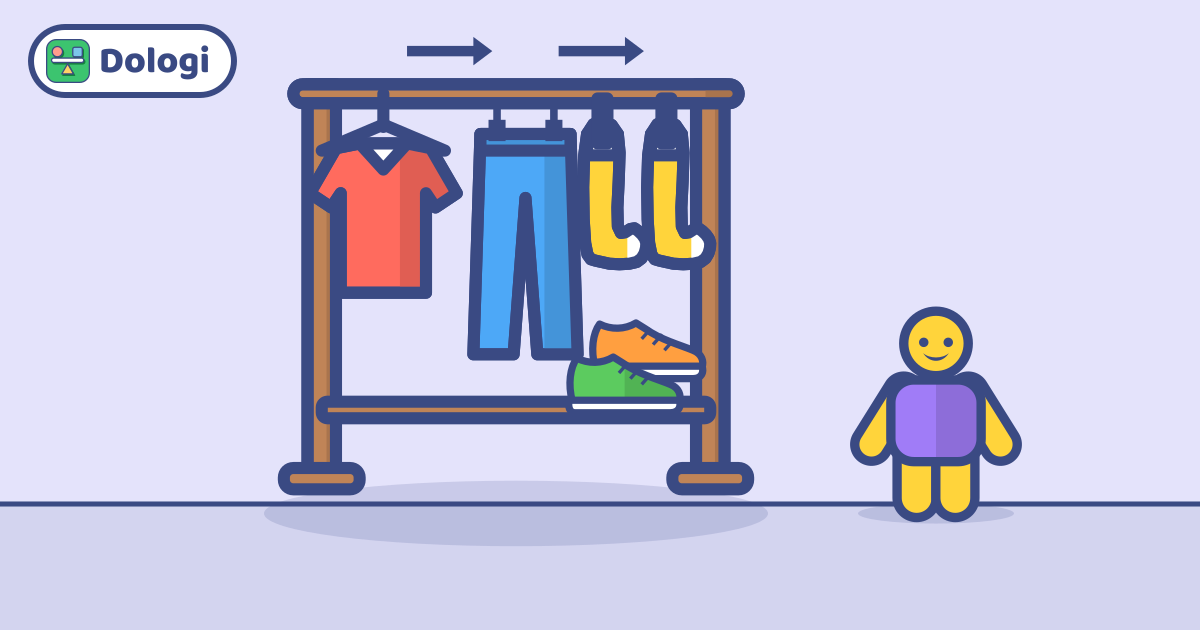
On a busy morning, it is so much faster to dress your child yourself. But getting dressed is one of the first big jobs children can do on their own, and it practices more than it seems: remembering steps in order, telling front from back and left from right, and using both hands with care.
This post covers what children can usually manage at each age, how to set clothes out so the job is easier, a few tricks for front, back, left and right, and how to let your child do it without turning every morning into a race.
What children can usually do at each age
These are rough guides. Every child is different, and what your child can do on a calm Saturday may fall apart on a rushed Monday.
| Age (roughly) | What many children can do |
|---|---|
| 2–3 | Pull off socks, take off pull-on pants, push arms through sleeves while you hold the shirt |
| 3–4 | Put on pull-on pants and a loose T-shirt (sometimes backwards), slip-on or hook-and-loop shoes |
| 4–5 | Do large buttons, zip a zipper once you start it, begin to notice front and back |
| 5–6 | Put on most of an outfit, smaller buttons, the right shoe on the right foot; many start learning to tie laces |
| 7 and up | Choose clothes for the weather, lay out tomorrow's clothes, fold and put things away |
If your child is well past these ages and still finds gripping, buttons or balancing while putting on pants very hard, ask their teacher what they see at school, and talk to your pediatrician if you're still concerned.
Lay the outfit out in order
For young children, the hard part is often not their fingers but remembering what comes next. Setting things out does the remembering for them:
- Line the clothes up on the bed or floor, left to right in the order they go on: underwear, shirt, pants, socks. Your child just works along the row.
- Picture cards on the wall help children who can't read yet: one card per item, taped up in order. Your child flips each card when that item is on.
- Sit down for the bottom half. Pants and socks are much easier sitting on the floor or a low stool than balancing on one leg.
- Start with easy clothes: elastic waists, wide necks, big zipper pulls, hook-and-loop shoes. Save tiny buttons for later.
Tricks for front and back, left and right
Front, back, left and right are real spatial skills, so mix-ups are normal. These tricks let your child check for themselves:
- Tag in back, picture in front. Most shirts have a tag at the back of the neck, and the printed picture is usually on the front. Pants often have a button or pockets in front.
- Lay the shirt face down first. Spread it on the bed with the front facing down and the neck away from your child. They slide their arms in from the bottom and pull it over their head, and it ends up the right way around.
- The coat flip: lay the open coat on the floor, inside facing up, with the hood or collar by your child's feet. They put both arms in the sleeves and flip the coat up over their head. Many preschools teach it, and it's handy in winter.
- Left and right shoes: cut a sticker in half and put one half inside each shoe. When the two halves make a whole picture side by side, the shoes are on the right feet.
If the shirt still ends up backwards, try not to fix it right away. Ask, "Where's the tag?" and let your child notice. A backwards shirt at home is no big deal.
Let your child do it, even when it's slow
Children only get better at dressing by doing it, and doing it takes time. A few things make the wait easier:
- Practice on weekends or in the evening, when nobody has a bus to catch. A school morning is not the time to learn something new.
- Build in time: wake up ten minutes earlier, or lay out clothes the night before.
- Start with the last step. You do most of it and your child does the final bit: pulling pants up from the knees, zipping the last inch. Once that's easy, they take on the step before. This way your child always gets to finish.
- Praise what they did: "You found the tag all by yourself" helps more than "Good job."
- Don't redo it for them. A slightly crooked shirt or twisted sock can stay. Fixing it right away can tell your child they didn't really do it.
Choosing clothes for the weather
From about 5 or 6, children can start choosing their own clothes, within limits:
- Offer two outfits you're both fine with instead of the whole closet.
- Check the weather together each morning, out the window or on a simple picture forecast: sunny means a hat, rain means a raincoat and boots, cold means a coat, hat and gloves.
- Sort clothes by season in drawers or bins your child can reach, and put away what doesn't fit the season.
- Dress in layers so your child can take one off when the afternoon warms up.
By 7 or 8, your child can lay out tomorrow's clothes on a chair before bed, including the school uniform if they wear one. That's the next step after dressing: getting themselves ready the night before.
In Dologi's Space topic, the Mirror painting puzzle asks your child to paint one half of a picture so it matches the other half in a mirror. A left shoe and a right shoe are mirror images too, so after a round, set your child's shoes side by side and ask: "Which one is the mirror of the other?"
In short
- The age guides are rough; start with easy clothes like elastic waists and hook-and-loop shoes.
- Lay the outfit out in a row in dressing order, and let your child sit down for pants and socks.
- Teach tricks for front, back, left and right so your child can check their own work.
- Practice when you're not rushed, start with the last step, praise what they did, and from 5 or 6 let them choose clothes for the weather.
Read more: Five minutes before school, Holding a pencil well and building strong little hands