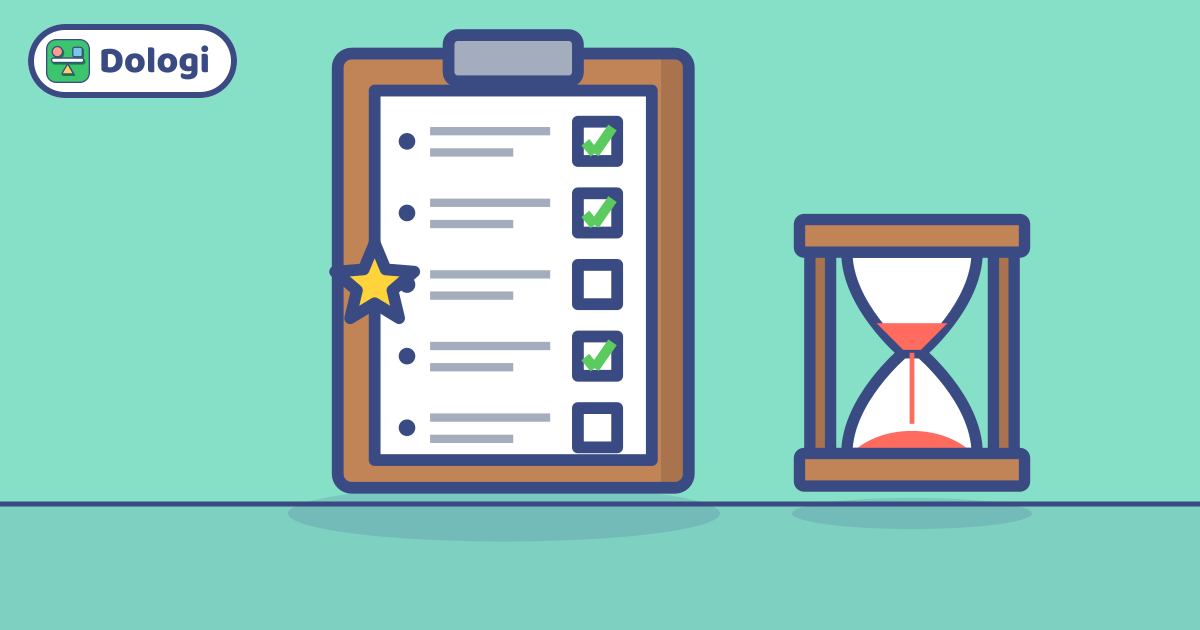
At home, your child does fine on practice problems. Then the test comes back with the last three questions blank. "I got stuck on number two for so long," they say, and after that they rushed through the rest. Another time they finished everything but lost points for copying a number wrong from the question or forgetting the units.
Knowing the material and showing it under a time limit are two different things. Taking a test is a skill of its own, and it can be practiced at home. This post is for kids around 8 to 12: skim the whole test, do the sure questions first, mark the hard ones to come back to, save a few minutes to check, plus a low-pressure way to practice with a homemade quiz and a sand timer. If your child gets very nervous before tests, see helping kids stay calm before a test.
Skim the whole test first
Many kids get the test and start on question one right away. Teach your child to spend about the first minute looking over the whole thing:
- How many questions and sections are there? Which parts are long, and which are worth the most points?
- Which questions look familiar and doable? Which look new?
- Is there anything that needs a longer written answer, like a short essay or a word problem, so they should save time for it?
That minute isn't wasted. Your child gets a "map" of the test, so a hard question is less scary: they already know there are questions later on that they can do.
Do the sure questions first
On the first pass, your child answers the questions they know how to do, from top to bottom. If they've thought about one for a while without finding a way in (for older kids, a minute or two), they mark it and move on instead of sitting there stuck.
The mark can be a small star or a question mark in the margin. Ask the teacher ahead of time whether writing on the test is allowed. If it isn't, your child can jot the question number on scratch paper. What matters is having a way to remember "I'm coming back to this one," instead of either skipping it for good or getting stuck.
Doing the sure questions first locks in the points your child already knows how to earn, and they go back to the hard ones feeling more confident. Often, working through later questions jogs their memory about an earlier one.
Go back to the marked questions
On the second pass, your child returns to the starred questions. A few ways to get unstuck:
- Reread the question slowly. Underline what it's asking and the numbers or facts it gives.
- Draw it if it's a word problem: a quick sketch, a bar diagram, little circles for objects.
- Rule out answers if it's multiple choice: cross out the ones that are definitely wrong first (see teaching your child to rule out wrong answers).
- Write down what you can. Even without a final answer, writing the steps they tried can help, since many teachers give credit for the work.
If it still doesn't come, your child picks the most sensible answer they can and moves on to checking. A good test doesn't mean getting every question.
Save the last few minutes to check for their own mistakes
"Check your work" often turns into a quick glance and handing it in. Checking works better when your child knows where they usually slip. Look at a few old tests together and find two or three mistakes they make often, for example:
| Common slip | How to check |
|---|---|
| Copying a number wrong from the question | Put a finger on the number in the question and compare it with the number in the answer |
| Leaving off units (inches, pounds, dollars) | Look at each answer on its own and ask, "Units?" |
| Solving correctly but not answering what was asked | Reread the question, then reread the answer |
| Missing periods or capital letters | Read each sentence silently and stop at the period |
| Skipping a question | Count the answered questions |
Your child writes their two or three slips on a small card and reads it before each practice at home. Over time they remember without the card. To understand why the same mistake keeps coming back, see patterns in mistakes and the habit of checking calculations.
Practice at home with a homemade quiz and a sand timer
There's no need to wait for test day to practice. Once a week, make a short quiz of 8 to 10 questions from material your child has already learned: mostly easy, a few medium, and one clearly harder question so they can practice skipping and coming back. Set a sand timer or a timer for about 15 minutes, and let your child work in rounds:
| Round | What your child does |
|---|---|
| First minute | Skim the quiz and say which questions look sure and which look new |
| First pass | Answer the sure ones, star the hard ones |
| Second pass | Go back to the starred questions |
| Last few minutes | Check using their mistake card |
When time's up, don't rush to grade it. Ask about the process instead: "Did you skip the hard one? Did you have time to check? Did checking catch anything?" Praise the strategy, even if an answer is still wrong. A sand timer works well because your child can see the time passing without a beep that makes them jump. If a timer makes your child tense, give extra time at first.
Checking means being willing to look closely at every part. The Spot the difference puzzles in Dologi's Focus topic practice exactly that habit: comparing two pictures piece by piece instead of guessing fast.
In short
- Spend the first minute skimming the whole test to see what's on it.
- Do the sure questions first, mark the hard ones and move on, then come back on a second pass.
- Save the last few minutes to check for the two or three slips your child makes most.
- Practice once a week at home with a homemade quiz and a sand timer, and praise the strategy more than the score.
Read more: Helping kids stay calm before a test, Reviewing for end-of-term tests, Ruling out wrong answers