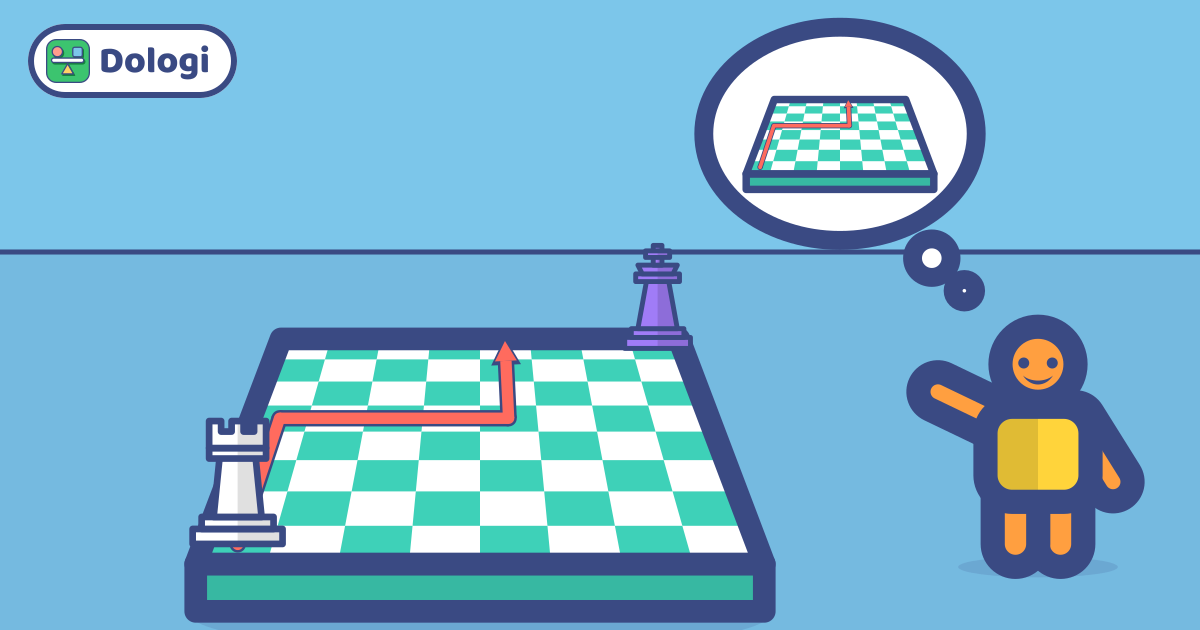
Your child makes a bold move, you answer, and their eyes go wide: "Wait, I didn't think you'd do that!" That's the moment they run into one of the hardest skills in chess: thinking ahead. Not just "where do I want to go?" but also "then what will you do, and then what will I do?"
This post starts at the chessboard: the levels from one move to three, why kids find it hard, games to practice right on the board, and how to bring the "if… then…" habit into everyday life. Planning in general is covered in Planning before doing; here we start from the board and work outward.
The levels of thinking ahead
| Level | What your child thinks | On the chessboard |
|---|---|---|
| Only my move | "Where do I go?" | Sees a piece to take and takes it, no further thought |
| One reply | "I move, then how will you answer?" | Before capturing, asks "Will I get taken back?" |
| Two moves | "I move, you answer, I move again" | Brings a rook out so it can capture next turn |
| Three or more | A planned sequence | Drives the king back with two rooks, one row at a time |
Beginners usually start at the first level, and that's completely normal. The second level is the biggest leap: seeing the board through the other player's eyes. Tic-tac-toe is a great place to practice it; see Tic-tac-toe for children. Three moves ahead usually comes after months of play, and every child is different.
Why thinking ahead is hard for kids
- They have to hold the whole sequence in their head. Every imagined move is a new position where nothing on the board has actually moved. Young children can hold only a little information at once, so two or three moves is a lot.
- They have to imagine what someone else wants. Kids tend to assume the other player will do exactly what they hope. Realizing "you have a plan too" is a big step.
- They have to keep their hands still. Seeing a piece makes them want to grab it. Pausing a few seconds to think takes practice.
Knowing this helps you stay patient: when your child blunders, it isn't because they "won't think," it's because thinking ahead really is hard at this age.
Practicing on the board
- Say the if… then… chain out loud. You go first: "If I move my knight here, then you can take this pawn, then I take back with my bishop." Then invite your child to say their own chain.
- Guess my move. Before you move, your child guesses what you'll play. A correct guess earns a point. This makes them look at the board from your side.
- Think first, touch second. Agree on "hands on your lap while you're thinking," and only pick up a piece once the move is chosen.
- Two moves, one goal. Set up a few pieces and the task is to capture one piece in exactly two moves while the other side stands still. Then make it harder: the other side gets one move in between.
- What if I'd moved differently? After the game, go back to a key move, try something else and play on to see what happens. Your child sees how one choice changes the whole chain.
A few minutes at a time is plenty. With young kids, just practice the second level: "Will I get taken back?"
"If… then…" chains in everyday life
Thinking ahead on the chessboard doesn't automatically carry over to other things. You can help your child make the link, using the same question from the game:
- Packing the backpack at night: "If you have gym tomorrow, what do you need? What if it rains?"
- Building a block tower: "If you put the big block on top of the small one, what will happen to the tower?" Try it, then predict before the next try.
- Planning the afternoon: "If we play first and do homework after, will we finish before dinner?"
- Playing other games: card games and any board game have moments to ask "What will they do next?"
Every time your child predicts first and then sees what happens, right or wrong, that's one more round of practice.
When your child isn't thinking ahead yet
- Don't scold the blunder. Ask, "What did you think I would do?" so your child can look back for themselves.
- Allow take-backs while learning. Taking back a move after spotting the mistake is thinking ahead a little late, and it still helps.
- Model it. Now and then, think out loud about your own blunders: "Oops, I forgot to think about how you'd answer."
- Keep games short. Long games tire kids out, and tired kids have the hardest time thinking ahead.
In Dologi's Creative corner, the Chess room is labeled with exactly this skill: Thinking ahead. After a game, Watch the game again lets your child replay it move by move; at any move they can tap Try again from move to play something different and keep going, so they can see "what if I'd moved differently?" for themselves. The original game stays saved.
In short
- Thinking ahead grows from "where do I go?" to "I move, you answer, I move again"; the hardest step is seeing the board through the other player's eyes.
- Kids find it hard because they must hold a chain in mind, guess someone else's plan and keep their hands still; blunders are normal.
- Saying the if… then… chain out loud, guessing the other player's move, thinking before touching and replaying a different move are gentle ways to practice.
- Bring "if… then…" to packing a backpack, building towers and planning the afternoon so your child practices away from the board too.
Read more: Planning before doing: teaching children to think three steps ahead, Chess for children: what age to start, and what they really learn