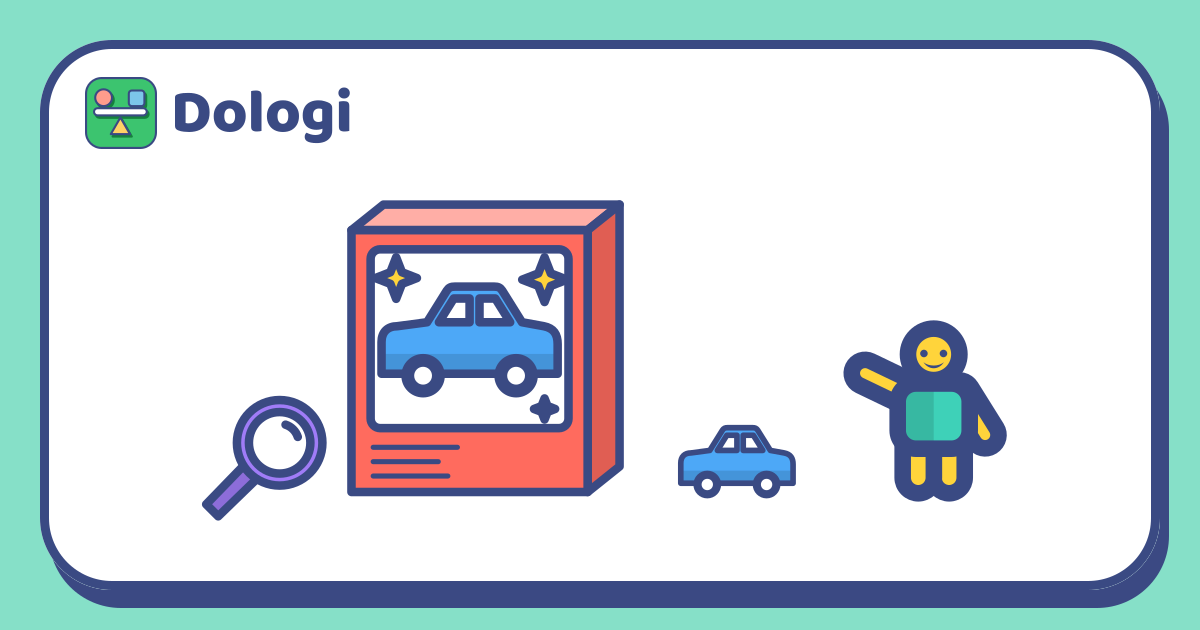
Your child spots a box in the toy aisle: a huge, gleaming car racing across a bright scene, with sparkles all around it. At home the box opens to a car the size of a palm, no race track, no sparkle, and a line on the side saying the batteries are not included. The disappointment is real. So is the chance to learn something from it.
We often talk with children about adverts in videos and games. But a lot of persuasion happens away from the screen: on packaging, on store shelves and in small free gifts. This article gives you a few simple habits to practice with children aged roughly 6 to 11, plus a drawing activity that lets your child see the tricks from the inside.
A toy box is an advert you can hold
The front of a toy box has one main job: to make someone want the toy. There is nothing wrong with that, but it helps your child to know it. You can put it simply: "The people who made this box want you to choose it, so they show the toy at its very best."
Here are some things boxes often do that children can learn to notice:
- Close-ups. The toy fills the whole picture, so it looks bigger than it is.
- Exciting scenes. It sits in a jungle, on a race track or in a castle that is not in the box.
- Sparkles and flashes. Shiny effects and bright backgrounds make it feel more special.
- Extra things in the picture. Other toys, sets or figures appear next to it, but only one item is inside.
Keep the tone light. The aim is not to make your child distrust everything, but to look twice before deciding.
Box or real? Compare the picture with the toy
Next time you open a new toy, or take an old one out of the cupboard together with its box, play "box or real?".
- Before opening, ask: "What do you think is inside? How big is it? What can it do?"
- Open the box and put the toy right next to the picture.
- Look for differences together: size, colors, parts, what it does.
- Sort them: "What was true on the box? What was only in the picture?"
| What to look at | What the box may show | A question to ask |
|---|---|---|
| Size | The toy fills the whole front | "How big is it next to your hand?" |
| Parts | Tracks, figures, extra pieces | "Which of these are actually inside?" |
| Action | The toy flying, glowing or zooming | "Does it do that by itself, or do we move it?" |
| Scene | Sky, castle, race track | "Is the background part of the toy?" |
Sometimes the box is completely fair, and that is worth saying too.
Hunt for the small print
Most boxes have a few short lines in small letters, often near a corner or along the bottom edge. Children who read can go on a small-print hunt. A magnifying glass makes it more fun.
Lines you will often find, and what they mean in plain words:
- "Batteries not included": we need to buy something else before it works.
- "Pictures for illustration only": the toy may look different from the picture.
- "Each sold separately": the other things in the picture are not in this box.
- An age range: who the toy was made for.
Then ask the interesting question: "Why do you think this is written so small, and the car is drawn so big?" With younger children who do not read yet, read the lines aloud and ask whether the front of the box told them the same thing.
In the store: shelves and free gifts
Where things sit is a choice too
In a store, the place where a product sits has been chosen by someone. Some things are put low down, where children see them first. Others wait near the checkout, where families stand still for a few minutes.
Try a small game when you walk into a store: "What is at your eye level? What is at mine?" Then ask, "Why do you think they put it there?" Let your child guess: simply noticing is the skill you want.
Does the gift make the main thing better?
A sticker on a snack, a small figure taped to a magazine, a surprise inside a box: free gifts make one item stand out from the one next to it. Three questions help your child think past the gift:
- "If there were no gift, would you still want this?"
- "Does the gift make the main thing better, or just more exciting to pick?"
- "Do you think you will still play with the gift next week?"
If two similar items sit side by side, one with a gift and one without, compare them as you would any two options.
Design an honest box together
Once your child knows the tricks, let them be the box maker.
- Choose a toy your child already has.
- On a sheet of paper or an old cereal box, draw a box front for it. Trace around the toy so the picture is its real size.
- Show only what is really inside. Write any "small print" in big letters.
- For a twist, draw a second, "very persuasive" version with sparkles, a big scene and a close-up. Put the two side by side and ask which one would sell better, and which one tells the truth.
Roughly speaking, children around 6 or 7 enjoy the tracing and the comparing, while many children from 8 to 11 enjoy spotting the tricks and making both versions. Every child is different, so follow their interest.
In Dologi, the Focus topic has "Spot the difference" puzzles, where children compare two pictures and tap what has changed: the same careful habit as comparing a box with the toy inside.
In short
- A toy box is an advert you can hold: it shows the toy at its very best.
- Play "box or real?": guess before opening, then compare size, parts, action and scene.
- Hunt for the small print and talk about why it is small, and notice what the store puts at your child's eye level.
- Ask whether a free gift makes the main thing better, then design an honest box together.
Read more: Need or want? A sorting game that helps children think before asking for things, Compare, then choose: teaching children to spot the differences between two options