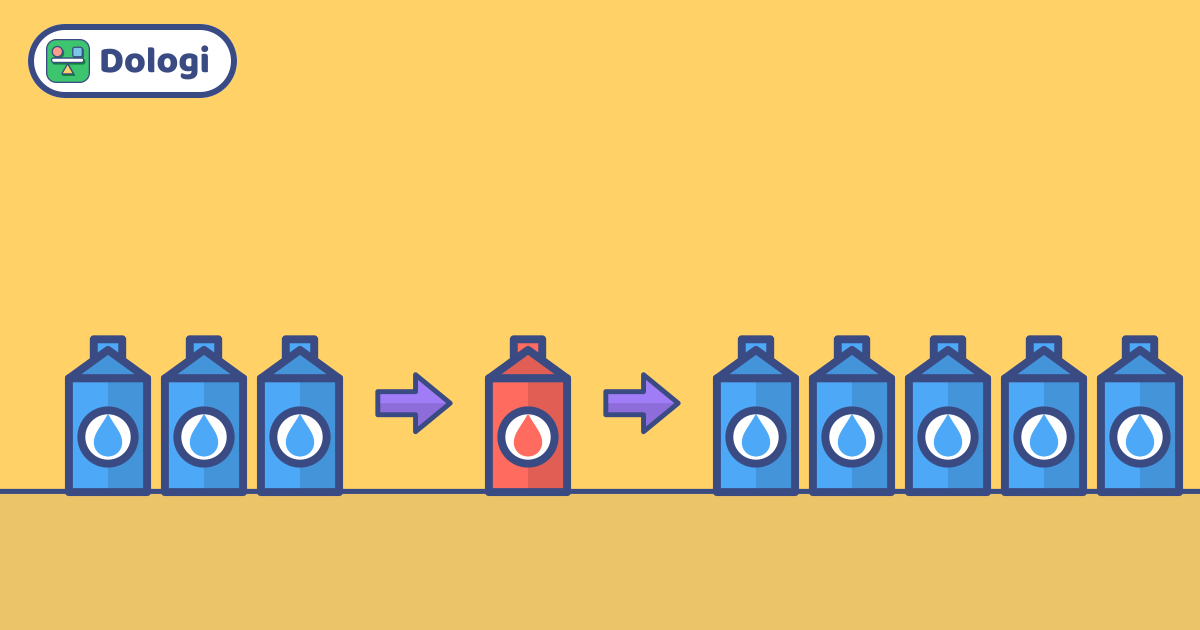
"Three cartons of milk cost $6. How much would 5 cartons cost?" It sounds simple, but many children aged 8 to 11 immediately do 6 times 5 and get $30. That's the price of 15 cartons, not 5. The reliable way is to find the price of one carton first, then work it out. In UK schools this is called the unitary method; it's also known as finding the unit rate.
Why multiplying straight away goes wrong
Your child sees two numbers, 6 and 5, and "how much would" sounds like a multiplication. But $6 is the price of 3 cartons, not 1. Multiplying by 5 gives five times the price of 3 cartons.
One question helps your child catch the mistake: "Are 5 cartons a little more than 3, or many times more?" Just a little more, so the price should be only a little more than $6, not five times as much.
A two-column table: going through "one carton"
Draw a table with one column for the number of cartons and one for the price:
| Cartons | Price |
|---|---|
| 3 | $6 |
| 1 | $2 |
| 5 | $10 |
- From 3 cartons down to 1 carton: divide by 3. $6 ÷ 3 = $2.
- From 1 carton up to 5 cartons: multiply by 5. $2 × 5 = $10.
The middle row, "1 carton," is the key step. At first, have your child write that row out even if they can do it in their head.
Try it with real things
Take 3 real milk cartons (or 3 cups) and 6 play coins. Share the coins equally among the 3 cartons: 2 coins each. Now add 2 more cartons, each with 2 coins too. Count them all: 10 coins. Your child can see why you go through "how much for one."
More problems of the same kind
- Notebooks: 4 notebooks cost $10. How much do 7 cost? One costs $2.50, so 7 cost $17.50.
- Walking: walking 3 km takes 45 minutes. How long for 5 km at the same pace? 1 km takes 15 minutes, so 5 km takes 75 minutes, which is 1 hour 15 minutes.
You don't always need to go down to one: from 3 cartons to 6, you can just double the price. But when the numbers don't scale neatly (3 to 5, 4 to 7), the "one" step is the safest route.
At the store together: is the big pack or the small pack cheaper?
Once your child is comfortable, take the problem to the supermarket. For example, two bags of the same rice:
| Bag | Price | Price per 100 g |
|---|---|---|
| 1 kg bag | $4.00 | $0.40 |
| 400 g bag | $2.00 | $0.50 |
The 1 kg bag holds 10 lots of 100 g, so $4.00 ÷ 10 = $0.40 per 100 g. The 400 g bag holds 4 lots of 100 g, so $2.00 ÷ 4 = $0.50. The big bag is cheaper per 100 g.
Many stores print a small "unit price" (per 100 g or per kg) on the shelf label. Have your child find it and check it with a division. Then ask a question that isn't in any textbook: "The big bag is cheaper, but will we use it all before it goes off?"
The Math topic in Dologi has a puzzle called Just enough: "Which basket is worth exactly the same as yours on the bottom card?" Your child has to bring things to the same unit to compare them, the same thinking as unit rate problems.
In short
- Multiplying the price of several items straight by the new number is a common mistake ($6 × 5 is the price of 15 cartons).
- Draw a two-column table and go through the "1 item" row: divide down to one, then multiply up to the number you need.
- Ask "a little more, or many times more?" to catch mistakes.
- At the store, compare the price per 100 g of big and small packs, and think about whether you'll use it all.
Read more: Teaching children about money, Word problems: helping your child understand the question