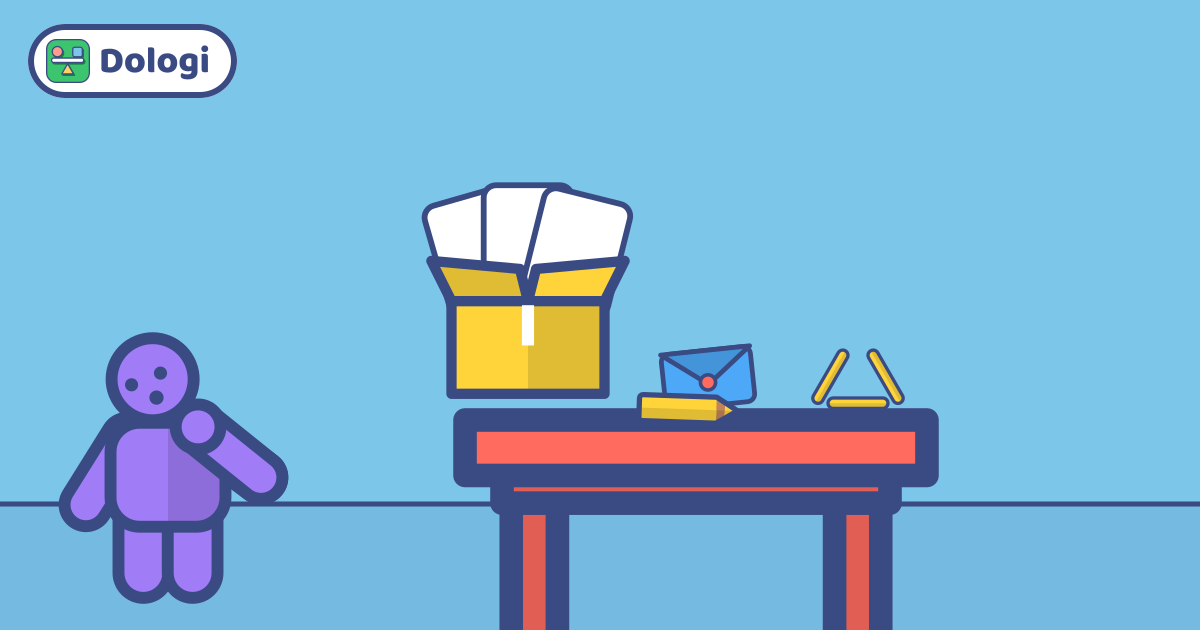
Eight is when many kids want to do things on their own: read the instructions themselves, think it through themselves, and find out for themselves whether they got it right. A small box with five challenge cards a week and sealed answer envelopes gives them exactly that. You only need to fill the box at the weekend; the rest is up to your child.
This doesn't replace time playing together. It fills the moments when your child is on their own: an afternoon waiting for you to get home from work, an early weekend morning, fifteen minutes before dinner.
Setting up the box
- A box with a lid: a shoebox or a cookie tin. Let your child decorate it and give it a name.
- Five cards about the size of a hand, each with one challenge written or stuck on.
- Five small envelopes, each holding the answers for one card, sealed, with the card number on the front.
- Pencil, eraser and scrap paper, plus whatever the cards need: toothpicks, squared paper, scissors.
- A tracking sheet: five rows for five cards, where your child marks which levels they've done.
Each card has three levels: Easy, Medium and Hard. Your child chooses where to start. Finished Easy and still keen? Move up to Medium.
Five card types to try
| Card type | Easy | Medium | Hard |
|---|---|---|---|
| Maze | A small maze with few turns | A bigger maze | A maze with doors and keys: get the key first |
| 4 × 4 number grid | Fill in 1–4 so no row or column repeats, with lots of numbers already given | Fewer numbers given | Extra rule: the shaded squares must add up to a given number |
| Toothpick puzzle | Copy a shape with toothpicks | Move 1 toothpick to make a different shape | Move 2 toothpicks to leave exactly the number of squares asked for |
| Five-square pieces | Cut out pieces made of five squares from squared paper and fit 2 of them into a 2 × 5 rectangle | Fit 3 pieces into a 3 × 5 rectangle | Fit more pieces into a bigger rectangle |
| Picture code | Each picture stands for a letter; decode one word | Decode a short sentence | Write a sentence in code for a parent to crack |
The next week, swap one or two card types to keep it fresh: spot the difference, tangram, counting the triangles in a drawing, moving a tower of disks.
Where do the puzzles come from? Puzzle books, children's magazines, or ones you make up yourself. Thinking activities for 8-year-olds has plenty more ideas for this age.
Envelope rules
The answer envelope is the key part: it lets your child check their own work without asking anyone. But opening it too soon spoils the fun. Agree on a few rules:
- Try at least two approaches before opening an envelope.
- Open it to check a finished answer, not to peek.
- If you were wrong: read the answer, close the envelope, then solve it again from scratch without looking.
- If you open it and still don't understand: set the card aside and ask a parent at the weekend.
No penalties for opening early. The goal is for your child to learn to judge their own work, not to keep the envelope sealed.
A tip for parents: for hard cards, prepare two envelopes, a hint envelope (a short nudge) and an answer envelope. Your child gets used to opening the hint first and the answer second.
The weekend chat
At the weekend, before putting new cards in the box, spend ten minutes with your child:
- "Which card was the hardest?"
- "What did you try? What didn't work?"
- "When you cracked it, what did you realize?"
- "Do you want harder or easier cards next week?"
Eight-year-olds often talk with real passion about the card that annoyed them most. Explaining how they thought helps them notice their strategies: start from a corner, work backward from the goal, rule options out. Those are what carry over to other problems.
What do parents do during the week?
- Don't help unless asked. The box belongs to your child.
- Notice without grading: check the tracking sheet to see which types your child loves and which they avoid.
- Adjust the levels: if your child breezes through every Hard level, step it up next week; if lots of cards are left unfinished, make them easier and add favorites.
- Swap roles now and then: let your child make a challenge card for you, complete with an answer envelope.
The Space topic in Dologi has a puzzle called Maze: "Draw a path from the circle to the star. Don't go through the walls." Like the cards in the box, the mazes come in many levels, and your child can keep trying until they find the way.
In short
- One box, five challenge cards a week, three levels per card, answers sealed in envelopes.
- Five types to try: maze, 4 × 4 number grid, toothpick puzzle, five-square pieces, picture code; swap a couple each week.
- Envelope rules: try two approaches before opening, and if wrong, solve it again yourself; no penalties for opening early.
- At the weekend your child talks through the hardest card; you adjust the levels for next week.
Read more: Thinking activities for 8-year-olds, Tangram for children