Your child can count five apples on the table without a mistake, then stares blankly at "5 + 3" on paper. They happily share out candy with a friend, but when you say "let's be fair", they ask what fair means. None of this is strange: your child is learning to think about things they can't see or touch.
That skill is called abstract thinking. This article explains it in plain words, shows the steps it usually grows through, gives rough ages and suggests everyday activities for children aged 4 to 12.
What abstract thinking means
Concrete thinking works with things you can see, touch and move: three cookies, a red ball, the way to school. Abstract thinking works with things that exist only as ideas: the number three, the word "fair", "tomorrow", the rule that a red light means stop.
| Concrete | Abstract | |
|---|---|---|
| What it is about | Things you can see, touch and count | Ideas, symbols, rules |
| Examples | Three cookies on a plate, a ball | The number 3, "fair", "next week" |
| How a child shows it | Points, picks up, counts one by one | Explains in words, uses a symbol, finds a rule |
Abstract doesn't mean vague or difficult. It means taking an idea out of the particular things it came from. "Three" is what three apples, three cars and three claps have in common. Once your child sees that shared part, they can use it anywhere, even with nothing on the table.
From objects to pictures to symbols
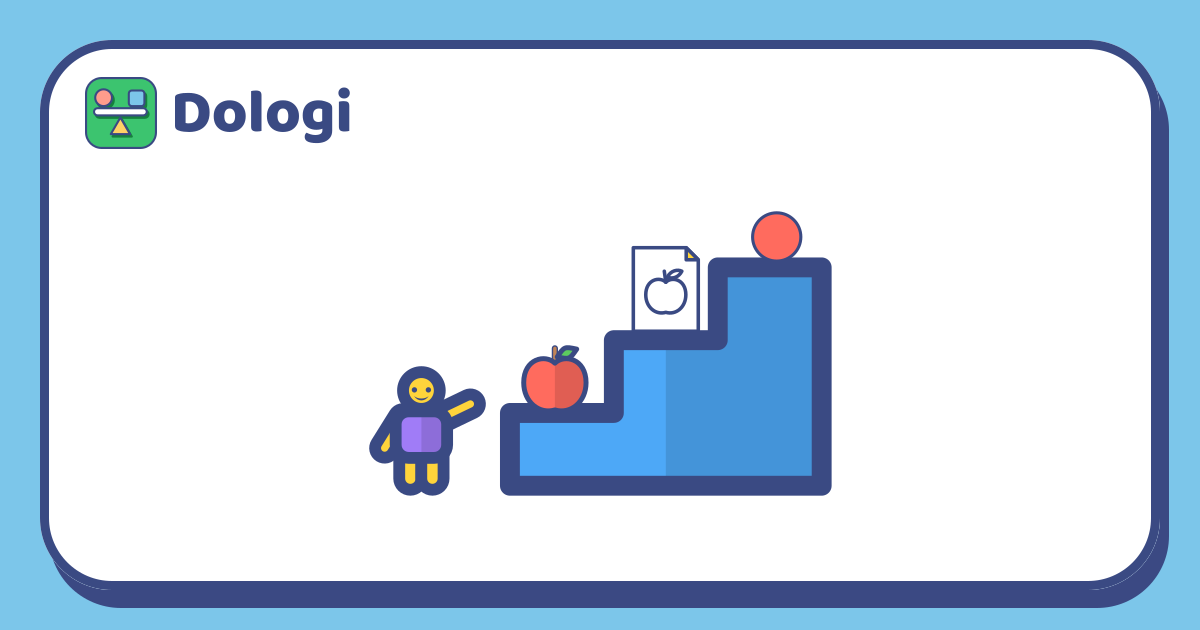
Children rarely jump straight into abstract ideas. They climb, step by step, and most new ideas go up the same stairs.
| Step | What it looks like | Example with apples |
|---|---|---|
| Real objects | Holding, moving, counting things | Three apples in a bowl |
| Pictures | A drawing of the things | Three apples drawn on paper |
| Symbols | Dots, marks, numerals, words | Three dots, then the numeral 3 |
| Ideas | Something that has no picture at all | "More", "half", "fair share" |
The steps go down as well as up. When your child meets something new, they often go back to objects or drawings for a while, and that is normal. Adults do the same: when a problem gets hard, we reach for a pen and draw a diagram.
Pretend play is an early step too. When a block becomes a phone or a cushion becomes a boat, your child lets one thing stand for another. That is the same idea a symbol rests on.
Rough ages: every child is different
The ages below are only a rough guide. Every child goes at their own pace, and the same child can think abstractly about numbers while still needing pictures for time.
| Roughly | Often seen |
|---|---|
| 4–6 | Thinks mostly with things they can see and handle; lets one object stand for another in play; starts to recognize simple signs and pictures |
| 6–8 | Uses numerals and written words as symbols, still helped by objects; can follow simple rules such as "every other one" |
| 8–10 | Sorts and reasons with groups and rules without objects in front of them; talks about ideas such as fairness through examples |
| 10–12 | Begins to handle "what if" questions, compare ideas with each other and use a symbol for an unknown number |
Activities to climb the stairs
Each activity takes a few minutes and things you already have at home. Start where your child succeeds, then move up one step.
| Activity | Age | How to play | Make it harder |
|---|---|---|---|
| Objects into dots | 4–7 | Put a few spoons on the table; your child draws one dot for each spoon | Hide the spoons and ask them to set out the right number from the dots |
| Our own symbols | 5–9 | Invent a symbol for "clap", "jump" and "stamp"; draw a row of them and act it out together | Your child writes a row for you to perform |
| What is this sign telling us? | 4–10 | On a walk, look at signs with pictures and guess what they ask people to do | Design a sign for your home, such as "quiet, someone is sleeping" |
| What do they have in common? | 6–12 | Name three things (an apple, a banana, grapes) and find what links them | Choose trickier sets: a clock, a calendar, an hourglass |
| Big words with examples | 6–12 | Pick a word like "fair", "brave" or "time" and tell each other a moment that fits it | Find a moment that doesn't fit, and say why |
| What if…? | 8–12 | "What if there were no clocks? How would we know when to go to school?" | Your child makes up a "what if" question for you |
Two questions help at every age: "How would you explain it to a younger child?" and "Can you give me an example?" When a child can put an idea into their own words and find an example, the idea has really made sense to them.
When your child doesn't get it yet
When an idea doesn't click, go back down one step. If your child gets stuck on 7 + 5, bring out beans or draw dots. If "fair" is confusing, share out real cookies and ask whether everyone feels it went well. If a map makes no sense, walk the route together first and draw it afterwards.
Going back to objects isn't going backwards: it gives your child a firm place to stand before climbing again. Avoid "that's easy" or "you should know this by now"; try "Let's look at it with real things first".
In Dologi, puzzles in the Patterns topic ask your child to find the rule behind a row of shapes and colors: the rule can't be seen or touched, only worked out from the examples. A few minutes a day on a device is one more way to practice, alongside games and conversations with you.
In short
- Abstract thinking means working with ideas, symbols and rules, not just with real objects; it lets a child use one idea in many situations.
- It usually grows step by step: objects, then pictures, then symbols, then ideas with no picture at all.
- Ages are only a rough guide, and the same child can be at different steps for different ideas.
- Practice with dots, home-made symbols, signs, "what do they have in common" and "what if"; when your child is stuck, go back to real objects.
Read more: Leaving out what doesn't matter: abstraction for 8-to-12-year-olds with train maps and three-line drawings, What can children do at each age? Thinking milestones from 4 to 10