"Where does my voice go?" "Why does the drum make a noise?" Children ask about sound from a very young age, but you can't see sound, so it's hard to explain in words.
The easiest way is to let your child feel it, see it and hear it for themselves. Here are four experiments using things you already have at home, each taking about ten minutes. All four lead to the same idea: sound is made when something vibrates. And every time, your child guesses first, then tests.
What you need
- A few rubber bands of different sizes and an open plastic tub or cardboard box.
- A bowl, cling film, a pinch of rice or coarse salt, a saucepan and a wooden spoon.
- Two paper cups, a string 3–5 metres long (yarn or garden twine), two paper clips and a pencil.
- Three or four matching sturdy glasses or glass jars, water and a spoon.
A few safety notes:
- Stretch rubber bands away from faces, don't pull them too hard and don't flick them at anyone.
- An adult makes the hole in the bottom of each paper cup with the tip of a pencil.
- Tap glasses very gently; with younger children, an adult holds the glass. Skip thin or chipped glasses.
- Speak into the paper cup in a normal voice, never shout: someone's ear is at the other end.
Feel the sound: throat and rubber band
Guess first: "When you talk, does anything move inside your throat?"
Your child rests their fingertips lightly on their throat and hums "mmmm". Their fingers feel a buzz. Now whisper very softly: the buzz almost disappears. They've just felt their own voice.
Next, stretch a rubber band across the open tub and pluck it. Look closely: the band moves so fast it looks blurry. Put a finger on the band to stop it: the sound stops too.
Ask before you try:
- Pluck hard, then gently: which is louder? (A hard pluck makes the band swing wider, so the sound is louder.)
- A thick band and a thin one: which sounds lower?
- Stretch the band tighter: does the sound go up or down?
See the sound: dancing rice
Guess first: "If I bang a saucepan loudly nearby, what will the rice on the cling film do?"
- Stretch cling film tightly over the bowl, like a drum skin.
- Sprinkle a pinch of rice in the middle.
- Hold the saucepan close to the bowl, about a hand's width away, and bang it with the wooden spoon.
The rice jumps. The bang makes the air vibrate, the air makes the cling film vibrate, and the cling film makes the rice dance. Try tapping softly and then hard, holding the pan close and then further away: when does the rice jump higher?
The paper cup phone
Guess first: "If you whisper into the cup, will someone on the other side of the room hear you?"
- An adult makes a small hole in the middle of the bottom of each cup.
- Push each end of the string into a cup from the outside, and tie it to a paper clip so it can't slip out.
- Each person takes a cup and steps back until the string is tight and not touching anything.
- One person speaks quietly into their cup; the other holds their cup to their ear and listens.
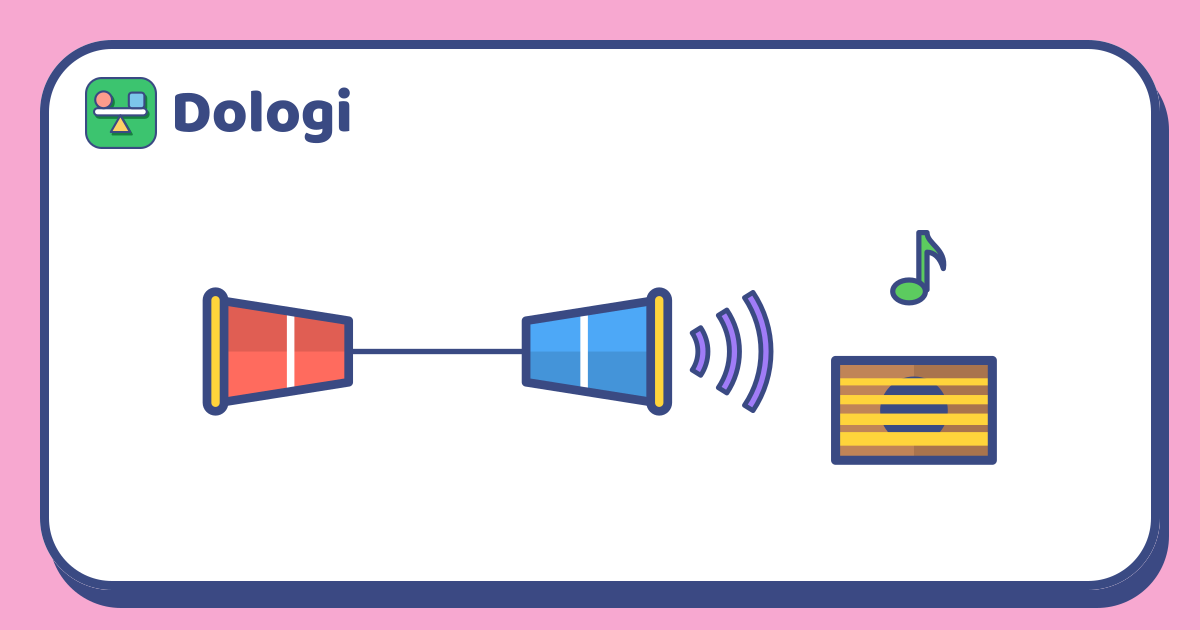
The voice makes the bottom of the cup vibrate, the cup pulls the string so it vibrates too, the string passes the vibration to the other cup, and that cup makes the air vibrate all the way to the listener's ear.
| What to try | Question to ask first |
|---|---|
| Tight string and slack string | Which one is easier to hear? |
| Someone pinches the middle of the string | Will the sound still get through? |
| Yarn and garden twine | Which string carries the sound better? |
With a slack or pinched string, you can hardly hear anything: the vibration can't get through.
Water glass music
Guess first: "A glass with lots of water and one with a little: which sounds higher when you tap it?"
Line up three or four matching glasses and pour a different amount of water into each, from a little to a lot. Tap the side of each glass gently with a spoon. The more water in the glass, the lower the sound, because the water makes the glass vibrate more slowly.
Once your child can hear the difference, keep playing:
- One person taps while the other closes their eyes and guesses which glass it was.
- Add or pour off water until the four glasses go up in four steps from low to high, then tap out a short tune of your own.
- If your child says "more water makes it louder", tap with the same force each time: "loud" and "high" are two different things.
Guess first, then test
Experiments work best when your child says what they think first. A wrong guess is fine; it's where you get to ask "why?"
- Give a reason. "I think the tight string will be clearer, because…"
- Test and listen carefully. Change only one thing at a time, such as tight or slack, and keep everything else the same.
- Compare with the guess. Right or not quite? How would they guess differently next time?
| Rough age | What to try |
|---|---|
| 4–6 | Feel the throat buzz, watch the rice jump, say "loud" or "quiet", "high" or "low" |
| 7–9 | The paper cup phone with a tight and a slack string; fill in a chart of guesses and results |
| 10–12 | Ask their own question about the glasses or rubber bands, design the tests and explain the results with the idea of vibration |
These ages are only a rough guide; every child is different.
In Dologi, the Listening topic has a puzzle called "Which instrument?": your child hears a sound and picks the instrument that made it, noticing whether it rings on or stops short. After your experiments, they'll know that each of those sounds also comes from something vibrating.
In short
- Sound is made when something vibrates: a throat, a rubber band, cling film, the side of a glass.
- Vibration travels through the air or along a tight string until it reaches someone's ear.
- A wider vibration makes a louder sound; a tighter or thinner band, or a glass with less water, makes a higher one.
- Before each try, let your child guess and give a reason, then test and compare with the guess.
Read more: Homemade instruments from recycling: a drum, a shaker and a rubber band guitar and The sink-or-float experiment: guess first, then test.