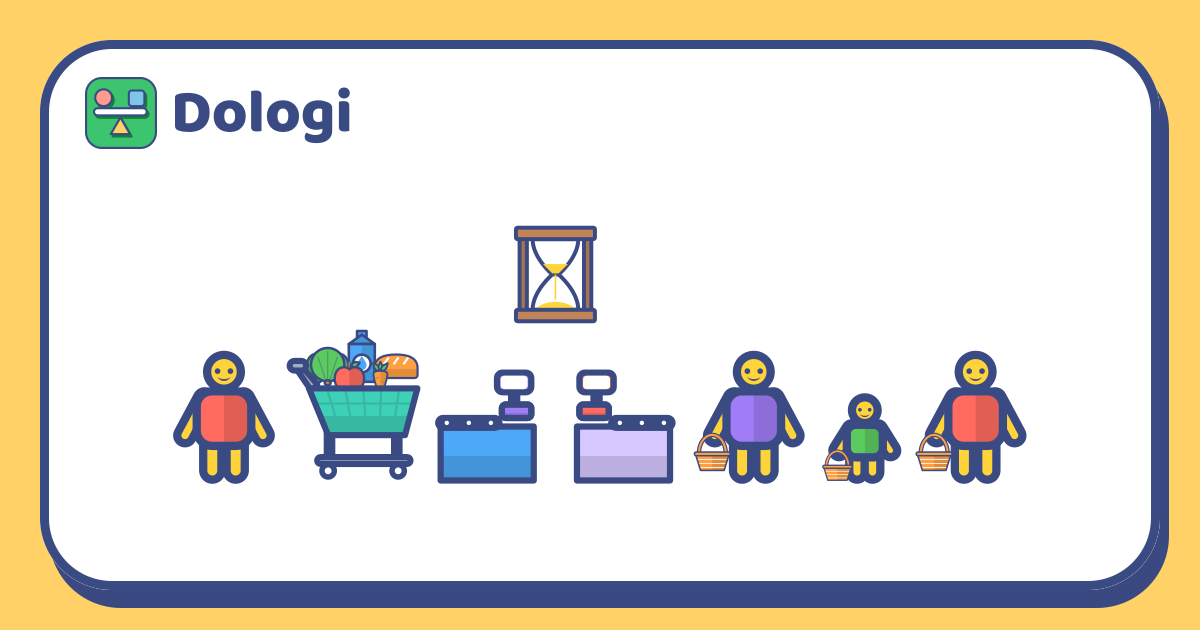
You reach the checkouts with a full cart and look at the lines. One has two people, another has five. Most of us pick quickly and then spend the next few minutes watching the "wrong" line move faster.
Next time, hand the decision to your child. Choosing a line is a small real-life puzzle: there are clues to collect, a prediction to make and, a few minutes later, an answer you can check. This article shows how to turn it into an estimation and reasoning game for children aged roughly 7 to 12, and how to talk it over afterwards so the next guess is a little better.
Why choosing a line is a good thinking puzzle
Picking a line looks simple, but it asks children to do several things at once:
- Estimate instead of counting everything: how many items are in that cart, roughly?
- Weigh more than one clue: fewer people is good, but not if one of them is buying a week's shopping.
- Make a prediction and say why, before knowing the answer.
- Check the result and work out what they missed.
The stakes are tiny, which is exactly what makes it useful. Being wrong costs a minute or two, and the answer arrives quickly, so children can test an idea and adjust it on the spot.
Look before you guess: what to notice
Before your child chooses, ask them to look at each line for a moment. A few clues are worth noticing:
| Clue | How to estimate it | Why it matters |
|---|---|---|
| Number of people | Count them, it only takes a second | Each person needs time to pay, even with one item |
| Items in each basket or cart | Count one small basket, then compare the others: "about the same", "twice as much", "a lot more" | More items take longer to scan and pack |
| How full the belt already is | Is it nearly empty or covered? | Shows how much is still waiting to be scanned |
| Whether someone is packing or paying right now | Watch the front of the line | The first person may be almost done or just starting |
Younger children can stick to the first two rows. Older ones can weigh all four and decide which matters most.
Make a prediction, then check it
Turn the choice into a small experiment:
- Predict and explain. Your child picks a line and gives a reason: "This one, because there are three people but they only have baskets."
- Pick a marker in the other line. Choose someone who joins the other line at about the same time as you, for example a person with a red bag. They are your comparison.
- Time it. Your child counts seconds quietly, or glances at a watch or clock when you join and when you reach the counter.
- Compare. Who got to the counter first, you or the person with the red bag? Was the prediction right?
Children aged about 9 and up can also guess the waiting time before it starts: "I think we'll be there in about four minutes." Then they compare the guess with what really happened. Getting close counts as a good estimate. It doesn't need to be exact.
When the shorter line is slower
The most interesting moments are when the prediction is wrong. Back home or in the car, talk about why. Some common reasons:
- One person had a very full cart, so a short line still had many items.
- Someone paid with coins and needed change, or an item needed its price checked.
- A customer had a question for the cashier.
- The other line had more people, but each person only had a few things.
Keep the talk about the situation, not about the people in it. "That cart had a lot of shopping" is a fair observation. Commenting on a stranger in a way they could hear is not. Everyone takes longer sometimes.
Learn from it for next time
The point is not to win every time, but to guess a little better each time. After each trip, ask: "What will you look at next time?"
Some children like to keep a short list of their own rules of thumb, such as "count the items, not just the people" or "check how full the belt is". Each new trip is a chance to test whether a rule holds.
You can make the game harder as your child grows:
- Around 7 to 8: count the people in each line and compare basket sizes ("big", "small").
- Around 9 to 10: estimate the items in each line and add them up roughly.
- Around 11 to 12: build a simple model. "Suppose each item takes a couple of seconds and paying takes about half a minute. Which line should be faster?" Then check whether the model matches what happened, and adjust the guesses if it doesn't.
That last step is real reasoning: making an assumption, using it to predict, and changing it when the evidence says otherwise.
Keep it relaxed
This game works best on calm shopping trips. If the store is crowded, everyone is tired or you are in a hurry, just pick a line and skip it. Avoid switching lines back and forth to "win", and remind your child to count and guess quietly. A whispered "I told you this one was faster" is plenty of celebration.
If your child enjoys estimating and checking, the Math topic in Dologi has short puzzles on counting, comparing amounts and measuring, a calm way to practice the same habit of guessing first and then checking.
In short
- Choosing a checkout line is a quick real-life puzzle in estimating, comparing clues and predicting.
- Ask your child to look at the number of people, the items in each basket and how full the belt is before choosing.
- Turn the choice into an experiment: predict with a reason, pick a marker in the other line, time it and compare.
- When the guess is wrong, talk about why and what to notice next time, and keep comments about other shoppers kind.
Read more: Teaching children to estimate: guess first, then count to check, Making a hypothesis: teaching children to guess with a reason, then test it, Thinking games for car rides, lines and waiting for food