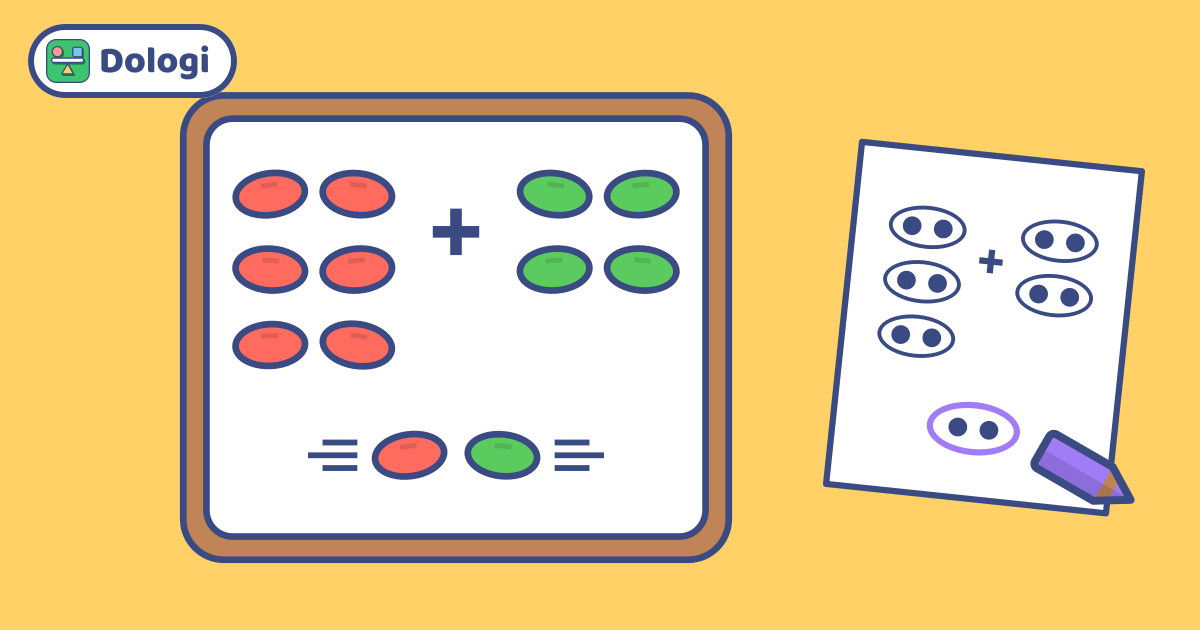
Your child adds 3 + 5, 7 + 9, 11 + 13 and announces: "Odd plus odd is always even!" Great noticing. But here's a fair question to ask back: "How do you know it works for numbers you haven't tried?" There are infinitely many odd numbers. Trying twenty, or two hundred, can't cover them all.
The way mathematicians answer that question is a proof: an explanation of why something must be true, every time. Kids aged 9 to 12 can build real, honest proofs with a bowl of dried beans. This article shows how.
Trying examples vs. showing why
Testing examples is useful. It's how you find a counterexample that knocks a statement down, and how you start to believe a pattern. But a pile of examples that work is still only a pile of examples.
A proof is different: it finds something that stays the same no matter which number you pick. Once your child sees that, they don't need to try more numbers. They can say "it has to be."
Even and odd, with beans
Start by making the words visible. Grab a handful of beans and lay them out in two columns, side by side, like pairs of shoes.
- If every bean has a partner, the number is even.
- If one bean is left over, the number is odd.
Try a few handfuls. Ask: "Can an odd number ever have two beans left over?" No: two leftovers would just make another pair. An odd number always has exactly one left over, however big it is. That sentence is the key to the first proof.
Proof 1: odd plus odd is always even
Lay out 7 beans (three pairs and one extra) and 5 beans (two pairs and one extra). Now push the two groups together. The pairs stay pairs. The two extras slide together and become a new pair. Nothing is left over, so the total is even.
Then ask the question that turns this into a proof: "Would it work with 99 beans and 57 beans?" Your child doesn't need to count them. Every odd number is "some pairs plus one," so any two odd numbers bring exactly two extras, and two extras always make a pair.
Have your child predict the other cases before trying them:
| Sum | What happens to the leftovers | Always |
|---|---|---|
| Even + even | No leftovers at all | Even |
| Odd + odd | Two leftovers make a pair | Even |
| Odd + even | One leftover stays alone | Odd |
From beans to a drawing to words
Proofs grow in three stages. Don't rush to the last one.
- Objects. Move real beans. Your child shows the proof with their hands.
- A drawing. Dots on paper, a loop around each pair, and the two leftover dots circled together. The drawing doesn't depend on the exact number: you can draw "a lot of pairs" with three dots and an ellipsis.
- Words. "Every odd number is some pairs plus one more. When you add two odd numbers, the two extra ones make another pair, so nothing is left over. That's why the answer is even."
The words will be clumsy at first. That's fine. Ask your child to explain it to someone who wasn't there, like a grandparent or a younger sibling. Explaining it again makes it clearer.
Proof 2: three numbers in a row
Pick three numbers in a row, like 4, 5 and 6. Add them: 15. Try 9, 10, 11: 30. Try 20, 21, 22: 63. All multiples of 3. Why?
Make three piles of beans: 4, 5 and 6. Take one bean from the biggest pile and put it on the smallest. Now all three piles have 5. So the total is 3 × 5, three equal piles of the middle number.
Does it work every time? The biggest number is always one more than the middle, and the smallest is always one less. So moving one bean always evens them out, and the total is always 3 times the middle number. Check with 20, 21, 22: 3 × 21 = 63.
For a challenge, ask: "What about four numbers in a row? Is the total ever a multiple of 4?" Let your child try with beans. They'll find that after evening out the piles, there are always two beans left over, so the answer is never a multiple of 4. (1 + 2 + 3 + 4 = 10; 5 + 6 + 7 + 8 = 26.)
A bonus for 11- and 12-year-olds: odd numbers make squares
Add odd numbers in order: 1, then 1 + 3 = 4, then 1 + 3 + 5 = 9, then 1 + 3 + 5 + 7 = 16. Squares! With beans, put down 1 bean. Add 3 beans in an L around it: a 2-by-2 square. Add 5 in a bigger L: 3 by 3. Each new L needs two more beans than the last one, because it goes along two sides of the square and around the corner. That's why the next odd number always fits.
How to help without giving it away
- Ask "Would it still work for 101?" more than "Is that right?"
- Ask "What stays the same, however big the number gets?"
- If an idea doesn't work, celebrate it: you've found a counterexample, which is useful too.
The Math topic in Dologi has a puzzle called Fruit numbers: each kind of fruit stands for a number, and your child works out which number goes where the question mark is. Ask them to explain why it has to be that number, not just that it looks right. It's the same habit as a bean proof.
In short
- Many examples that work still aren't a proof; a proof shows why something holds for every number.
- Even means everything pairs up; odd means exactly one is left over. Two leftovers always make a pair, so odd plus odd is even.
- Three numbers in a row are three equal piles once you move one bean, so their total is always 3 times the middle number.
- Go from objects to a drawing to words, and ask "Would it work for 101?"
Read more: Always, sometimes or never true? Teaching kids to find a counterexample, Factors and multiples with rectangles for 10 to 12 year olds