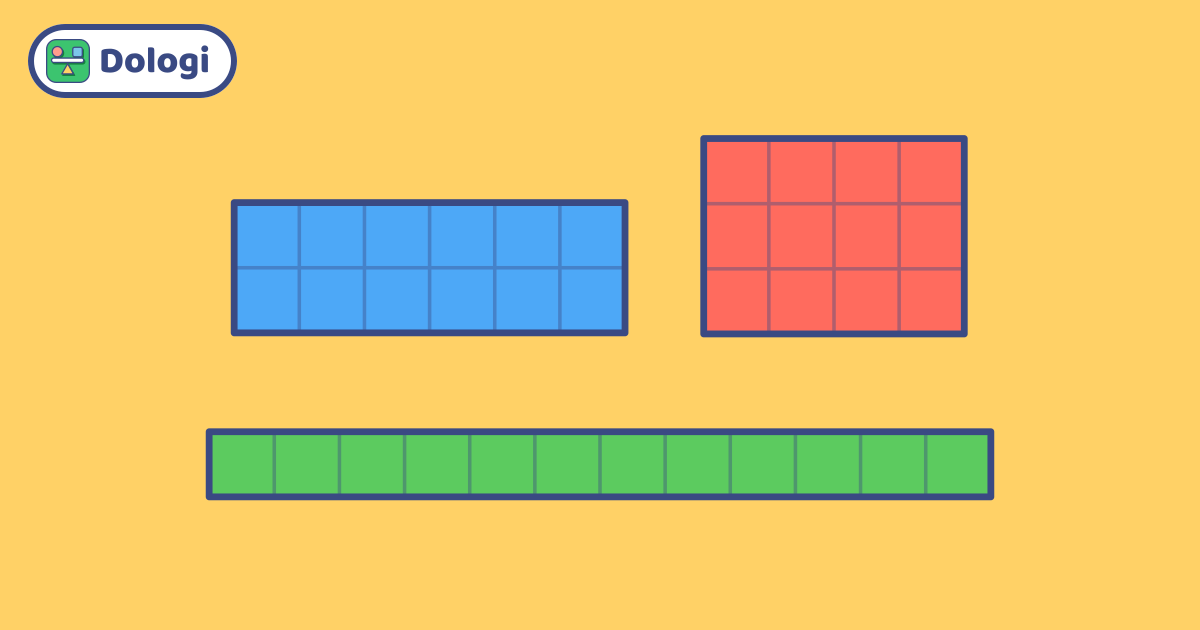
Give your child 12 square tiles (or 12 sugar cubes, or 12 bottle caps) and ask: "How many different solid rectangles can you make, with no gaps and nothing left over?" Most 10 to 12 year olds find one or two and stop. Finding them all is the same as finding the factors of 12, and it is the clearest way into factors, multiples and prime numbers.
Twelve tiles, three rectangles
With 12 tiles there are three rectangles (turning one on its side does not count as new):
- 1 × 12: one long row.
- 2 × 6: two rows of six.
- 3 × 4: three rows of four.
What about rows of 5? Two rows make 10, with 2 left over: no rectangle. So 5 is not a factor of 12.
List every side length: 1, 2, 3, 4, 6, 12. Those are the factors of 12. Each rectangle gives a pair of factors, and each pair multiplies to 12: 1 × 12, 2 × 6, 3 × 4.
Multiples: stretch the rectangle
Now go the other way. Start with a row of 3 tiles and keep adding rows of 3: 3, 6, 9, 12, 15, 18... Every one of those numbers makes a rectangle with a side of 3, so they are the multiples of 3.
Factors and multiples are two ways of looking at the same picture: 3 is a factor of 12, so 12 is a multiple of 3. A line that sticks: a factor is a side, a multiple is the whole rectangle.
Numbers that only make one row
Try 7 tiles: only 1 × 7 works. The same goes for 13. Numbers greater than 1 that only make a single row are prime numbers: they have exactly two factors, 1 and themselves.
The primes up to 30 are 2, 3, 5, 7, 11, 13, 17, 19, 23 and 29. A child who finds them with tiles or on grid paper remembers them better than one who learns the list.
And 1? A single tile has only one factor, so 1 is not a prime number.
Numbers that make a square
With 9 tiles: 1 × 9 and 3 × 3. With 16: 1 × 16, 2 × 8 and 4 × 4. When the rectangle is a square, the pair of factors is the same number twice, so these numbers have an odd number of factors: 9 has 3, 16 has 5, 36 has 9. They are the square numbers.
A game: hunt for the record
Challenge your child: which number from 1 to 30 makes the most rectangles? Each player picks a number and draws every rectangle on grid paper; whoever has more wins. This table lets you check:
| Tiles | Rectangles | Factors |
|---|---|---|
| 7 | 1 × 7 | 1, 7 |
| 9 | 1 × 9, 3 × 3 | 1, 3, 9 |
| 12 | 1 × 12, 2 × 6, 3 × 4 | 1, 2, 3, 4, 6, 12 |
| 16 | 1 × 16, 2 × 8, 4 × 4 | 1, 2, 4, 8, 16 |
| 24 | 1 × 24, 2 × 12, 3 × 8, 4 × 6 | 1, 2, 3, 4, 6, 8, 12, 24 |
| 30 | 1 × 30, 2 × 15, 3 × 10, 5 × 6 | 1, 2, 3, 5, 6, 10, 15, 30 |
The record up to 30 is shared by 24 and 30, with four rectangles each. To beat it you have to go up to 36: five rectangles, including the 6 × 6 square.
Greatest common factor: tile a floor with the biggest squares
A rectangular patio is 12 squares by 18 squares. You want to cover it with equal square slabs, as big as possible, without cutting any. 2 × 2 slabs fit, 3 × 3 slabs fit, and 6 × 6 slabs are the biggest that fit: exactly 6 of them. The side of the slab has to be a factor of both 12 and 18, and 6 is their greatest common factor.
Least common multiple: two paper strips and two gears
Cut lots of paper strips 3 squares long and 4 squares long, and lay them end to end in two rows. The first row grows 3, 6, 9, 12... The second grows 4, 8, 12... The first time both rows are the same length is at 12, the least common multiple of 3 and 4.
Gears tell the same story. A gear with 4 teeth meshes with a gear with 6 teeth, and one tooth on each is marked where they touch. The two marks meet again after 12 teeth have gone by: the small gear has turned 3 times and the big one 2 times. 12 is the least common multiple of 4 and 6.
Common mix-ups
| Your child thinks | Actually | How to help |
|---|---|---|
| 24 is a factor of 12 | 24 is a multiple of 12; a factor is never bigger than the number | A factor is a side, a multiple is the stretched rectangle |
| 1 is a prime number | 1 has only one factor | One tile makes only one shape |
| Even numbers can't be prime | 2 is prime | 2 tiles only make one row |
| Bigger numbers have more factors | 31 has 2 factors, 24 has 8 | Try building both |
| Forgetting 1 and the number itself | Every number has these two | The single long row always works |
How it is written
In English-speaking schools you will see the GCF (greatest common factor, in the US) or HCF (highest common factor, in the UK and elsewhere), and the LCM (least common multiple): GCF(12, 18) = 6 and LCM(3, 4) = 12. Children often meet factors and multiples in the upper elementary years, and the GCF and LCM a little later. A child who has already built the rectangles, tiled the patio and turned the gears sees the abbreviations as shorthand for something they have already seen.
The Math topic in Dologi has a puzzle called Count the turns: "How many turns does the question mark gear make?" The number on each gear is how many teeth it has, and touching gears move the same number of teeth, so your child multiplies and divides to find the turns. Just like the 4-tooth and 6-tooth gears above, this is where factors and multiples show up in real machines.
In short
- Arrange a number of tiles into every possible rectangle: the side lengths are the factors.
- Stretch a row one row at a time: you get the multiples.
- Only one row possible: a prime number. A square possible: an odd number of factors.
- The biggest square slab that covers the floor is the greatest common factor; the first time two strips match is the least common multiple.
Read next: Roll two dice, draw a rectangle, Times tables: should children memorize them or understand them first?