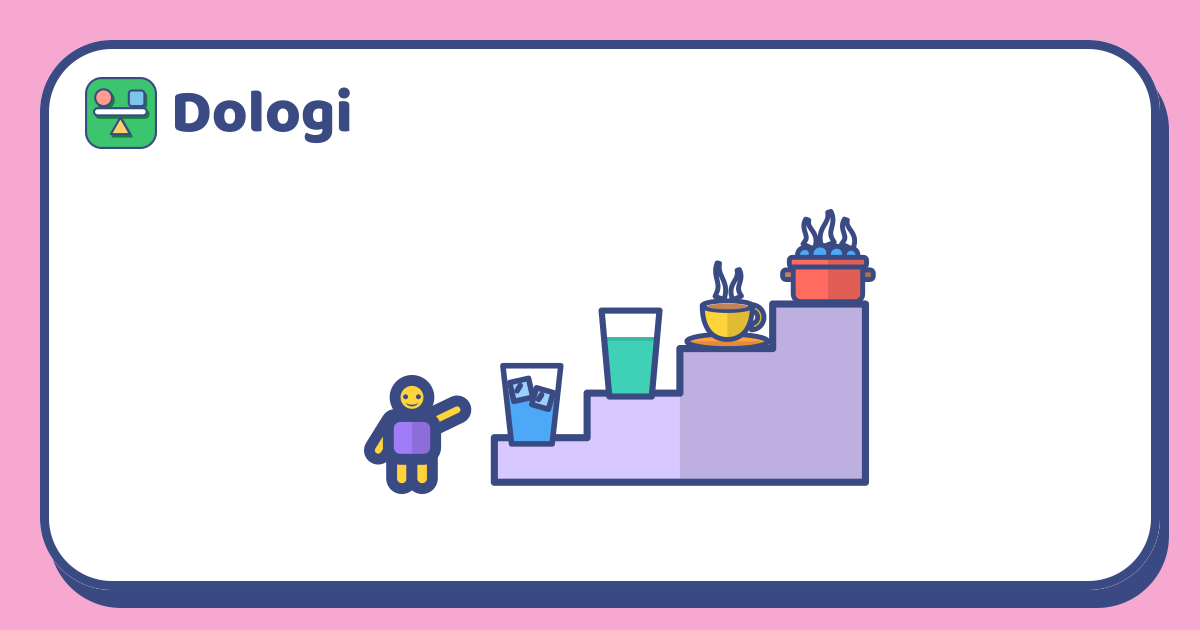
"This is the best day ever." "That was the worst film in the world." "I'm starving!" Children often reach for the strongest word they know, or for the same handy word every time: everything is "good", "bad", "big" or "awful". Usually they are not exaggerating on purpose. They simply have one word where adults have five.
A word ladder is a quick way to add those missing steps. You write words that mean nearly the same thing but differ in strength, and your child arranges them from mild to strong. This article shows how to make one at home, which word families work well, how to handle the friendly arguments that follow, and how to use the ladder in everyday conversations. It suits children of roughly 6 to 10.
Why words come in steps
Many words belong to small families that share a meaning but not a strength. Cool, cold and freezing are all about low temperature. Pleased, happy and overjoyed are all about feeling good. Damp, wet and soaked are all about water on your clothes. Choosing the right step tells the listener much more than the meaning alone.
That matters in real life. "My knee hurts a little" and "my knee hurts a lot" lead to very different reactions from an adult. "I'm a bit annoyed" invites a short chat, while "I'm furious" signals that something big has happened. A child who can pick the right step is easier to understand and is understood more fairly.
It is also a thinking skill. Putting words in order is the same kind of work as lining up sticks from shortest to longest: compare two things, decide which comes first, then fit the next one in. The difference is that here your child compares meanings, which is harder because you cannot hold them side by side. Saying the reason out loud is what makes the comparison visible.
Make a word ladder at home
You need a few cards or strips of paper, a pen, and a ladder or staircase drawn on a large sheet. A real staircase at home works too, with one card on each step.
- Pick one word family. Temperature is a good start, because your child already knows what each step feels like: cold, cool, warm, hot, boiling.
- Write one word per card. For a child who is not reading yet, draw a small picture next to each word and read the cards aloud together.
- Shuffle and arrange. Your child places the cards from mildest at the bottom to strongest at the top.
- Ask for a reason. "Why does warm go below hot?" "Is there anything between cool and cold?" Listen to the explanation rather than marking it right or wrong.
- Make a sentence for each step. "The bath is warm. The soup is hot. The water in the pot is boiling, so only grown-ups touch it."
For temperature, you can also check the lower steps with your hands: a glass of ice water, a glass of tap water, a bowl of warm (not hot) water. Keep hot and boiling as words only.
Here are word families that work well on a ladder:
| Meaning | From mild to strong |
|---|---|
| Cold | cool, cold, freezing |
| Hot | warm, hot, boiling |
| Small | small, tiny, minuscule |
| Big | big, huge, enormous |
| Happy | pleased, happy, delighted, overjoyed |
| Tired | sleepy, tired, worn out, exhausted |
| Wet | damp, wet, soaked |
| Cross | annoyed, cross, angry, furious |
When your child disagrees with you
Sooner or later someone says, "No, enormous is bigger than huge!" and someone else says the opposite. That is a good moment, not a problem. For words that are close in strength, there is often no single correct order, and dictionaries do not settle it either. What counts is the reason.
- Allow ties. Two cards can share a step if your child can say why they feel the same.
- Look for a missing step. "Is there a word between happy and overjoyed?" Finding delighted is a small victory.
- Spot the stranger. Slip in a card that looks related but is not on the same ladder, like spicy among the temperature words. Spicy food can be cold, so it belongs to a different ladder.
- Adjust to age. Around 6 or 7, three cards with clear gaps are plenty. From about 8, many children enjoy five or six close words and building ladders of their own for friends to solve. Every child is different, so follow your child's interest.
Using the ladder in everyday life
The game is most useful when the ladder leaves the table and turns up in ordinary conversations.
- Feelings. When your child is upset, ask, "Are you annoyed, or really angry?" Pointing to a step can be easier than finding words. Then you can respond to the size of the feeling your child actually has.
- Aches and pains. "Does it hurt a little, or a lot?" helps your child tell adults clearly what is going on.
- "Worst day ever." Ask gently, "Worst ever, or just a bad afternoon? Where would it go on the ladder?" The aim is not to brush the feeling aside, but to give your child more ways to describe it.
- Your own words. Let your child hear you use the steps: "I'm a bit tired, not exhausted." Children copy the language they hear around them.
In Dologi, the Listening topic includes "Sound stairs" puzzles: your child listens to sound cards and places them on the stairs from the lowest sound to the highest. It uses the same idea of putting things in order step by step, this time with the ears instead of with words.
In short
- Many words come in families with the same meaning but a different strength, and children often use only the strongest one.
- Make a word ladder with cards: arrange from mild to strong, give a reason, and make a sentence for each step.
- When there is disagreement, look for the reason, allow ties, and search for missing steps.
- Bring the ladder into daily life for feelings, aches and pains and "worst day ever" moments, and use the steps yourself.
Read more: High is not the same as loud: helping your child tell pitch, volume and length of sounds apart, Analogies for children, Teaching children to measure