"What is 1 + 2 + 3 + ... all the way to 100?" Most children start adding one number at a time: 1, 3, 6, 10, 15... After a few minutes they lose their place or make a slip somewhere around 40. There is a much faster way, and the nice part is that a child aged roughly 8 to 12 can discover it, not just memorize it.
This article shows you how to set it up with a handful of dried beans or building blocks, which questions to ask instead of giving the answer away, and what to try once your child has the idea.
A famous story, probably polished over time
There is a well-known anecdote about a mathematician who, as a schoolboy, was told to add up the numbers from 1 to 100 and handed in the answer within moments. Versions of the story differ, and nobody knows exactly what happened, so treat it as a story rather than a fact.
It still makes a good opening line: "Someone once did this in less than a minute. How do you think they did it?" Children enjoy a challenge that sounds impossible, and it gives them a reason to look for a shortcut.
Start small: a staircase from 1 to 10
Don't start with 100. Start with 1 to 10, which your child can check by hand.
- With beans or blocks, build a staircase: a column of 1, then 2, then 3, and so on up to 10.
- Ask: "How many beans are there altogether?" Let your child count or add however they like. The answer is 55.
- Build a second staircase exactly like the first, in a different color if you can.
Counting 55 beans is fine. The point of this step is that your child knows the answer for sure before looking for a faster way.
Two staircases make a rectangle
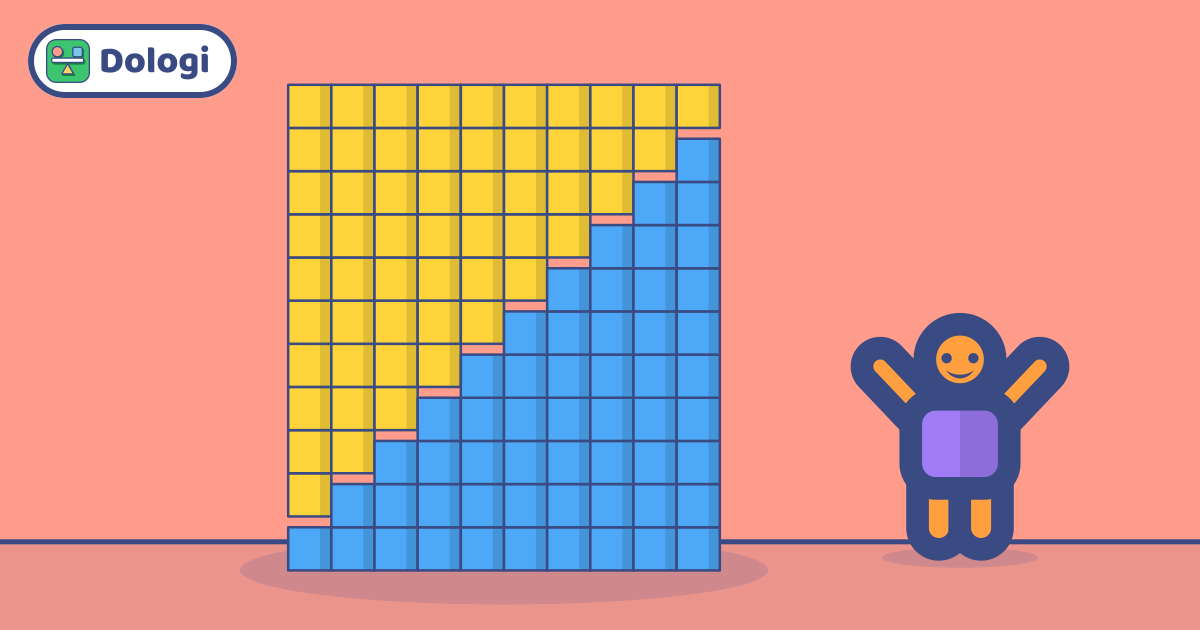
Now the key move. Ask your child to turn the second staircase upside down and fit it onto the first. The column of 1 sits on the column of 10, the 2 on the 9, the 3 on the 8, and so on.
Every column is now 11 tall, and there are 10 columns. The two staircases together make a rectangle of 10 × 11 = 110 beans. One staircase is half of that: 110 ÷ 2 = 55. That's the same answer your child counted.
Questions to ask, one at a time, with plenty of waiting in between:
- "Why is every column the same height?" (Because each time one side goes down by 1, the other goes up by 1.)
- "How many columns are there?"
- "So how many beans in the rectangle? And in one staircase?"
If your child spots that 1 + 10, 2 + 9, 3 + 8 all make 11, they have found the whole trick.
From 1 to 100: pair the first and the last
On paper, write 1 to 100 in a row, and the same numbers backwards underneath: 100, 99, 98... Each pair adds up to 101: 1 + 100, 2 + 99, 3 + 98.
- There are 100 pairs of 101, which makes 10,100.
- That counts every number twice (it's the two staircases), so halve it: 5,050.
Another way children often find: pair the numbers within one row. 1 + 100, 2 + 99, and so on up to 50 + 51 gives 50 pairs of 101, which is 5,050 again. Both ways are right. Ask your child which one feels easier to explain.
Try it on other sums
Once the idea clicks, give your child a few new sums and let them choose a method. Check the answers together.
| Sum | One way to see it | Answer |
|---|---|---|
| 1 to 20 | 20 × 21 ÷ 2 | 210 |
| 1 to 9 | 9 × 10 ÷ 2, or the pairs 1 + 9 to 4 + 6 with 5 left over | 45 |
| 2 + 4 + 6 + ... + 100 | 25 pairs of 102 (2 + 100, 4 + 98...) | 2,550 |
| 1 + 3 + 5 + ... + 99 | 25 pairs of 100 (1 + 99, 3 + 97...) | 2,500 |
| 11 to 20 | 5 pairs of 31 | 155 |
Two details are worth a chat. First, with 1 to 9 there's a number in the middle with no partner, the 5, and children need to decide what to do with it. Second, the even and odd sums add up to 2,550 + 2,500 = 5,050: every number from 1 to 100 is either even or odd, so of course they do. Older children like spotting checks like that.
For a bonus pattern, add up the odd numbers from the start: 1, then 1 + 3 = 4, then 1 + 3 + 5 = 9, then 16. With beans, each new odd number wraps around a growing square like an L shape. That's why the odd numbers to 99, the first 50 of them, add up to 50 × 50 = 2,500.
Let your child do the discovering
The trick is easy to tell and easy to forget. Finding it takes longer but sticks much better. A few habits help:
- Ask, then wait. "Is there a faster way than adding one by one?" Count to ten in your head before giving a hint.
- Give the smallest hint that works. "What do 1 and 10 make? What about 2 and 9?" is usually enough.
- Ask your child to explain it back. "How would you explain this to a friend?" If they can teach it with the beans, they understand it.
- Praise the method, not the speed. "You noticed every column was the same height" is more useful than "You're so fast."
Spotting that each column of a staircase is one more than the last is a pattern question. In Dologi's Patterns topic, More and fewer puzzles show a row of pictures that grows or shrinks by the same amount each time, and your child works out how many more or fewer come next. It is the same habit of looking at how a pattern changes from one step to the next.
In short
- Start with a staircase from 1 to 10 in beans or blocks, and let your child find the answer, 55, by counting.
- Two identical staircases, one turned upside down, make a rectangle: half of 10 × 11 is 55.
- For 1 to 100, pair the first and last numbers: 50 pairs of 101 make 5,050.
- Ask questions and wait instead of explaining the trick, and let your child explain it back in their own words.
Read more: Patterns in numbers: odd and even, counting in twos and skip counting, Two-digit mental math: split the tens, round to a friendly number, add and subtract fast