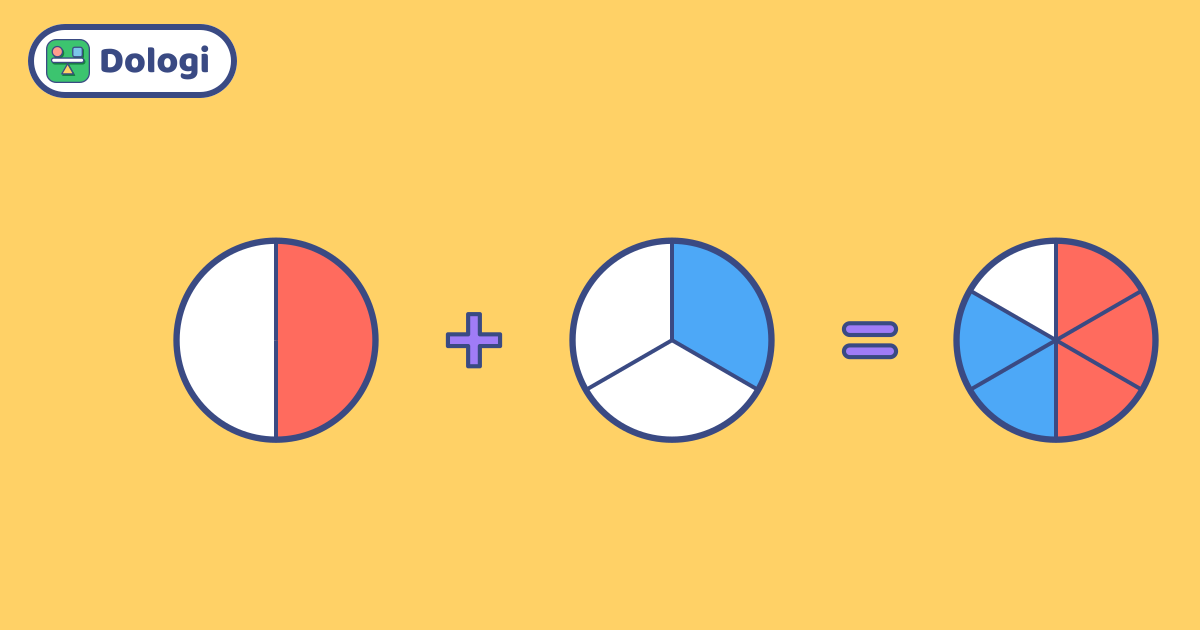
Your child adds fractions and writes: 1/2 + 1/3 = 2/5. It's a very natural thing to do: add the top numbers, add the bottom numbers, just like adding ordinary numbers. But the answer is wrong, and it's wrong in a way your child can see for themselves once they understand what a fraction is. This article helps children aged 9 to 12 see why it's wrong, add correctly with paper pies, and check themselves by estimating.
Seeing the mistake for yourself
Ask your child: "Half a pie, plus another piece. Is that more or less than half?" More, of course. Yet 2/5 is less than 1/2. That answer can't be right.
An even clearer example: adding top to top and bottom to bottom, 1/2 + 1/2 = 2/4, and 2/4 is exactly one half. Half a pie plus half a pie, and you still only have half a pie? Your child will laugh, and that's when they're ready to hear how it really works.
Cut paper pies
- Draw three equal circles on card and cut them out as three "pies."
- Cut the first into two equal pieces and the second into three equal pieces.
- Take one half and one third and lay them on top of the third, uncut pie.
Your child sees straight away: the covered part is more than half but doesn't cover the whole pie. The answer has to be between one half and one whole.
Cut into equal pieces before adding
The problem is that the half and the third are different sizes, so you can't just count "one piece and one piece makes two pieces." Everything has to be cut into equal pieces first.
- Cut the third pie into six equal pieces.
- The half covers exactly 3 sixths. The third covers exactly 2 sixths.
- Together: 3 sixths plus 2 sixths is 5 sixths.
Written down: 1/2 + 1/3 = 3/6 + 2/6 = 5/6. At school this is called finding a common denominator.
A way to help your child remember: the bottom number is the "name" of the piece (halves, thirds, sixths). You can only add pieces with the same name. Once they share a name, add the number of pieces (the top number) and keep the name (the bottom number).
Estimate before calculating
Before finding a common denominator, have your child guess roughly what the answer will be:
- Bigger than each fraction being added. 1/2 + 1/3 has to be more than 1/2.
- Compare with a half and with a whole. If both pieces are less than a half, the total is less than a whole pie; if one piece is a half or more, the total is a half or more.
After calculating, compare with the guess. 5/6 is more than 1/2 and less than 1, exactly what your child saw with the paper pies.
Practice from easy to harder
| Sum | Cut into | Answer | Adding top and bottom gives |
|---|---|---|---|
| 1/4 + 1/4 | already quarters | 2/4 = 1/2 | 2/8 = 1/4, only as much as one of the pieces |
| 1/2 + 1/4 | quarters: 2/4 + 1/4 | 3/4 | 2/6 = 1/3 |
| 2/3 + 1/6 | sixths: 4/6 + 1/6 | 5/6 | 3/9 = 1/3 |
| 1/3 + 1/4 | twelfths: 4/12 + 3/12 | 7/12 | 2/7 |
The last column shows your child that the wrong method never gives an answer bigger than the largest fraction being added, while the right total must be bigger. That's why estimating is the fastest way to catch the mistake.
By age
- Age 9: add fractions with the same denominator using paper pies, saying it out loud: "one quarter plus one quarter is two quarters."
- Age 10: different denominators where one divides into the other (1/2 + 1/4, 2/3 + 1/6), so only one pie needs cutting smaller.
- Ages 11–12: completely different denominators (1/3 + 1/4), finding a common denominator, and always estimating first.
The Math topic in Dologi has a puzzle called Equal parts: "Tap every shape that is exactly half colored." Recognizing equal parts is the first step to understanding why only same-sized pieces can be added.
In short
- 1/2 + 1/3 = 2/5 is wrong, because half plus another piece must be more than half, and 2/5 is less.
- Paper pies: a half and a third cover more than half the pie but not the whole of it.
- Cut into equal pieces (sixths) before adding: 3/6 + 2/6 = 5/6.
- The bottom number is the piece's name: only add pieces with the same name, and always estimate before and compare after.
Read more: Teaching fractions to children: start by sharing a cake, Rushed math mistakes: building the habit of checking, Equivalent fractions and comparing fractions