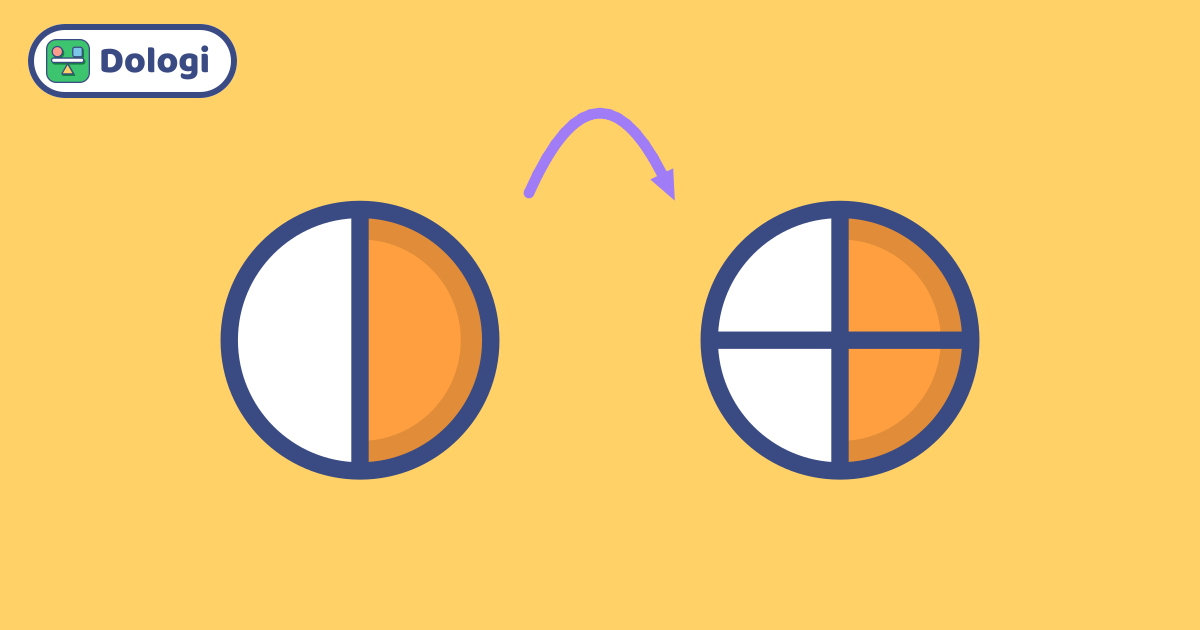
After a while with fractions, two questions often trip children up: "Which is bigger, 1/2 or 2/4?" and "Which is bigger, 1/3 or 1/4?" Many children say 2/4 is bigger "because it has a 4," and 1/4 is bigger "because 4 is more than 3." Both are wrong. This article is for children aged 8 to 11 and uses paper and cake so your child can see fractions before learning the rules.
Folding paper: one half, two quarters, four eighths
- Take a long strip of paper. Fold it in half, open it and shade one part: that's one half (1/2).
- Fold it back, then fold it in half again. Open it: the strip now has 4 equal parts, and the shaded area covers 2 of them. That's two quarters (2/4).
- Fold once more: 8 parts, with the shading covering 4, four eighths (4/8).
The shaded area never changed; the folds just cut it into more, smaller pieces. So 1/2 = 2/4 = 4/8. These are equivalent fractions.
Sharing a cake: the same amount of cake
Two cakes of the same size: one cut in half, one cut into four. Take one piece of the first cake and two pieces of the second. Put them side by side: the same amount. Ask your child: "One person has 1 big piece, another has 2 small pieces. Who has more?" This question helps your child separate the number of pieces from the amount of cake.
The pattern: cutting every piece into smaller pieces
Look back at the strip: each time it's folded in half, the number of parts in the strip doubles, and so does the number of shaded parts. That's the rule from the textbook:
- Multiply the numerator and denominator by the same number to get an equivalent fraction: 2/3 = 4/6 = 6/9.
- Divide both by the same number to simplify: 6/9 = 2/3.
A way to say it that sticks: "Cut every piece into 2 smaller pieces and you have twice as many pieces, but the same amount of cake."
A fraction wall
Cut several paper strips of the same length and stick them in rows: one whole, one cut into 2, one into 3, one into 4, one into 6, one into 8. Your child lays a ruler down vertically to compare:
| Strip | Each part is | Same as |
|---|---|---|
| Cut into 2 | 1/2 | 2/4, 3/6, 4/8 |
| Cut into 3 | 1/3 | 2/6 |
| Cut into 4 | 1/4 | 2/8 |
The wall makes it obvious: the more parts, the smaller each part. 1/3 is longer than 1/4.
Four ways to compare fractions
1. Same denominator: same size pieces, so compare the number of pieces. 3/8 < 5/8.
2. Same numerator: same number of pieces, so compare the size of the pieces. 1/3 > 1/4, because sharing a cake among 3 people gives bigger pieces than sharing among 4.
3. Compare with one half: 3/8 is less than a half (half of 8 is 4), 5/8 is more. 4/7 is more than a half, because half of 7 is 3.5. The "one half" benchmark makes many comparisons quick.
4. Look at what's missing: which is bigger, 2/3 or 3/4? 2/3 is 1/3 short of a whole cake, 3/4 is only 1/4 short. Less missing means bigger, so 3/4 > 2/3. Check with the rule: 2/3 = 8/12 and 3/4 = 9/12. In the same way, 5/6 > 4/5.
Common mistakes
| Your child thinks | Actually | How to help |
|---|---|---|
| 1/4 is bigger than 1/3 because 4 > 3 | 1/3 is bigger | Share a cake among 3 and among 4 |
| 2/4 is bigger than 1/2 because it has a 4 | They're equal | Fold a paper strip |
| 2/3 equals 3/4 because each is one piece short | 3/4 is bigger | A quarter is smaller than a third |
Reading and writing fractions
In English, 1/2 is read "one half," 2/4 "two quarters" (or "two fourths" in many American schools), 3/8 "three eighths": the numerator first, then the denominator. When writing, the numerator goes above the line and the denominator below. Have your child read each fraction aloud when comparing: saying "quarters" and "thirds" reminds them it's about the size of the pieces.
The Math topic in Dologi has a puzzle called Equal parts: "Tap every shape that is exactly half colored." The shapes are split into different numbers of parts, and your child has to spot which ones are exactly half colored, whatever the number of parts: exactly the idea that one half equals two quarters.
In short
- Fold paper strips to see 1/2 = 2/4 = 4/8: the shaded part stays the same, it's just cut finer.
- Multiplying or dividing the numerator and denominator by the same number gives an equivalent fraction.
- A fraction wall shows that the more parts there are, the smaller each one is.
- To compare: same denominator, same numerator, compare with one half, and look at what's missing.
Read more: Teaching fractions to children: start by sharing a cake, Is sharing equally the same as sharing fairly?