Try this at the dinner table: "All cats have tails. My neighbor's pet has a tail. So my neighbor's pet is a cat. Right?" Many children say yes straight away. Both sentences are true, and the ending sounds sensible. But the pet could just as easily be a dog.
Reasoning from two sentences to a conclusion turns up everywhere: in word problems, in science, in arguments between brothers and sisters. This article shows a simple tool for children aged roughly 8 to 12: three small words (all, some, none) and two circles drawn on paper to check whether a conclusion really follows.
Three small words, three drawings
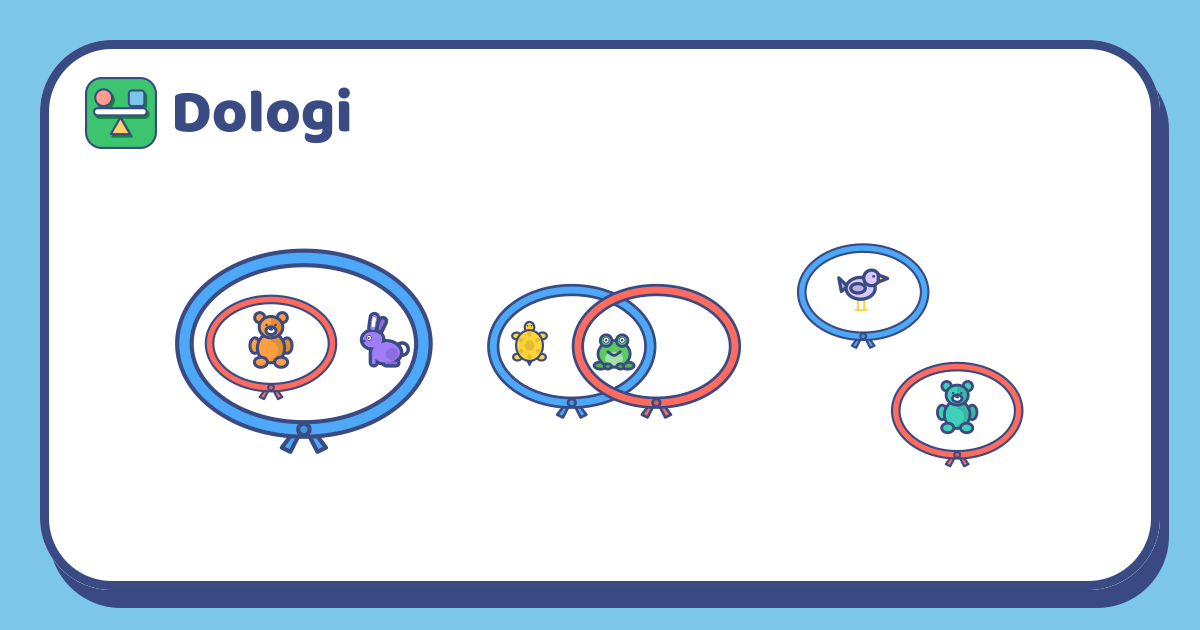
Each sentence built on "all", "some" or "none" can be drawn as two circles. Each circle holds one group.
| Sentence | Drawing | What it tells you |
|---|---|---|
| All cats have tails. | The "cats" circle sits completely inside the "has a tail" circle | Every cat is in the tail circle, but there is room for other animals with tails |
| Some pets are fish. | The "pets" circle and the "fish" circle overlap | At least one thing is in both circles |
| No fish have fur. | The "fish" circle and the "has fur" circle are apart | Nothing is in both circles |
One point is worth saying out loud to older children. In everyday speech, "some" often hints "but not all". In puzzles, "some" only means "at least one". "Some pets are fish" doesn't tell you anything about the pets that aren't mentioned.
Check a pair of sentences, step by step
To test a conclusion, draw both sentences in one picture, then ask a single question: Is there any way to draw this where the conclusion is false? If there is, the conclusion doesn't follow.
- Draw the first sentence.
- Add the second sentence to the same drawing. Use a dot for one particular thing, like "Tom" or "my neighbor's pet".
- Look at the conclusion. Must it be true in your drawing, or could you draw it differently and make it false?
Three examples to try together:
- All cats have tails. Tom is a cat. So Tom has a tail. Tom's dot is in the cat circle, and the cat circle is inside the tail circle. The dot has nowhere else to go. This follows.
- All cats have tails. My neighbor's pet has a tail. So it's a cat. The dot must be in the tail circle, but it can sit in the part outside the cat circle. This doesn't follow. One example is enough to show it: a dog.
- All birds have feathers. No cats have feathers. So no cats are birds. The bird circle is inside the feather circle, and the cat circle is apart from the feather circle, so it is also apart from the bird circle. This follows.
The most common slip: turning a sentence round
The cat-and-tail mistake comes from flipping a sentence: "all cats have tails" quietly becomes "everything with a tail is a cat". Ask your child to test which sentences survive being turned round.
| Sentence | Turned round | Still true? |
|---|---|---|
| All squares have four sides. | Everything with four sides is a square. | No: a long rectangle has four sides |
| No fish have fur. | Nothing with fur is a fish. | Yes |
| Some pets are fish. | Some fish are pets. | Yes |
| All bananas are fruit. | All fruit are bananas. | No: an apple is fruit |
The drawings explain the pattern. Two circles that are apart stay apart whichever one you name first. An overlap is shared by both circles. But a circle inside another is not the same the other way round: the small one is inside the big one, never the reverse.
Another slip worth a moment: "Not all birds can fly" is not the same as "No birds can fly". The first only says that at least one bird can't fly.
Games: make pairs and catch hasty conclusions
- Does it follow? Say two sentences and a conclusion. Your child answers "follows" or "doesn't follow". If it doesn't, they give one example that breaks it.
- Loops on the floor. Lay two loops of yarn or string on the floor and use soft toys as the things being sorted. Place the loops inside each other, overlapping or apart to match each sentence. This suits children at the younger end of the range.
- Made-up words. "All zibbles are blue. This stone is blue. Is it a zibble?" With invented words, your child can't lean on what they already know and has to use the circles.
- True or just follows? "All dragons can swim. Pip is a dragon. So Pip can swim." The conclusion follows, even though dragons aren't real. Older children enjoy seeing that "follows" and "true" are different questions.
- Your child sets the puzzle. Let them invent a pair for you, and now and then give a hasty answer on purpose so they can catch you.
As a rough guide, children around 8 or 9 manage well with loops, toys and familiar facts. Around 10 to 12 many can work on paper, handle made-up words and spot the "not all" trap. Every child is different, so follow your child's pace.
In Dologi, the Logic topic has "Two rings" puzzles: two overlapping rings, each with its own label. Things that fit both labels go in the middle, and things that fit neither stay outside, which is the same picture your child draws to check a pair of sentences.
In short
- "All", "some" and "none" each have a drawing: one circle inside the other, overlapping, or apart.
- To check a conclusion, ask whether there is any way to draw the two sentences where it is false.
- "All" can't be turned round safely; "some" and "none" can.
- Made-up words and silly sentences help children reason from the sentences, not from what they already know.
Read more: If… then…: teaching children to reason through everyday moments, Groups inside groups: sorting animals, food and everyday things with children