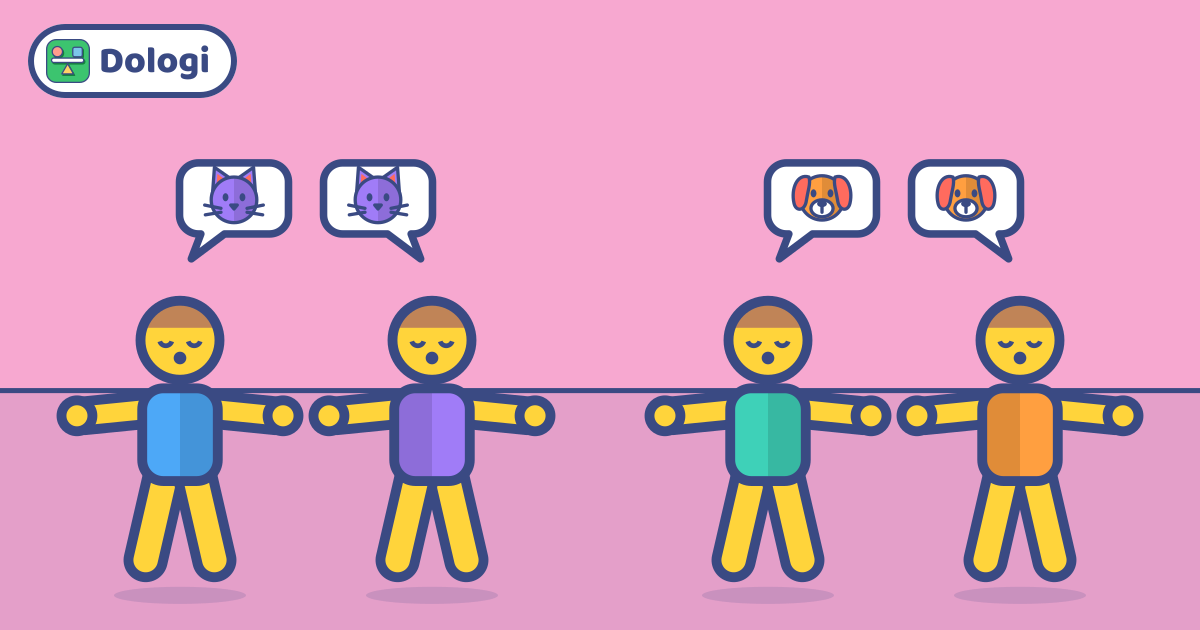
Birthday party, playdate or recess with a big group and no plan? The animal sounds game only needs a few hand-drawn cards: everyone secretly gets an animal, the whole group closes their eyes, and they walk slowly making their animal's sound until they find everyone else making the same one. The room fills with woofs, meows and cock-a-doodle-doos, and a lot of laughing.
This post is for groups of about 6 to 20 kids aged roughly 4 to 10. It covers setup, rules, keeping kids safe with their eyes closed, why the game builds listening skills, and versions for older kids.
Getting ready
- Animal cards: draw an animal on each slip of paper, two to four cards per animal depending on group size. For 12 kids: four animals, three cards each.
- Pick animals with sounds that are easy to tell apart: dog, cat, rooster, duck, cow, sheep.
- Space: a lawn, a big room or a gym, cleared of chairs and anything kids could trip on.
- Grown-ups: one or two adults stand around the edges as "spotters."
| Animal | Sound |
|---|---|
| Dog | Woof woof |
| Cat | Meow |
| Rooster | Cock-a-doodle-doo |
| Duck | Quack quack |
| Cow | Moo |
| Sheep | Baa |
How to play
- Hand out the cards face down. Each kid peeks at theirs, tells no one, and hands it back to an adult.
- The group spreads out and everyone closes their eyes.
- On "Go!", everyone walks very slowly while making their animal's sound.
- When you hear your sound, move toward it, hold hands with that person, and keep looking together for the rest of your group.
- When a group thinks it's complete, everyone in it sits down, eyes still closed.
- Once everyone is sitting, open your eyes. An adult checks each group: is it right? Is anyone in the wrong group?
Play a few rounds with different animals each time.
Keeping it safe with eyes closed
- Walk as slowly as a turtle. No running.
- Hold your hands out in front at chest height, palms open, like a bumper.
- Adults stand around the edges and gently turn kids away from walls and furniture.
- Young kids or anyone nervous about closing their eyes can keep their eyes open but look at the floor. The point is listening, not bravery.
- Blindfolds are only for older kids who are used to the game and want to try.
Why this game builds listening
- Picking out one sound among many: everyone's making noise at once, so your child has to tune out the rest to catch the sound that matches theirs. Hearing one voice in the noise has more games for this.
- Figuring out where a sound comes from: left or right, near or far. Kids steer by ear.
- Adjusting their own volume: if everyone shouts, no one can hear anyone. Kids often figure out on their own that they need to make their sound at a medium volume and pause to listen.
- Teamwork: once two kids find each other, they have to search for the rest together, guiding each other.
Versions for kids 7 to 10
- Clapping rhythms instead of sounds: each group gets a rhythm, like two claps and a pause, or clap, pause, clap. Much harder without voices.
- A word instead of an animal sound: each group gets a word from the same category, like "apple," "banana," "orange," "grape."
- Uneven groups: a group of two, a group of three, a group of four, and nobody knows how big their own group is. Kids have to decide when they're complete.
- Same sound, high or low: two groups both say "meow," but one uses a high voice and the other a low one. Ears have to work much harder.
Playing at home with just a few people
With only three or four people at home, switch to a matching game by ear: two people share a sound, or use shaker boxes with the same thing inside, as in shaker box pairs. One person closes their eyes while the others shake a box or make a sound from around the room, and the listener points to where each sound is coming from.
The Listening topic in Dologi has a puzzle called Sound pairs: "Find the pairs of cards that sound the same." It's the same skill of holding a sound in your head and finding its match, just like finding the friend who's making your animal's sound.
In short
- Everyone secretly gets an animal, closes their eyes, makes its sound and walks slowly to find others with the same sound.
- Walk slowly, hands out in front, adults spotting the edges; nervous kids can keep their eyes open and look down.
- The game builds picking out one sound among many, telling where sounds come from, and adjusting volume.
- Older kids can try clapping rhythms, words, uneven groups or high and low voices.
Read more: Blind man's buff: a listening game, Shaker box pairs