A chessboard isn't only for playing games. Its light and dark squares also make a great puzzle board: place pieces so none can capture another, send a knight to every square, find the shortest way from one corner to the other. These puzzles need no opponent, have no winner or loser, and take about ten minutes each. They suit kids roughly 7 to 12 who already know how the pieces move.
Here are four challenges. Each one starts on a small board before moving to a bigger one, so your child can spot the pattern before the board gets overwhelming. The answers are at the end, and every one of them has been double-checked by computer.
Getting ready: small boards, stand-in pieces and ten minutes
- Small boards: draw a 4 × 4 and a 5 × 5 grid on paper, with squares about the size of a quarter. You can also use one corner of a real chessboard and block off the rest with books.
- Stand-in pieces: bottle caps, buttons or coins with a sticky note showing which piece they are. Add a handful of dried beans to mark squares you've already visited.
- Square names: columns a, b, c… from left to right, rows 1, 2, 3… from bottom to top, so a1 is the bottom-left corner. Younger kids can just point instead of naming squares.
- Ten minutes at a time: if time runs out, snap a photo of the board and pick it up tomorrow. No racing the clock.
Challenge 1: The knight's tour
Rules: the knight moves in an L, just like in a game, and may land on each square only once. Every time the knight leaves a square, drop a bean on it.
- Warm-up on a 3 × 3 board: put the knight in a corner. How many squares can it visit? Is there a square it can never reach?
- A 4 × 4 board: start in a corner and try to visit all 16 squares.
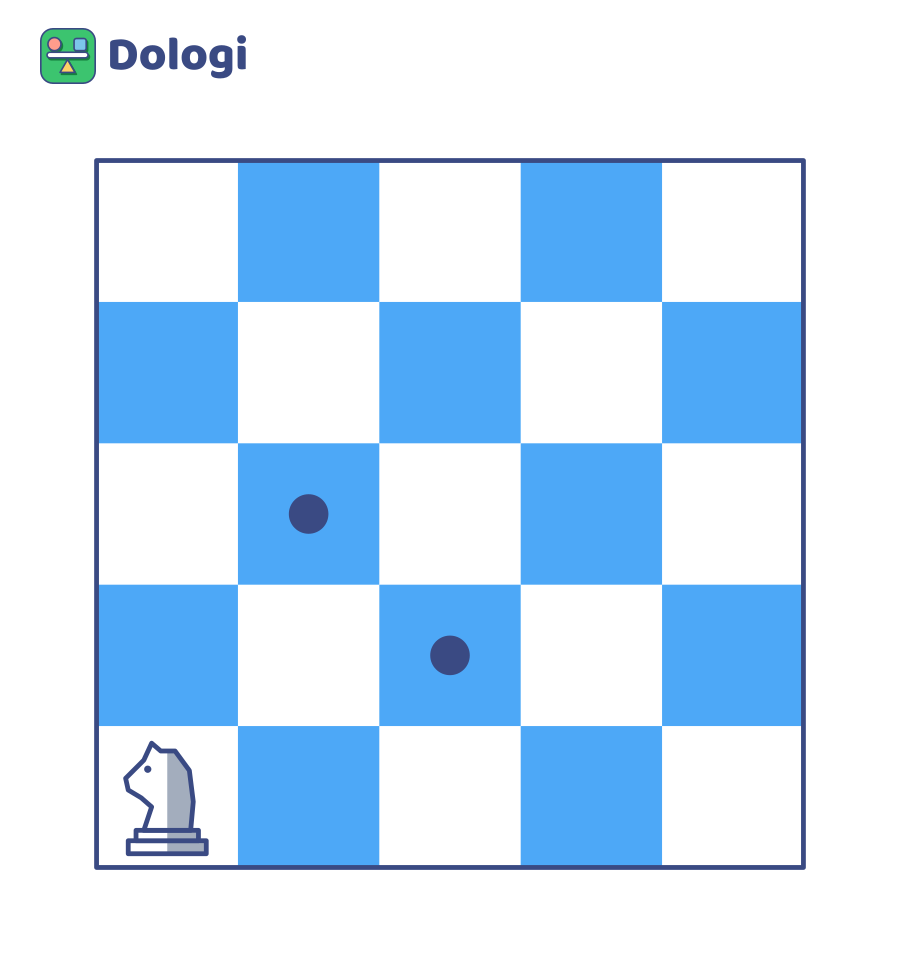
- A 5 × 5 board: the knight starts on a1, as in the picture. The two dots show its two possible first moves. Visit all 25 squares.
A hint if your child gets stuck: at each step, jump to the square that has the fewest ways out, and save the easy-to-reach squares for later. Corners and edge squares are usually the hard ones, so visit them early.
A question for older kids: what if the knight starts on b1 instead of a1? Something about knights and square colors in Knights jump in an L, bishops slide diagonally will help answer it.
Challenge 2: Queens that can't capture each other
Rules: a queen captures along rows, columns and diagonals, as far as she likes. Place the queens so that none of them stands in another's path.
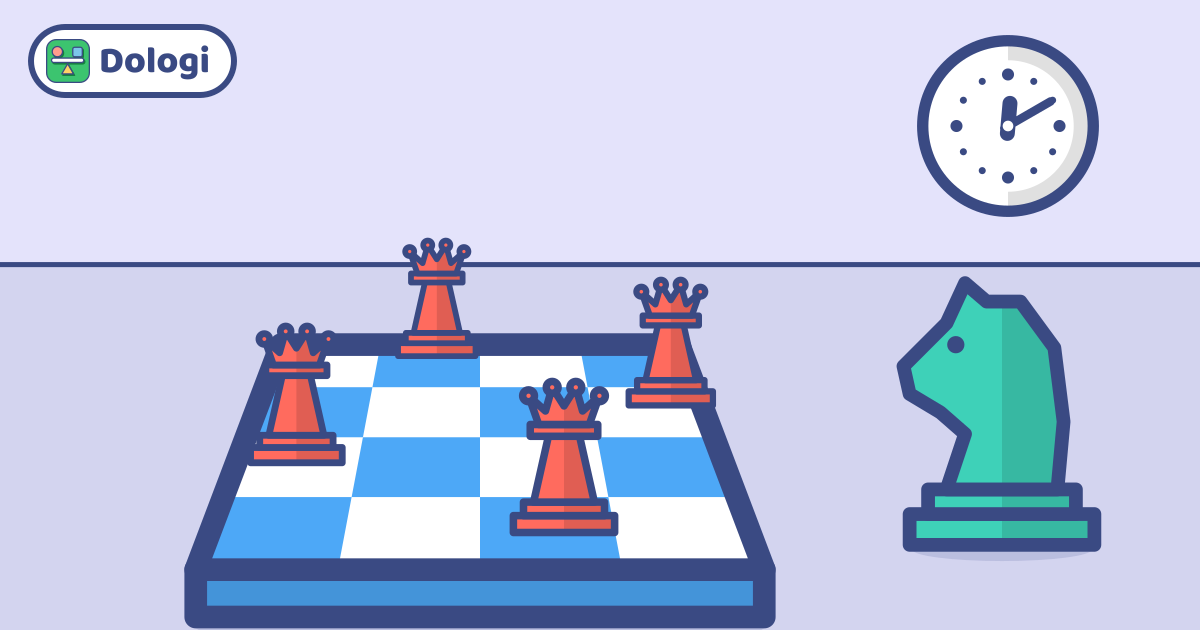
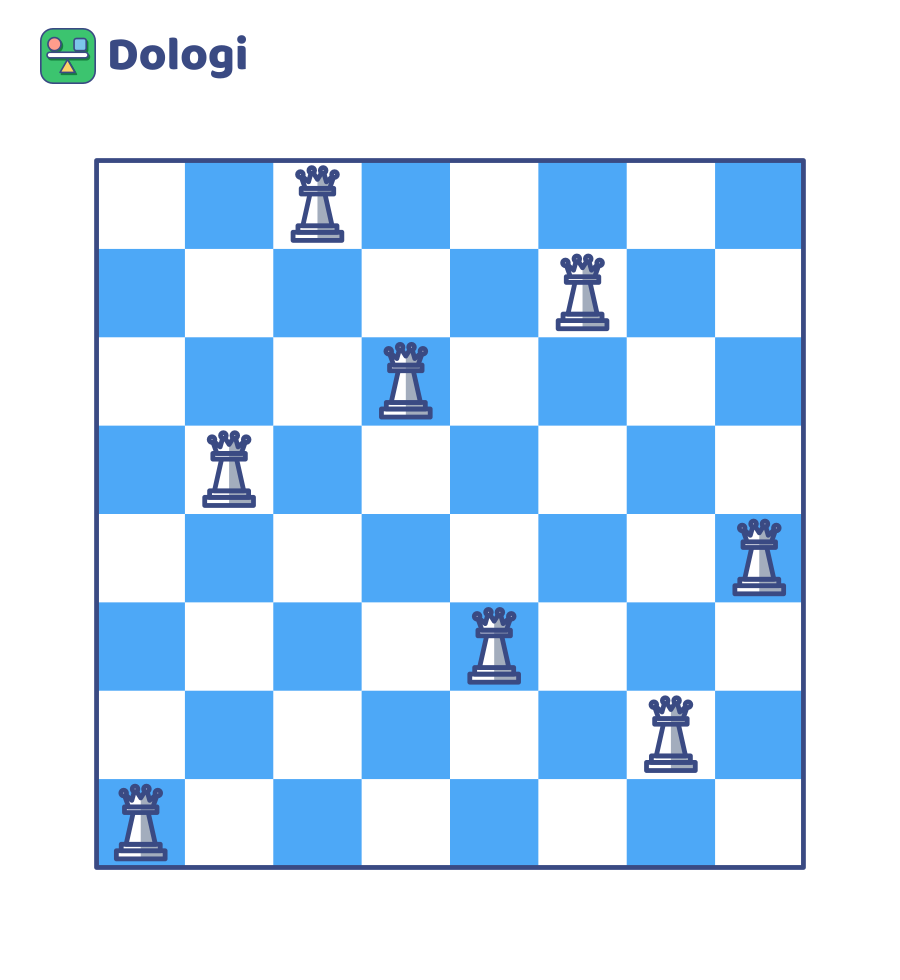
- Four queens on a 4 × 4 board. The cover picture of this post shows one answer, so keep it out of sight for now.
- Five queens on a 5 × 5 board.
- Eight queens on an 8 × 8 board, a famous puzzle among chess fans. This one can take a few sessions.
Hint: every row and every column holds exactly one queen. So place them one column at a time, left to right. When a column has no safe square, go back to the column before, move that queen to another square, and keep going. This "try, step back, try again" method is also how computers solve many puzzles.
Bonus questions: how many answers does the 4 × 4 board have? Does a bigger board always have more answers?
Challenge 3: A rook clears the pawns in the fewest moves
Rules: the pawns stay put. They don't move and don't capture. The rook moves along rows and columns like in a game and can't jump over pawns; landing on a pawn captures it. Count the fewest moves needed to capture them all.
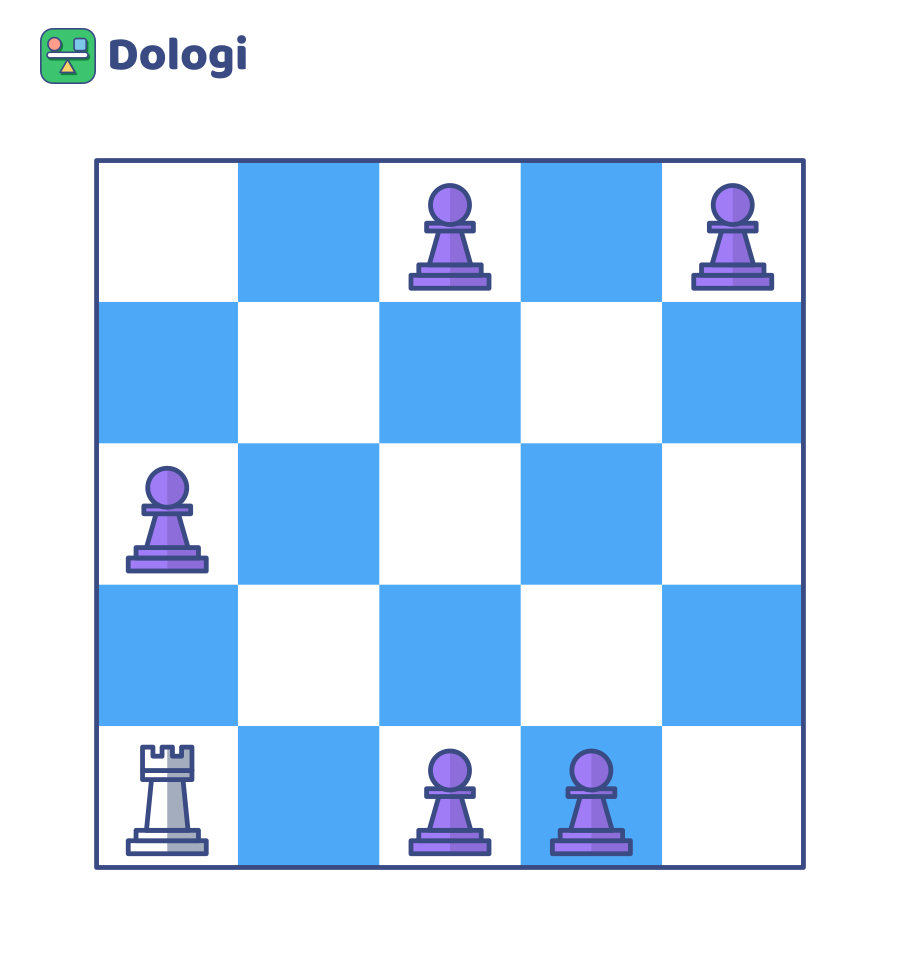
The rook is on a1, the pawns on a3, c1, d1, c5 and e5. Hint: grabbing the nearest pawn first isn't always fastest. Sometimes you need a move that captures nothing, just to get into the right row.
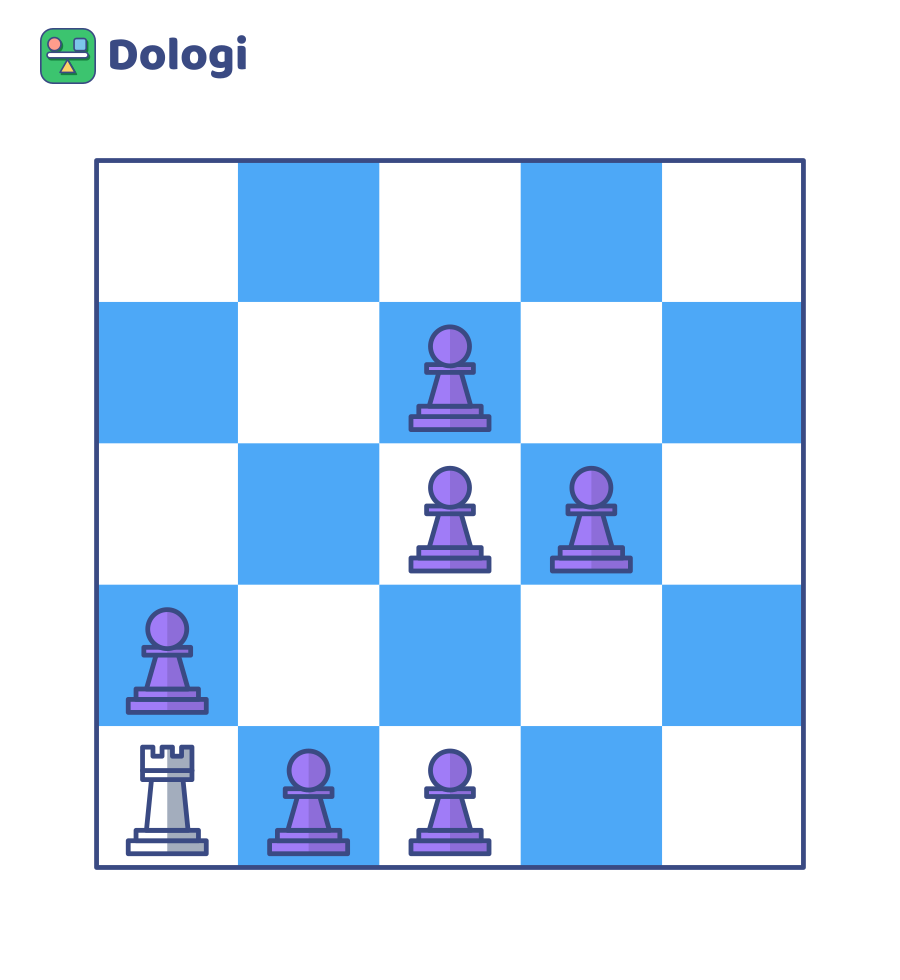
Harder: six pawns on a2, b1, c1, c3, c4 and d3. There's exactly one way to do it in the fewest moves.
Once it's solved, switch roles: your child sets up pawns for you. Whoever makes the puzzle has to find the answer first, which is good practice in itself.
Challenge 4: How many shortest routes does the king have?
The king moves one square in any direction. On a 5 × 5 board, the king starts on a1.
- What's the fewest number of moves to reach e5? How many shortest routes are there?
- Reaching e1 also takes 4 moves. But how many different routes are there this time? The picture shows one.
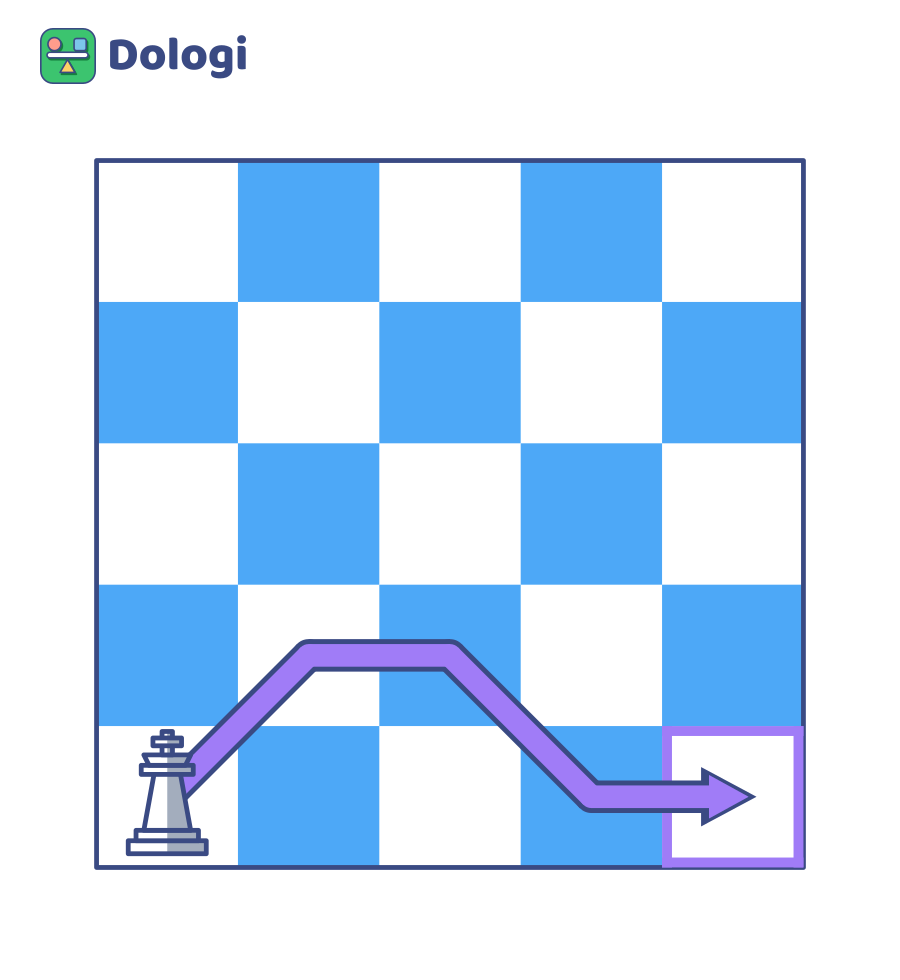
A way to count without missing any: write numbers in the squares. On a shortest route, the king has to move one column to the right on every move. So the number of routes to a square is the sum of the numbers in the three squares just to its left (diagonally up, straight across, diagonally down). Write 1 on a1, then fill in one column at a time.
For older kids: on an 8 × 8 board, how many 7-move routes take the king from a1 to h1?
Answers
Challenge 1. On a 3 × 3 board, the knight can visit 8 squares but never the center: from the center, every L-shaped move lands off the board. On a 4 × 4 board, there's no route through all 16 squares, wherever you start; from a corner, the best you can do is 15. On a 5 × 5 board, here's one route from a1 (the numbers show the order of the visits):
| a | b | c | d | e | |
|---|---|---|---|---|---|
| 5 | 25 | 18 | 3 | 12 | 23 |
| 4 | 8 | 13 | 24 | 17 | 4 |
| 3 | 19 | 2 | 7 | 22 | 11 |
| 2 | 14 | 9 | 20 | 5 | 16 |
| 1 | 1 | 6 | 15 | 10 | 21 |
Starting on b1 doesn't work. A knight changes square color on every move. A 5 × 5 board has 13 squares the same color as the corners and 12 of the other color, so a route through all 25 must start and end on the color with 13. The square b1 isn't the corner color. On the other hand, a full route exists from every square that is the corner color.
Challenge 2. The 4 × 4 board has exactly two answers, mirror images of each other: a2, b4, c1, d3 and a3, b1, c4, d2. On the 5 × 5 board, one answer is a1, b3, c5, d2, e4. On the 8 × 8 board, one answer is a1, b5, c8, d6, e3, f7, g2, h4. A bigger board doesn't always mean more answers: 5 × 5 has 10, 6 × 6 has only 4, and 8 × 8 has 92.
Challenge 3. At least 6 moves: capture a3, slide to d3 (no capture), then capture d1, c1, c5 and e5. Another 6-move route: capture a3, slide to e3, then capture e5, c5, c1 and d1. Taking c1 first means at least 7 moves. The harder one takes 7: capture a2, slide to d2 (no capture), then capture d3, c3, c4, c1 and b1. Taking b1 first means at least 8.
Challenge 4. To e5: 4 moves and only 1 route, diagonal all the way. To e1: 9 routes. Here's the number grid (squares you don't need are left blank):
| a | b | c | d | e | |
|---|---|---|---|---|---|
| 3 | 1 | ||||
| 2 | 1 | 2 | 5 | ||
| 1 | 1 | 1 | 2 | 4 | 9 |
e1 = d1 + d2 = 4 + 5 = 9. On an 8 × 8 board, there are 127 routes from a1 to h1.
In the Chess room in Dologi's Creative corner, The queen and The knight lessons in Learn chess include a practice round called "Take all the stars in as few moves as you can," the same kind of thinking as the rook challenge above. If your child wants to stump a friend, they can go to Set up a board, build a position with both kings, tap Make a challenge, pick a goal such as mate in 1, and tap Check it so the app confirms the puzzle can be solved. Saved puzzles can be sent as a file or with Show QR code for the other device to scan under Receive a challenge, and nothing goes to a server.
In short
- A chessboard works for solo puzzles too: the knight's tour, non-capturing queens, a rook clearing pawns, counting a king's routes.
- Start on 3 × 3, 4 × 4 and 5 × 5 boards before moving up to 8 × 8; small boards help kids see the pattern.
- About ten minutes at a time; if it's not done, take a photo and come back to it, with no racing.
- When your child is stuck, hint at a way of thinking (hard squares first, step back once, write numbers in squares) instead of reading out the answer.
Read more: 10 easy chess puzzles for kids who are just starting, with hints and answers, Knights jump in an L, bishops slide diagonally: how chess builds spatial thinking in kids