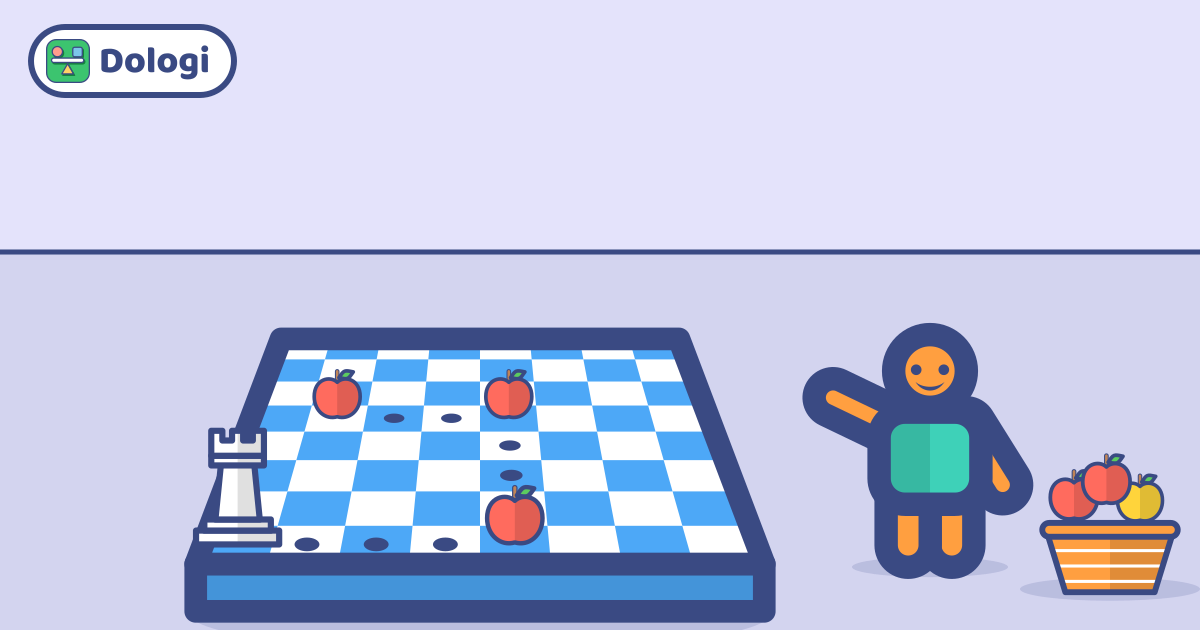
Your child can tell you that rooks go straight, bishops go diagonally and knights jump in an L. But in a real game, every piece can move and every piece can be taken, and it all gets confusing fast. Before full games, there's a small game that suits kids around 5 to 7 really well: one of their pieces, a few of the other side's pieces that stand still, and one question: what's the fewest moves to capture them all?
It helps your child get each piece's move down solid, see paths across the board, and start planning ahead: which one first, which one next? The ten puzzles below were written by Dologi and go from easy to a bit harder. Every position was checked by a computer to make sure the smallest number of moves in the answers is correct.
The rules of the game
- Only White moves. The white pieces belong to your child. The purple pieces are the other side, and they stand still like apples on a table. They don't run and they don't capture back.
- Every piece moves the way it normally does. Rooks and bishops can't jump over other pieces: if something is in the way, capture it first or go around. Knights can jump.
- Every move counts as one, whether it captures or not. When your child has two white pieces, moving either one counts as a move.
- Count the fewest moves. Capturing everything is great. Capturing everything in the fewest moves is the real puzzle. If two different paths are equally short, both are right.
How to solve them together
- Set them up on a real board if you have one. No purple pieces? Use small apple slices, bottle caps or dry beans. Here's a rule kids love: every apple slice you capture, you get to eat.
- Point before moving. Let your child put a finger on the piece, trace the path and count out loud, "one, two…". If a move doesn't work, ask "Can that piece really move like that?" instead of correcting right away.
- Hints in steps. Stuck? Read hint 1. Still stuck? Read hint 2. The answers are at the end.
- Two or three puzzles at a time is plenty. Stop right after a win so your child wants to come back.
In the diagrams, the bottom row is White's side and the bottom left square is a1. Square names (the letter is the column, the number is the row) are there so you can check the answers; your child doesn't need them yet.
Group 1: The rook
A rook moves in a straight line along a row or a column, as far as it likes, as long as nothing is in the way.
Puzzle 1
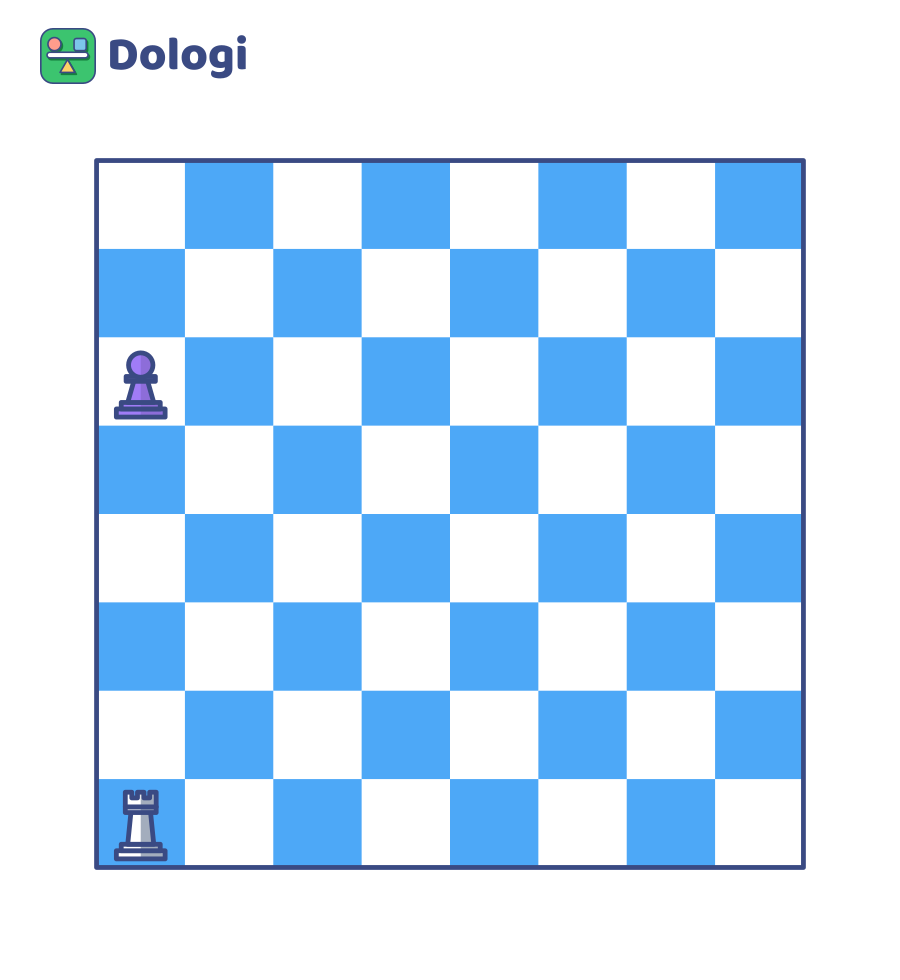
Capture the purple piece in the fewest moves.
- Hint 1: Which ways can a rook move?
- Hint 2: Look straight up the rook's column.
Puzzle 2
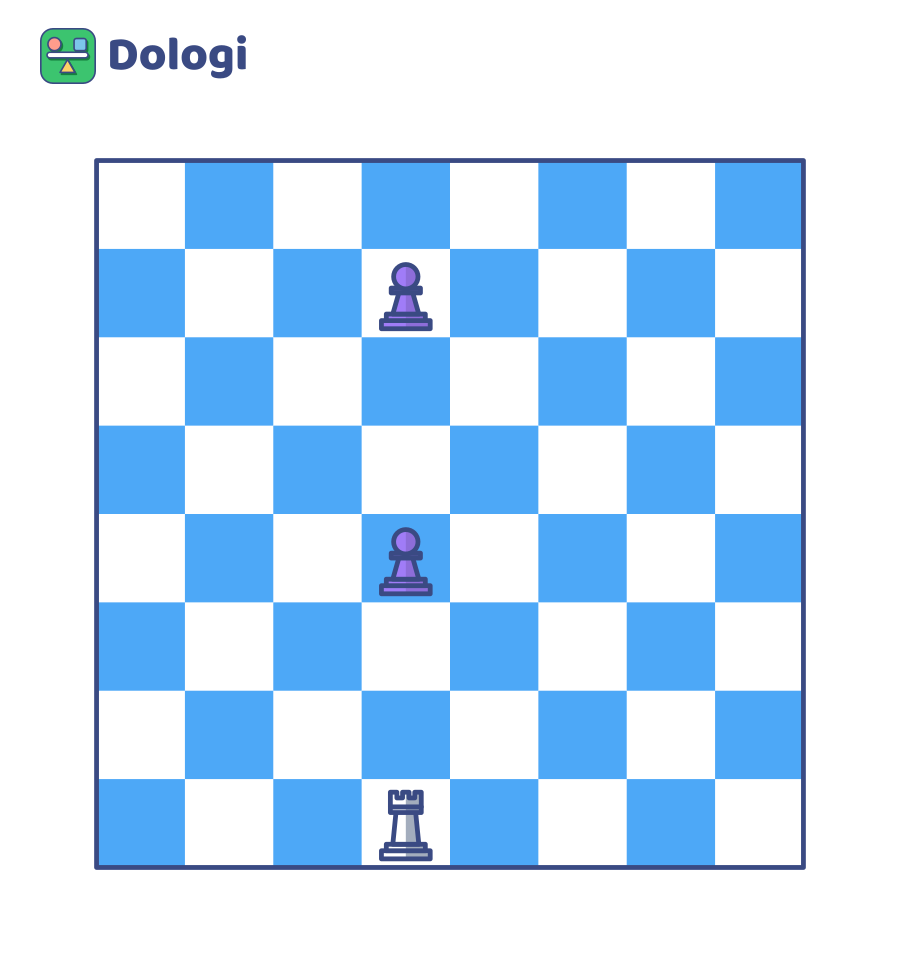
Capture both purple pieces in the fewest moves.
- Hint 1: Can the rook jump over the pawn in the middle?
- Hint 2: Which one has to go first?
Puzzle 3
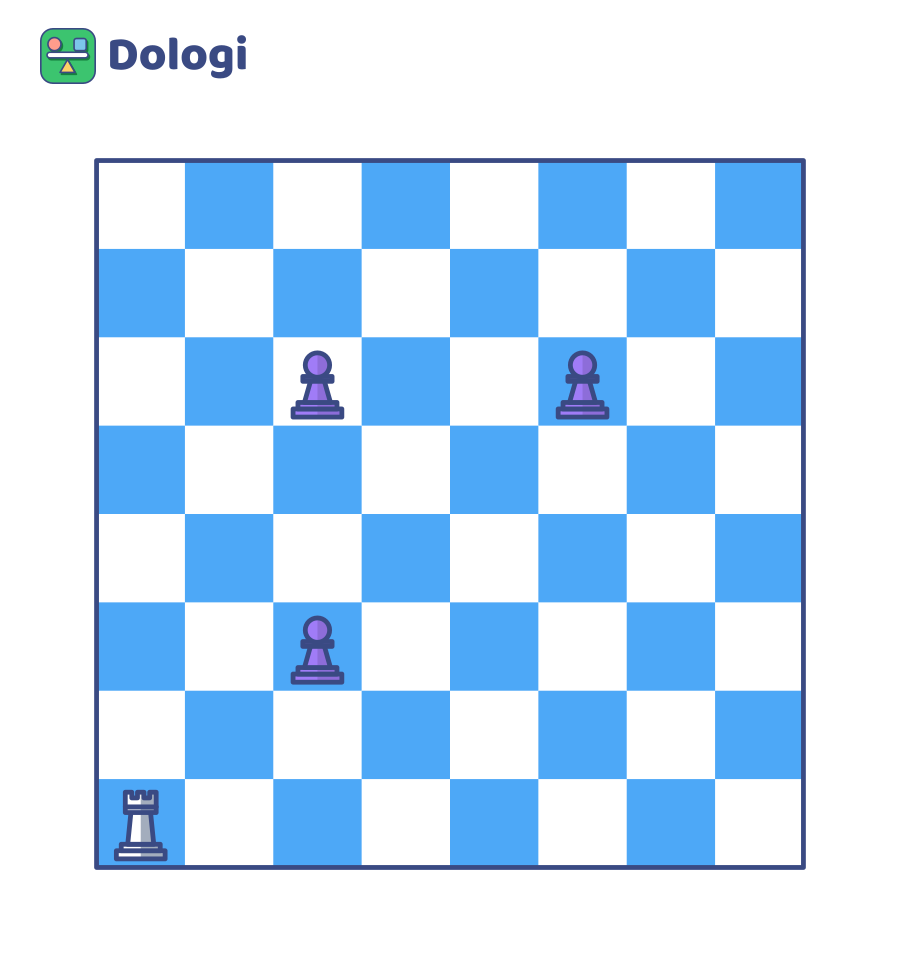
Capture all three purple pieces in the fewest moves.
- Hint 1: Can the rook capture anything right now?
- Hint 2: Sometimes the best first move captures nothing. It just gets the rook into position to grab several in a row.
Group 2: The bishop
A bishop moves diagonally, as far as it likes, and always stays on squares of the same color it started on.
Puzzle 4
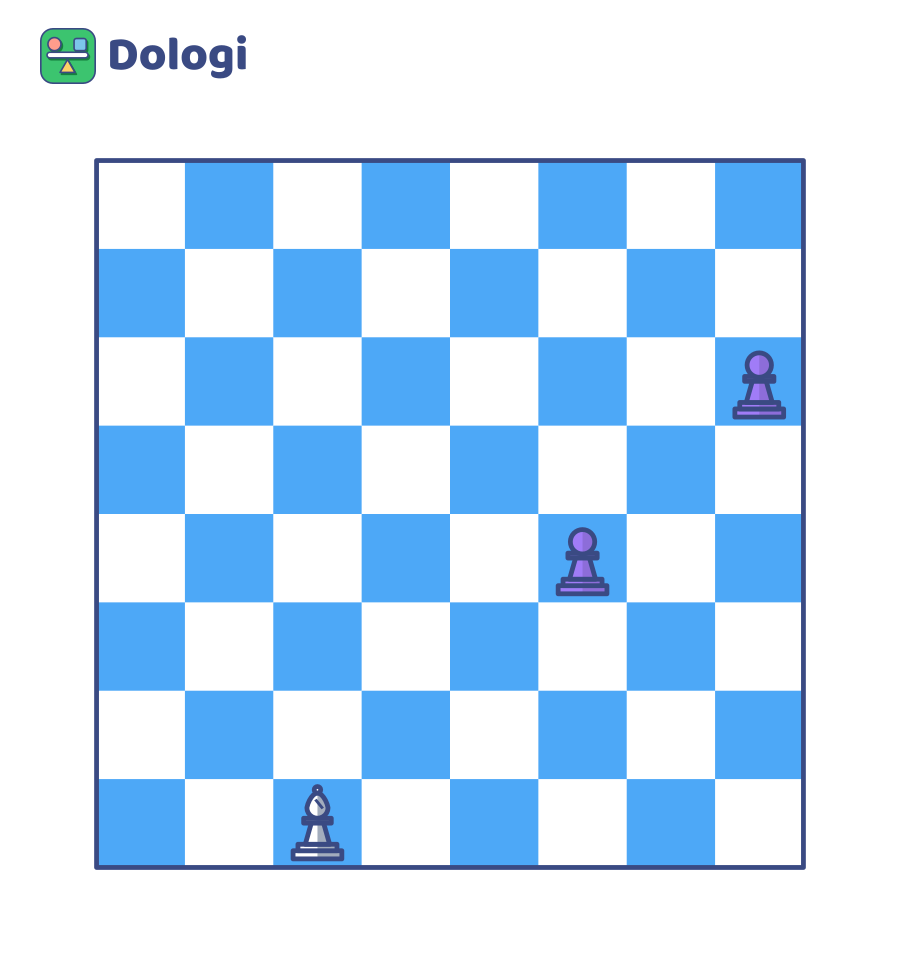
Capture both purple pieces in the fewest moves.
- Hint 1: Trace the diagonal from the bishop up and to the right with your finger.
- Hint 2: After the first capture, look at the diagonals from the new square.
Puzzle 5
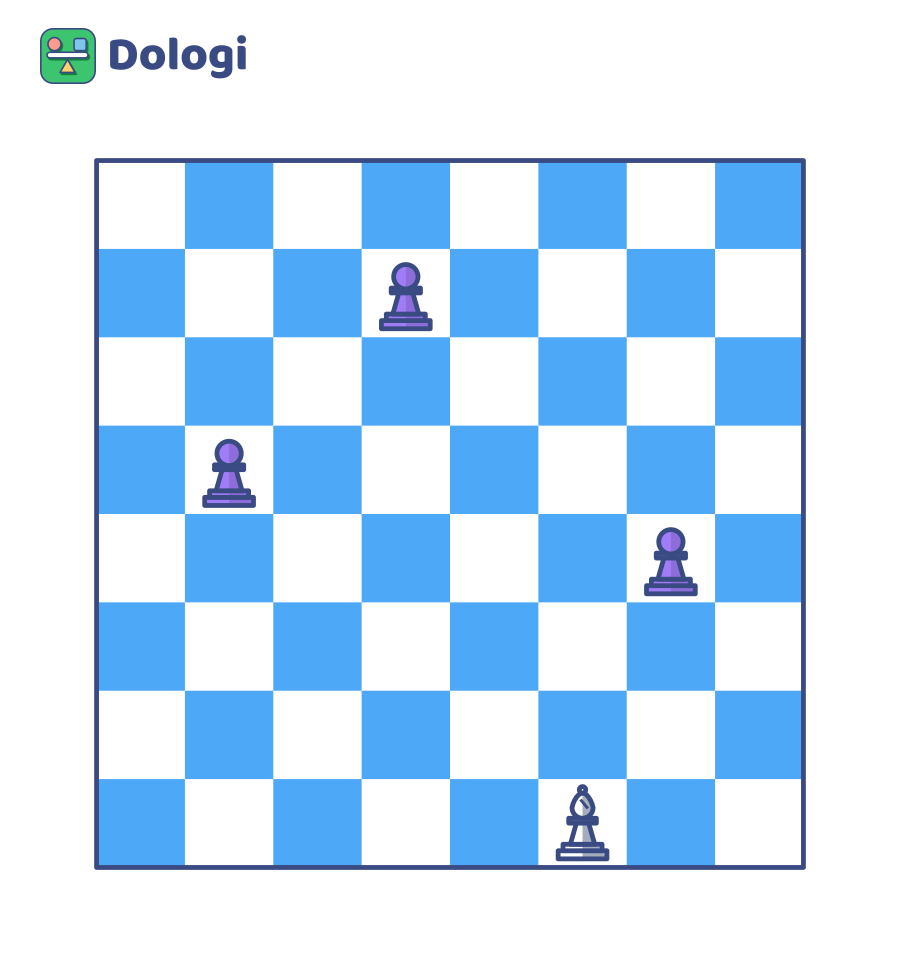
Capture all three purple pieces in the fewest moves.
- Hint 1: Which pawn is on the bishop's diagonal right now?
- Hint 2: After each capture, check both diagonals through the new square.
Group 3: The knight
A knight moves in an L: two squares straight, then one square to the side. It can jump over other pieces.
Puzzle 6
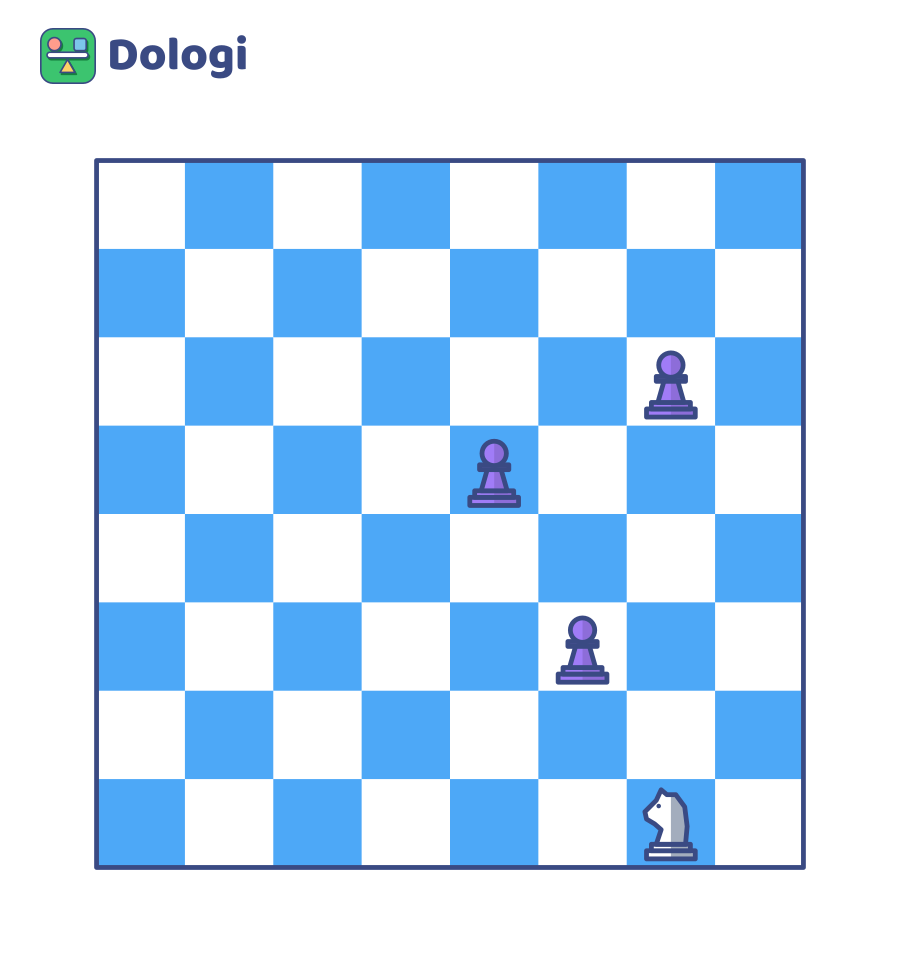
Capture all three purple pieces in the fewest moves.
- Hint 1: Which pawn is exactly one L away from the knight?
- Hint 2: After capturing, look for the next pawn one L away from the new square.
Puzzle 7
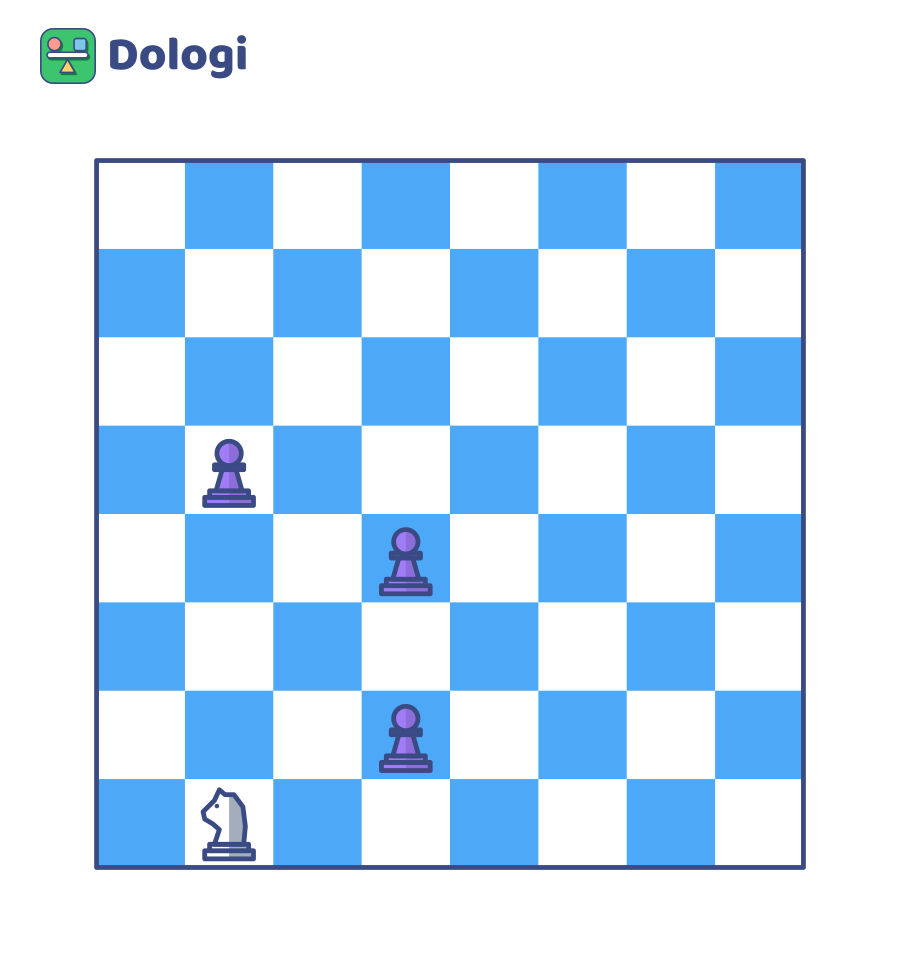
Capture all three purple pieces in the fewest moves.
- Hint 1: After taking the pawn on the second row, can the knight jump straight to the pawn on the fourth row?
- Hint 2: To reach a square two steps straight ahead, a knight needs two moves.
Group 4: Two pieces working together
Now your child has two pieces. Only one piece moves each turn, so think about which piece should take which pawn.
Puzzle 8
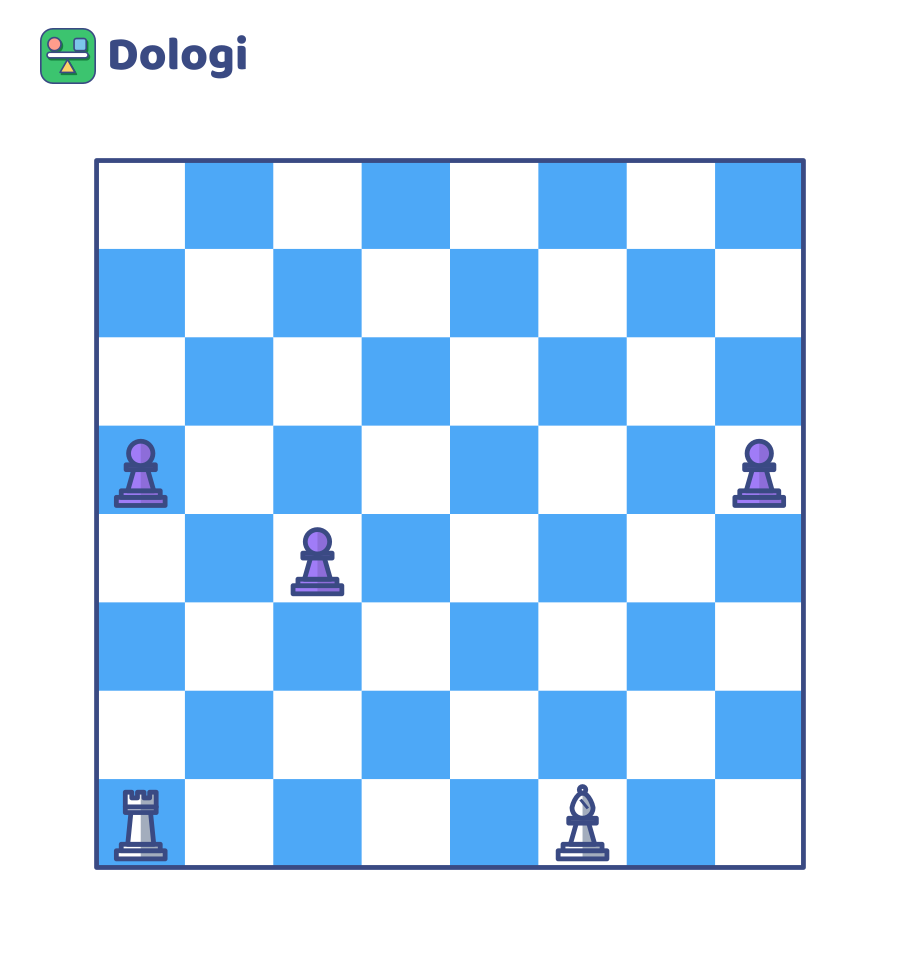
Capture all three purple pieces in the fewest moves.
- Hint 1: Which pawn is on the rook's path, and which is on the bishop's diagonal?
- Hint 2: Once the rook has captured, look sideways from its new square.
Puzzle 9
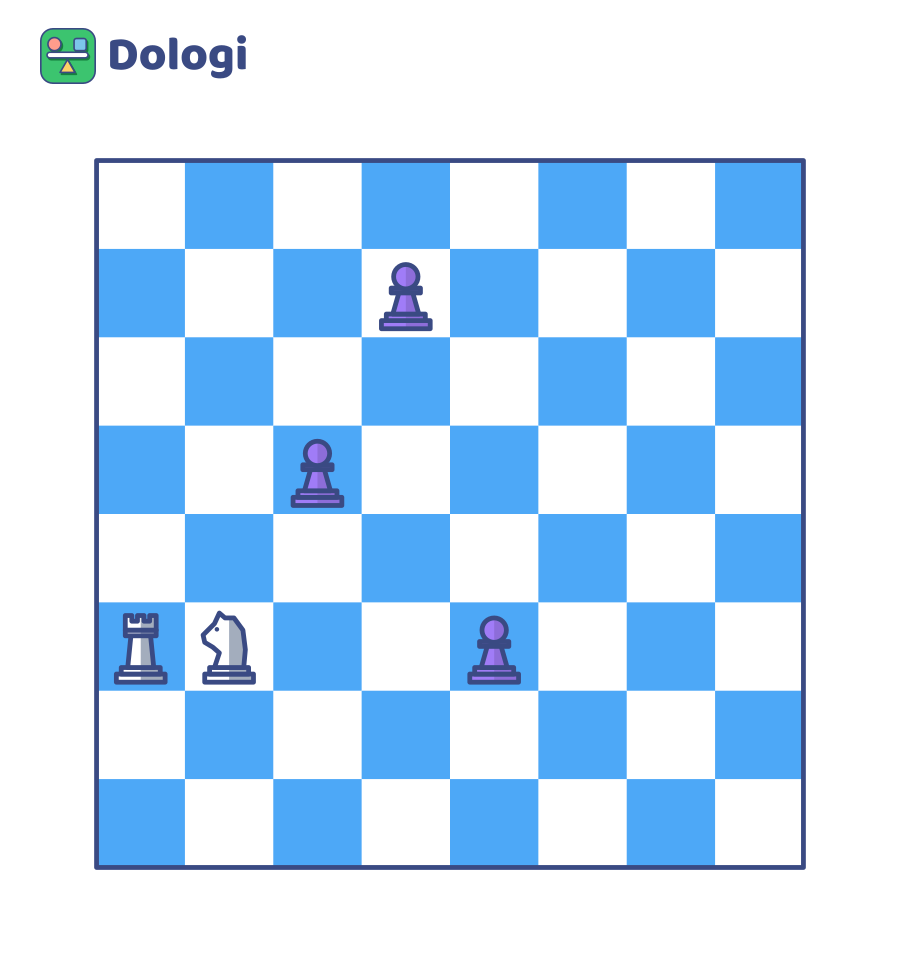
Capture all three purple pieces in the fewest moves.
- Hint 1: What's blocking the rook?
- Hint 2: Where can the knight go to get out of the rook's way and capture something at the same time?
Puzzle 10
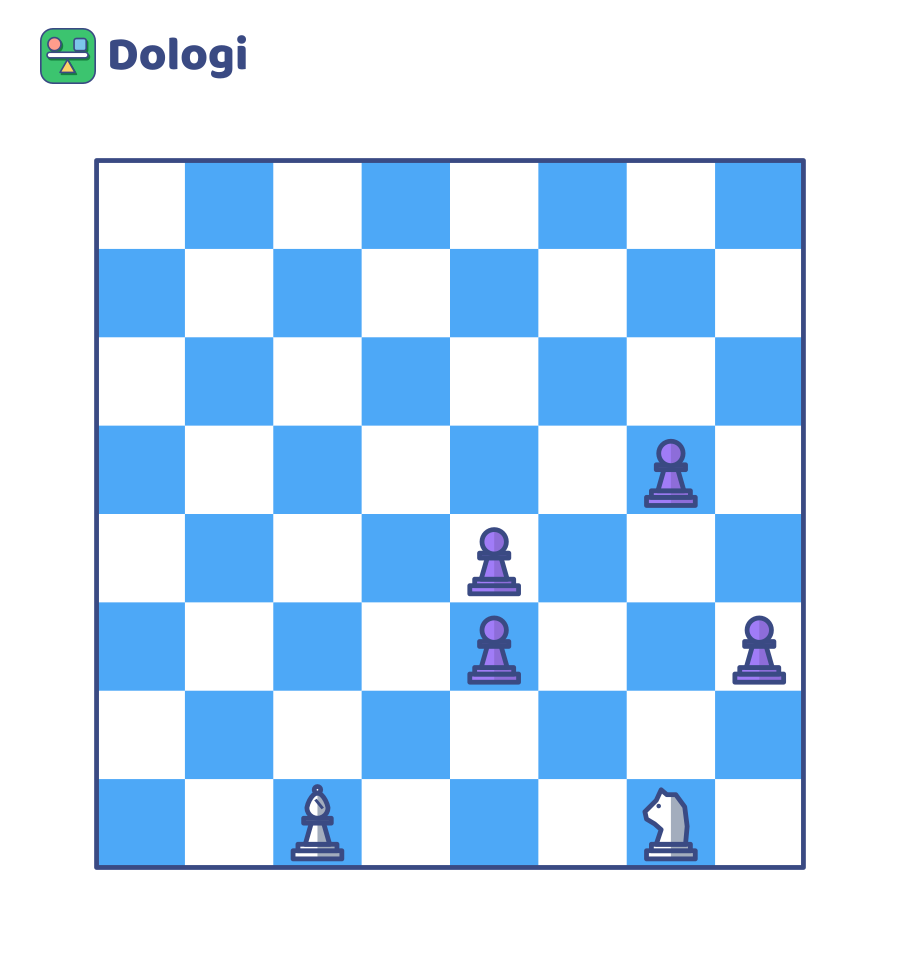
Capture all four purple pieces in the fewest moves.
- Hint 1: The bishop is on a blue square. Is any pawn on a white square? Can the bishop ever get there?
- Hint 2: Let the knight start with the pawn on the right edge, then keep going in L-jumps.
Answers
- 1 move. The rook goes straight up and captures the pawn (a1 to a6). Nothing is in the way.
- 2 moves. The rook takes the middle pawn first (d1 to d4), then the top one (d4 to d7). Rooks can't jump, so this is the only order that works.
- 4 moves. The rook can't capture anything yet, so the first move just gets it into position: up to a3 (or over to c1). Then it takes c3, c6 and f6. This is the first puzzle where the shortest path includes a move that doesn't capture.
- 2 moves. The bishop takes f4 (diagonally from c1), then h6.
- 3 moves. The bishop takes b5, then d7, then slides back down the other diagonal to take g4. The bishop can't reach g4 at the start, so that pawn comes last.
- 3 moves. The knight takes f3, then e5, then g6. Each pawn is exactly one L away from the one before.
- 4 moves. The knight takes d2, hops to b3 (or f3), takes d4, then takes b5. From d2 the knight can't jump straight to d4, so it needs one extra move around.
- 3 moves. The rook takes a5, the bishop takes c4, and the rook slides across from a5 to take h5. Any order works, as long as each piece takes its own pawns.
- 3 moves. The knight takes c5 (capturing and clearing the rook's path in one move), the rook slides over to take e3, and the knight takes d7. Taking d7 with the knight before the rook takes e3 works too.
- 4 moves. The bishop takes e3, then the knight takes h3, g5 and e4. The bishop lives on blue squares, so it can never reach the pawn on e4, which sits on a white square: that one is the knight's job. The knight needs two jumps to get from h3 to e4 anyway, so landing on g5 in between saves a move; if the bishop takes g5 instead, it takes 5 moves.
Keep playing, at home and in Dologi
Once your child has solved all ten, switch roles: your child sets up the apples and you try to capture them, then count together who used fewer moves. Making a puzzle for someone else is a great way for kids to start asking themselves, "Is there a shorter way?"
In the Chess room in Dologi's Creative corner, Learn chess has Piece by piece lessons. The rook, bishop and knight lessons have a Practice step with "Take all the stars.": one piece, a few stars, and some boards with pieces in the way or a fewest-moves challenge, just like the game above. Kids around 4 to 7 can also play Little games such as Pawns and rook or Capture all (no kings, and you win by capturing every piece on the other side). Once the Creative corner is open, the daily session sometimes includes a Who can take it? or How many moves? puzzle.
In short
- Capturing pieces that stand still is a gentle step between learning the moves and playing full games.
- Go from one piece and one target to two pieces and several targets: rook and bishop first, knight after.
- Let your child point, count moves and use hints in steps; ask "why?" instead of correcting.
- Set up puzzles with apples or bottle caps on a real board, and let your child make puzzles for you.
Read more: 10 easy chess puzzles for kids who are just starting, with hints and answers, Knights jump in an L, bishops slide diagonally: how chess builds spatial thinking in kids