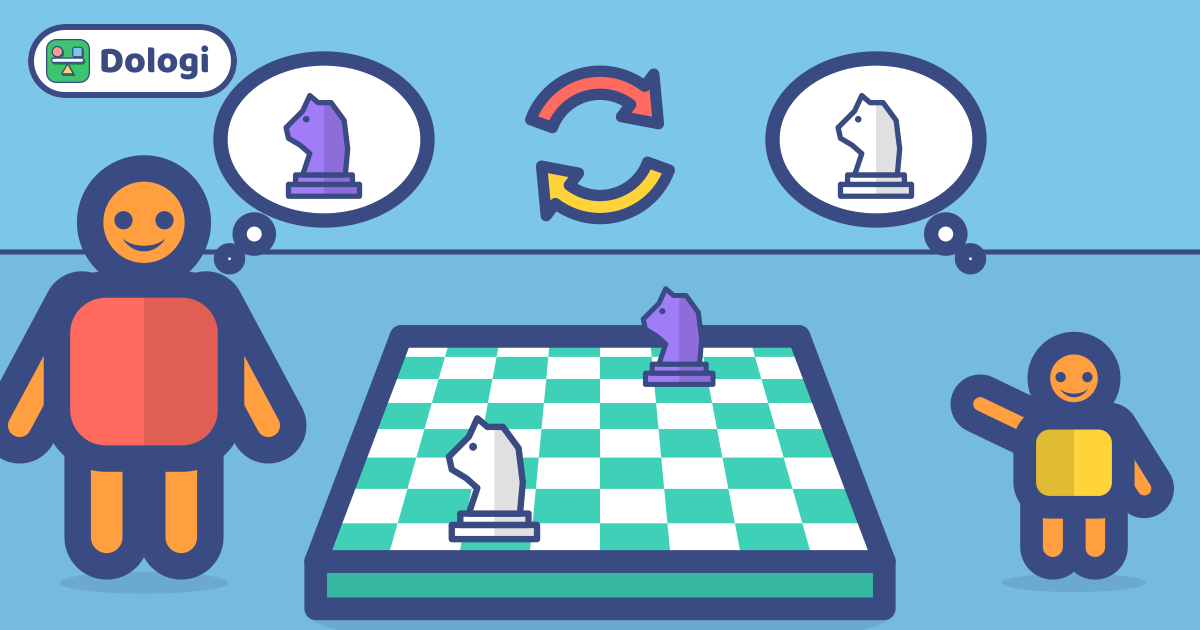
Your child is busy pushing a pawn forward to free up the queen when, click, your knight jumps in and takes their rook. Big eyes: "Why did you take my rook?" That knight had been waiting there for two moves. Your child just never looked at your side of the board.
Chess has something special: across the board there is always a person with a plan of their own. To play well, a child has to stop thinking "what do I want?" now and then and ask "what do they want?" This post offers a few ways to practice seeing the board from the other player's side, and to carry that habit into the times your child plays with friends.
Why kids forget about the other side
For many young children, a chess game is about themselves: where my pieces go, what I can capture. The other player's moves feel like surprises that just happen, not the result of someone thinking. That is normal for a beginner, not a fault.
Guessing what someone else wants is hard, because your child has to set aside what they want and imagine what another person wants. Chess makes that practice very concrete: the other side's plan shows up on the board in real pieces and real squares, so it can be seen and checked.
"What did they just want to do?": reading the last move
Every move the other player makes is a message. After you move, instead of letting your child rush to reply, read that message together with three questions:
| Question | Where your child looks |
|---|---|
| Which piece did I just move, and from where to where? | The old square and the new square of that piece |
| What is that piece aiming at now? | The lines it can travel from its new square, and whether any of your child's pieces sit on them |
| What do you think I want to do next? | Which of their pieces is in danger, which square the other side wants to reach |
At first, say your own plan out loud: "I moved my knight here because I want to take your bishop." A few games later, stop telling and ask: "Guess why I moved my knight here." A wrong guess is fine; just show where the knight is aiming.
This is different from predicting the next move, which the post on thinking ahead covers. Here your child doesn't need to calculate far, only to understand what the other player just did and why.
The turn-the-board game
This works for children who already know how the pieces move. Explain the rule before you start, then in the middle of a game:
- Pick a calm moment, not when your child is losing badly or upset.
- Turn the board halfway around. "Now you're the other side. If you were playing this side, what would you do?"
- Your child says which move they'd pick and why. You can play exactly that move.
- Turn the board back. Now your child has to answer the very move they just thought up for you.
Often, sitting on the other side for a moment is enough for a child to spot which of their own pieces is unprotected. Take your turn switching sides too, so it stays a game you play together, not a test.
For younger children, play this in a pawns-only game with few pieces and short games. Older children can actually swap seats, play the other side for a few moves, then swap back.
Retelling the game from the other side
After a game, ask your child to retell part of it as if they were the other player: "What did Black want at that point? What was Black worried about?" They don't need to remember every move; one or two key moments are enough.
Telling it from the other side helps your child see a chess game as a story with two people in it, each with reasons for their moves. If your child just lost, let them tell the winner's side. They often notice for themselves what they missed, which is gentler than hearing a grown-up point it out.
From the board to playing together
Chess practices guessing the other side's plan inside a game. Whether that habit carries over into everyday life on its own isn't certain, but you can help connect the two with the same questions you use at the board:
- Before playing: "What game does your little brother want to play? Which part do you think he likes best?" Then ask him and find out if the guess was right.
- While playing: "Your friend just lost three games in a row. How do you think she feels?"
- Afterward: "Next time, how could we play so both of you have fun?"
The key is to guess, then ask. On the board, the next move tells your child whether the guess was right; in real life, the only way to check is to ask the other person. This is about practicing seeing from someone else's side while playing, not about grading how caring your child is.
In Dologi's Chess room (in the Creative corner), the Free board section has Two players: two people share one device, and the board turns after every move so the player whose turn it is always sits at the bottom edge, much like the turn-the-board game above (to set the device between two players sitting across from each other, turn on Sit face to face in Settings). The Magnifier button shades the squares the other side is guarding and outlines the moving side's pieces that are under attack with no defender, so your child can see right away which of their pieces the other side is aiming at.
In short
- Across the board is a person with their own plan; learning to guess that plan is part of learning chess.
- After each of the other player's moves, ask: what is that piece aiming at, and what do they want next?
- The turn-the-board game and retelling the game from the other side let your child sit in the other player's seat for a moment.
- Away from the board, guess what a playmate wants, then ask to be sure; don't let guessing replace asking.
Read more: Seeing a problem from many sides: helping children understand other points of view, What is thinking ahead? Building the habit in kids through chess and everyday life