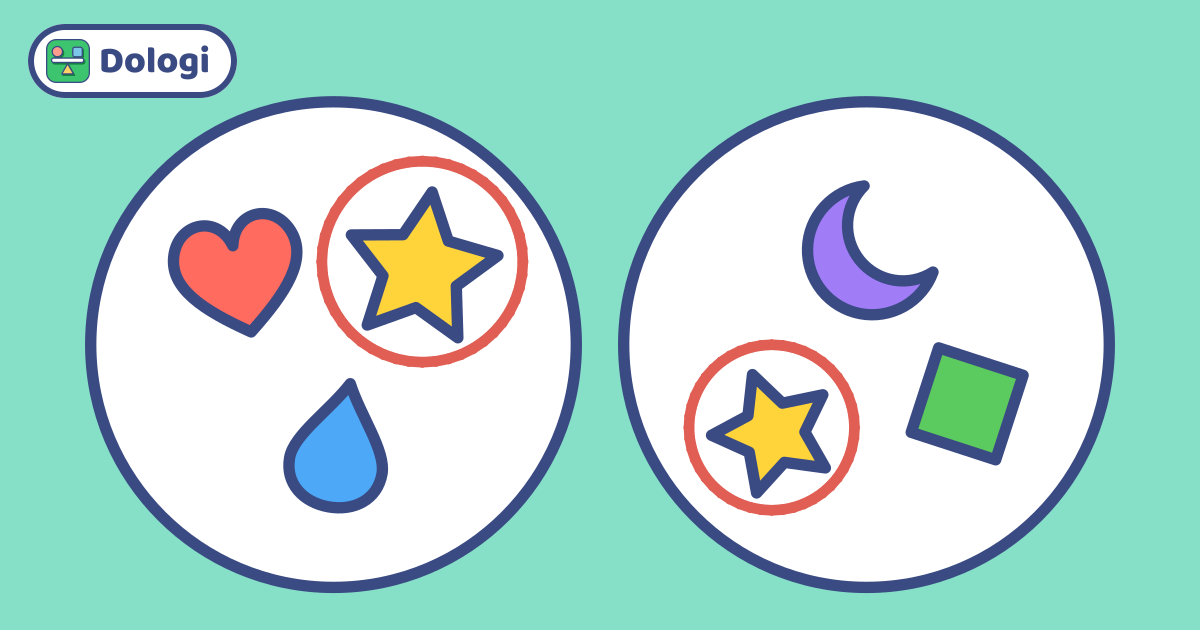
Flip two cards onto the table. Each card has three small symbols. Between the two cards there is always exactly one matching symbol, no more, no less. Whoever points to it and names it first wins the round.
It sounds simple, but the eyes have to work fast: compare each symbol on one card with each symbol on the other and skip the ones that don't match. Kids of 5 or 6 can play the small 7-card set, older kids can play a 13-card set, and families are often surprised to find the kids beating the grown-ups.
The magic part: any two cards share exactly one symbol. It isn't luck; the cards follow a ready-made plan. This post gives you that plan to draw from.
Making the small 7-card set
You need: seven pieces of card (trace around a bowl to cut circles, or just cut squares) and colored pens.
Choose seven easy symbols: star, heart, circle, square, triangle, moon, drop. Give each symbol its own color so it's easy to recognize. Then draw them exactly as in the table:
| Card | Three symbols on the card |
|---|---|
| 1 | star, heart, circle |
| 2 | star, square, triangle |
| 3 | star, moon, drop |
| 4 | heart, square, moon |
| 5 | heart, triangle, drop |
| 6 | circle, square, drop |
| 7 | circle, triangle, moon |
Try it: what do cards 4 and 7 have in common? Card 4 has a heart, a square and a moon; card 7 has a circle, a triangle and a moon. Only the moon. Try a few more pairs: every pair shares exactly one symbol.
Drawing tip: put the three symbols in different places on each card (the star isn't always at the top), make some big and some small, and tilt a few. That way eyes can't just check one corner and spot it instantly.
Three ways to play
Flip two (the easiest): shuffle and flip two cards into the middle. Whoever points to and names the shared symbol first gets a dried bean. Flip two more and keep going, reshuffling when you run out. Whoever has the most beans after five minutes wins.
The pile: everyone gets one card face up in front of them; the rest go face down in a pile in the middle, and the top card is turned over. Whoever first spots the symbol shared by their own card and the middle card takes the middle card and puts it on top of their own (it becomes the card they compare next). Turn over the next middle card. When the pile runs out, whoever holds the most cards wins. This version works even better with the 13-card set.
Beat the clock together (for little ones): parents and child are one team. Flip pairs one after another, everyone searches together, and you time how long it takes to get through all seven cards. Next time, try to be faster. Nobody loses.
Helping kids find it faster
- Pick one symbol and hunt for it: choose a symbol on one card and scan the other card for it; if it's not there, try the next. Each card has only three symbols, so it takes at most three tries.
- Don't get fooled by size or angle: if each symbol always gets the same color, color helps you spot it; and a big tilted star is still a star.
- Say the name out loud while pointing: "Moon!" Naming it double-checks the answer and stops wild guessing.
- Give little ones a head start: grown-ups silently count to five before looking, or play using their left hand.
This trains selective attention: finding exactly what you're looking for among lots of similar things. Find and cross out sheets has more ways to practice it on paper.
A bigger 13-card set for older kids
When seven cards get too easy, make 13 cards with four symbols each, using thirteen symbols: star, heart, circle, square, triangle, moon, drop, leaf, fish, cloud, flower, lightning bolt and arrow. The rule still holds: any two cards share exactly one symbol.
| Card | Four symbols on the card |
|---|---|
| 1 | star, heart, circle, square |
| 2 | star, triangle, moon, drop |
| 3 | star, leaf, fish, cloud |
| 4 | star, flower, lightning bolt, arrow |
| 5 | heart, triangle, leaf, flower |
| 6 | heart, moon, fish, lightning bolt |
| 7 | heart, drop, cloud, arrow |
| 8 | circle, triangle, fish, arrow |
| 9 | circle, moon, cloud, flower |
| 10 | circle, drop, leaf, lightning bolt |
| 11 | square, triangle, cloud, lightning bolt |
| 12 | square, moon, leaf, arrow |
| 13 | square, drop, fish, flower |
Notice how the table is arranged: the first four cards all have the star; after that, heart, circle and square each start three cards. Every symbol appears on exactly four cards.
Why does it work?
This part is for curious kids aged 9 to 12. For the 7-card set, draw a diagram:
- Draw a large triangle. Its three corners are three points.
- Mark the middle of each side: three more points.
- Mark the very center of the triangle (where the three lines from each corner to the middle of the opposite side meet): the seventh point.
- Draw the three lines from each corner to the middle of the opposite side, and a circle through the three side midpoints.
Now you have seven points and seven lines (three sides, three middle lines and one circle). Every line passes through exactly three points. Put the seven symbols on the seven points: each line gives you one card. Because any two lines always cross at exactly one point, any two cards always share exactly one symbol.
One more pattern for your child to test: cards with 3 symbols need 7 cards, and cards with 4 symbols need 13. Can they guess how many cards you'd need with 6 symbols each? (Answer: 31. The rule is the number of symbols per card times itself, minus the number of symbols, plus 1: 6 × 6 − 6 + 1 = 31.)
If your child enjoys games that are part play, part math discovery, try the homemade triples card game too; it can also be drawn at home.
The Focus topic in Dologi has a puzzle called Spot the difference: "Find the differences between the two pictures. Tap each one once." The card game does the opposite, hunting for what's the same, but both train the same way of looking: comparing two pictures one detail at a time.
In short
- The 7-card set has three symbols per card, drawn exactly from the table: any two cards always share exactly one symbol.
- Play flip two, the pile, or beat the clock together; point and name the shared symbol.
- Teach "pick one symbol and hunt for it"; big, small or tilted, it's still the same symbol.
- Older kids make the 13-card set with four symbols each, and draw the seven-point, seven-line diagram to see why it works.
Read more: Find and cross out sheets, Homemade triples card game