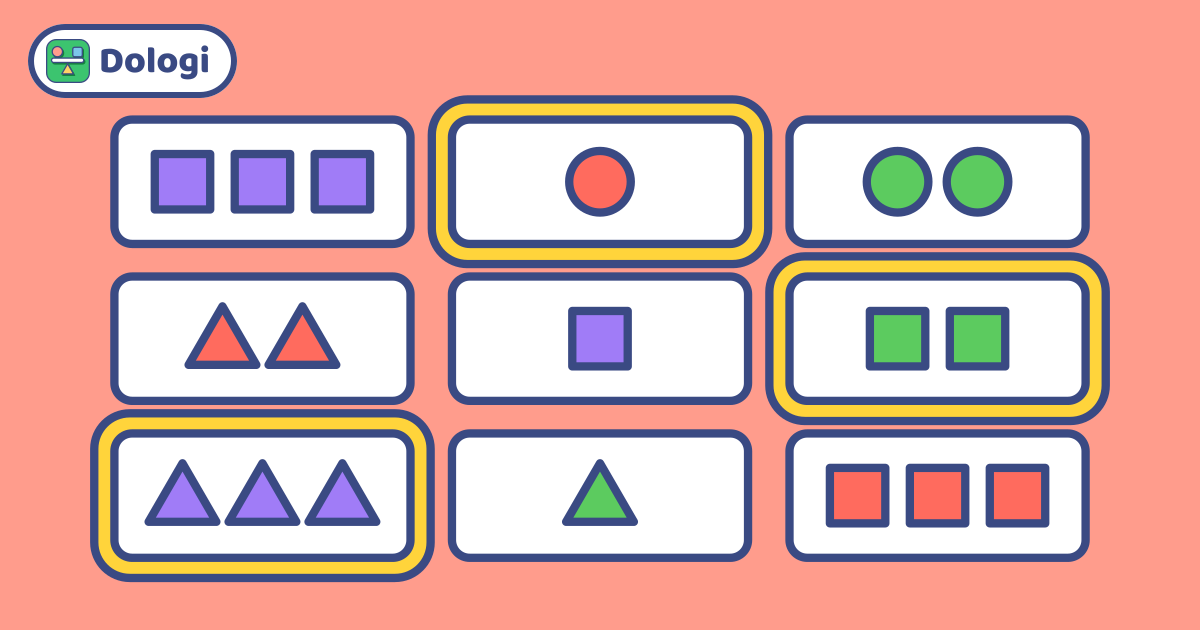
Lay nine cards on the table. Each card has one, two or three shapes; the shapes are circles, squares or triangles; they're colored red, green or purple. Your mission: find three cards that make a triple, meaning that for each feature, the three cards are either all the same or all different.
For example, one red circle, two green squares and three purple triangles make a triple: the colors are all different, the shapes are all different, and the numbers are all different. Two red circles, two green circles and two purple circles also make a triple: colors all different, shapes all the same, numbers all the same.
The game suits kids around 7 to 12, and adults often lose to children at it. Kids of 5 and 6 can play a two-feature version with nine cards. One afternoon of drawing gives you a deck that lasts a long time.
Making the 27-card deck
You need: 27 pieces of card cut to the same size (or index cards), and red, green and purple markers.
Each card is one combination: 3 colors × 3 shapes × 3 numbers = 27 cards, no two alike. To avoid missing one, work one color at a time:
| Red | 1 shape | 2 shapes | 3 shapes |
|---|---|---|---|
| Circle | card 1 | card 2 | card 3 |
| Square | card 4 | card 5 | card 6 |
| Triangle | card 7 | card 8 | card 9 |
Make the nine red cards from the table, then repeat with green, then purple. Older kids can draw up the table themselves and check "Do we have all 27? Are any doubled?", which is already a small counting problem.
Drawing tips: keep shapes the same size on every card, space them evenly, and color them in solid so they're easy to see. Pick colors that are clearly different (avoid red with orange, or green with blue).
How to play
- Shuffle the deck and lay nine cards face up in a grid.
- Everyone looks at the same time; there are no turns.
- When you spot a triple, call "Triple!" and point to the three cards.
- Everyone checks together. If it's right, you keep the three cards and three new cards fill the gaps.
- If everyone is sure there's no triple, deal three more cards (making twelve).
- When the draw pile is empty and no triples are left, the game ends. Whoever holds the most triples wins.
What about a wrong call? With younger kids, just say "not quite" and keep playing. Older kids can take a small penalty: give back one triple, or sit out the next search.
Checking one feature at a time
The most common mistake is looking at the cards as a whole: "they look pretty different." Teach your child to check one feature at a time, asking just one question each time:
- Color: all the same color? Or three different colors?
- Shape: all the same shape? Or three different shapes?
- Number: all the same number? Or one, two and three?
If even one feature turns out "two the same, one different," the three cards aren't a triple. For example, one red circle, two red squares and three green squares: the colors are red, red, green, which is two the same and one different, so it's out right away, with no need to check further.
"Two the same, one different means no" is the key to the whole game. Kids who get it start finding triples much faster.
Tips for spotting triples faster
- Pick two cards first, then look for the third. For any two cards there is exactly one card that completes the triple. Feature by feature: if the two cards match, the third matches too; if they differ, the third is the remaining option. A red circle and two green circles need three purple circles.
- Start with something that stands out: for instance, notice three purple cards and check whether they form a triple.
- Talk yourself through it: "colors all different, shapes all the same, numbers all different, yes!"
A two-feature version for younger kids
For 5 and 6 year olds, use just two features: color and shape, with exactly one shape per card. The deck has only nine cards (3 colors × 3 shapes).
- Lay out five cards and look for triples together. With five cards on the table there is always at least one triple, so your child never hunts for something that isn't there.
- Play cooperatively: the whole family finds all the triples in the five cards, and nobody wins or loses.
- Once your child is comfortable, add the number feature to get the full 27-card deck.
Thinking activities for 6-year-olds has more games for sorting by two features.
Some surprises for older kids
- The full 27-card deck contains 117 different triples.
- Nine cards on the table hold about three triples on average, and almost always at least one. A nine-card layout with no triple is rare: fewer than five deals in ten thousand.
- With ten cards or more on the table, there is always a triple. Challenge your child: try to pick nine cards with no triple at all. It can be done, but it's very hard!
- Why do two cards decide the third? Work it out with your child feature by feature, as in the tips above.
These questions lead into ideas from combinatorics that kids can touch with nothing but homemade cards. If your child enjoys reasoning by rows and columns, try 3×3 pattern grid puzzles next.
The Logic topic in Dologi has a puzzle called Sort into groups: "Drag each thing into the box with the same color, shape or number." It uses the same three features as the deck, making it a good warm-up for kids who aren't used to looking at one feature at a time.
In short
- The 27-card deck is 3 colors × 3 shapes × 3 numbers; make it one color at a time from a table so nothing is missed or doubled.
- Lay out nine cards; whoever spots three cards where each feature is all the same or all different calls it and takes them.
- Check one feature at a time; "two the same, one different" means no.
- Younger kids play a nine-card, two-feature version where five cards always hold a triple; older kids explore the 117 triples and try to find nine cards with none.
Read more: Thinking activities for 6-year-olds, 3×3 pattern grid puzzles