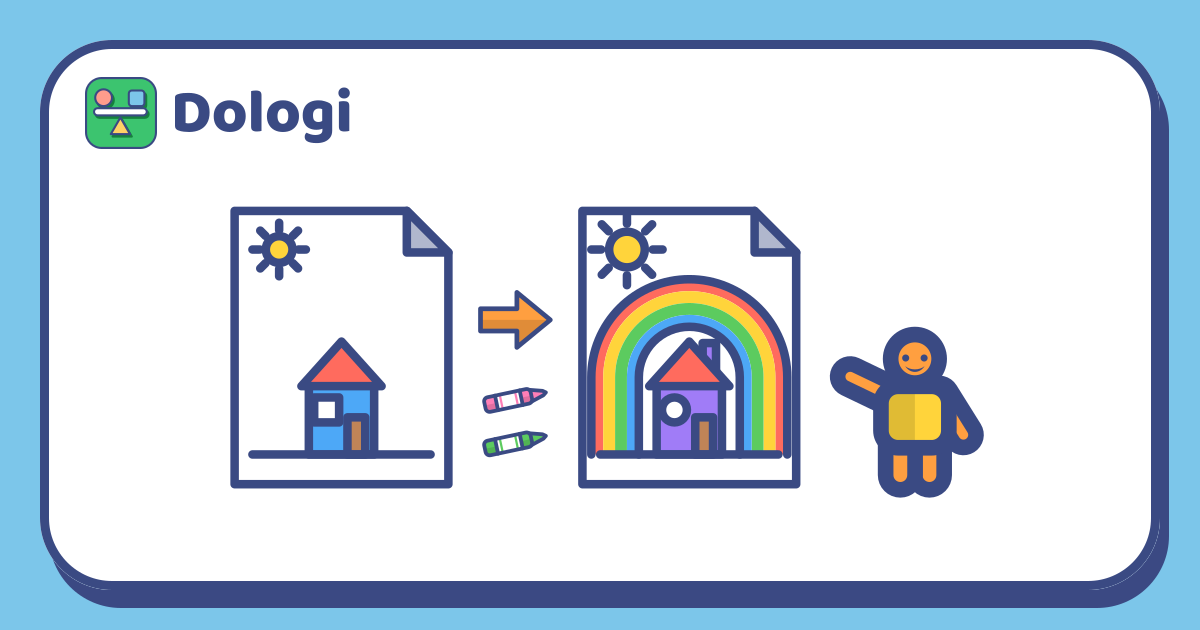
Your child comes home with a drawing that looks exactly like their friend's: the same cat, the same house, the same rainbow in the corner. Maybe the friend was upset about it. Maybe you are wondering why your child doesn't draw "their own" things.
Copying is not a sign that a child has no ideas. For many children aged about 5 to 10, it is one of the most natural ways to learn. This article explains why, and shows a simple game, "copy, then change three things", that helps your child turn someone else's picture into the start of their own.
Copying is how many children learn
Before a child can draw a house in their own way, they need to know how a house can be drawn at all: a square, a triangle on top, a door, some windows. Watching a friend or an older sibling and doing the same is a quick way to pick up those building blocks. Adults learn new skills in a similar way, by following an example first.
Copying also asks a lot of thinking. Your child has to look closely, notice which shape comes first, judge sizes and compare their drawing with the original. Those are the same skills of observing and comparing that help in puzzles and in math.
Children also copy because they like the person they copy. Drawing the same picture as a friend can be a way of saying "I want to be like you" or "let's be together".
So the goal is not to stop copying. The goal is to help your child take the next step: from "the same as" to "my own version of".
When a friend is upset about being copied
Sometimes the friend whose picture was copied feels that something was taken. That feeling is real, and it is a good chance to talk about it without blame.
- Explain both sides. "You liked their drawing so much that you wanted to make one too. Your friend worked hard on it and wants it to be special."
- Suggest asking first. "Can I draw one like yours?" is a kind question, and most friends say yes.
- Give credit. Your child can say "I got the idea from Mia's drawing." Naming where an idea came from is fair, and it is something adults do too.
- Add something new. A copy that changes a few things is no longer the same picture. That leads straight to the game below.
The "copy, then change three things" game
This game works with drawings, block builds, clay figures and even short stories. You need one example to start from: a picture in a book, a drawing by a friend or sibling, or something your child made earlier.
- Copy. Your child copies the example as closely as they can. There's no rush; looking carefully is part of the game.
- Change the color. Pick at least one part and give it a different color. A blue house becomes purple, a green tree turns autumn orange.
- Change the size. Make one thing bigger or smaller: a giant sun, a tiny door, an extra-tall tower.
- Add something new. Something that was not in the original: a chimney, a rainbow, a cat on the roof, a flag on the tower.
- Give it a name. Your child names their version: "The rainbow house", "Grandma's house in summer". A name helps them see it as their own work.
Put the original and the new version side by side and ask your child to point out what is the same and what changed. Spotting differences is a small thinking exercise in itself.
What to copy and change at each age
The steps are the same at every age, but what children copy and how much they change can grow with them. These ages are only a rough guide; every child is different.
| Age (rough guide) | What to copy | What to change |
|---|---|---|
| 5–6 | A simple drawing with a few shapes, a short block tower | One color, one size, one new thing |
| 7–8 | A picture with a background, a block house, a short rhyme | Several colors, the weather, the time of day, a new character |
| 9–10 | A detailed scene, a model with moving parts, a short story | The setting, the point of view, the ending, a new rule for how it works |
Older children can try "change five things", or swap roles: you draw something simple and your child decides what you must change.
What to say while your child works
Your words can help your child feel that changing things is exciting, not a test.
- Instead of "That's just a copy", try "Which part will you change first?"
- Instead of "Draw something of your own", try "What would make this one yours?"
- Ask about choices: "Why did you make the sun so big?" "Where does the rainbow go?"
- Admire the changes, not only the result: "I like how the round window makes it look like a boat house."
If your child likes drawing on a screen too, Dologi has a Creative corner with a Drawing board where they can draw freely, with no scores and no stars. A picture made there can also be a starting point for a "copy, then change" drawing on paper.
In short
- Copying is a natural way for many children aged about 5 to 10 to learn, and it takes careful looking and comparing.
- If a friend is upset, talk about asking first, giving credit and adding something new.
- Play "copy, then change three things": copy, change a color, change a size, add something new, then give it a name.
- Praise the changes and the choices, so your child sees their version as their own.
Read more: Stuck for ideas? One-sentence creative prompts for drawing, building and storytelling, Grid drawing and symmetry for children: copy, mirror and fold to check