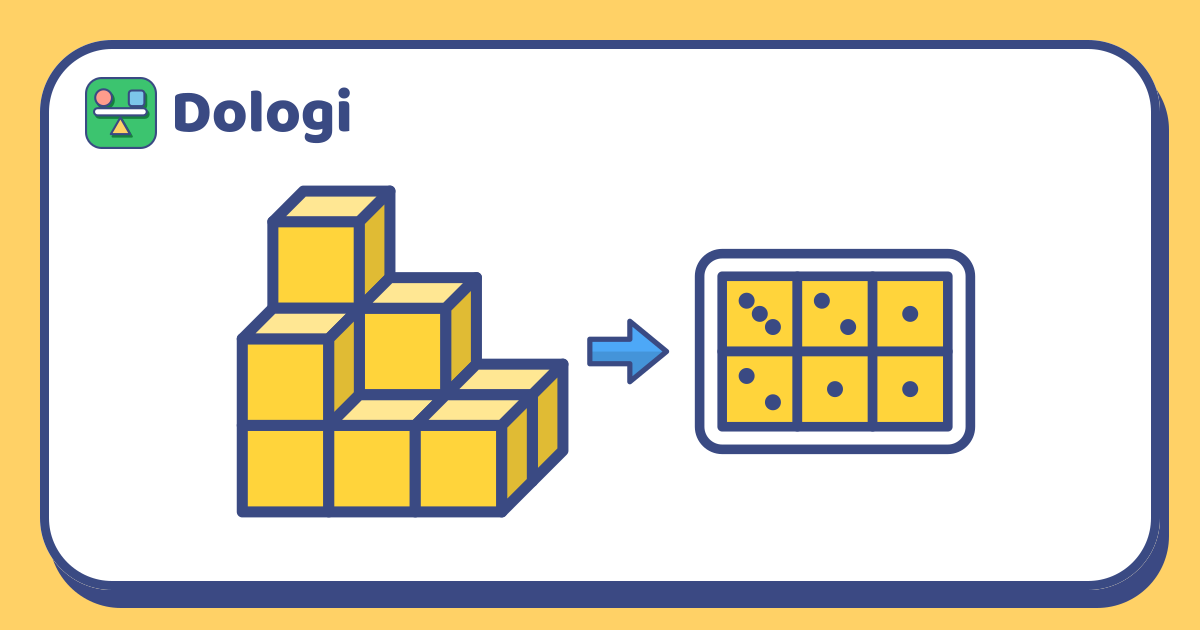
Show a child a picture of a stack of cubes and ask "how many?", and many will count only the faces they can see. The cubes underneath and behind get forgotten, because the picture doesn't show them. Yet every cube up in the air must be standing on something.
This post shows how to turn that into a puzzle habit: build with real blocks first, then count from photos and drawings. You'll find three ways to count, four puzzles that get gradually harder, and the answers at the end. Ages are only a rough guide; every child is different.
Why hidden cubes are easy to miss
Young children trust their eyes: what they can't see "isn't there". Counting a stack means keeping in mind something the eye doesn't show. A child has to think: "That cube is on the third floor, so there must be two cubes under it, even if I can't see them."
That is a big step in spatial thinking, and it is also good counting practice: grouping, adding, and checking the answer another way.
Start with real blocks
Any cubes of the same size work: wooden blocks, counting cubes, small boxes.
- Build together. Start small: five or six cubes, no more than two floors.
- Look from one side. Your child stands at one place and says how many cubes they think there are.
- Walk around. Look from the other sides and from above. Did a hidden cube show up?
- Take it apart to check. Lift the cubes off one by one and count them out loud. The guess and the real number side by side are the best lesson.
- Swap roles. Your child builds a stack and you guess. Children love catching an adult who forgot a cube at the back.
When this feels easy, take a photo of the stack from one corner and count from the photo before taking it apart. Then move on to drawings in books or puzzles.
Three ways to count
| Way | How | Good for |
|---|---|---|
| By layer | Count the bottom floor, then the next floor up, then add | Pyramids and stacks with flat floors |
| By column | Picture the stack from above, note how many cubes stand on each square, then add | Staircases and uneven stacks |
| "What is holding this one up?" | For each cube in the air, ask what is underneath it | Finding the cubes you can't see |
The column method is the one on the cover: draw the stack seen from above as a grid of squares, and write in each square how many cubes stand on it. The total is the sum of all the squares. For younger children, draw dots instead of numbers.
Four puzzles, from easy to hard
Build each one with real cubes if you can. Your child gives an answer first, then checks.
Puzzle 1 (about 6–7): the staircase. Put four towers in a row, side by side: one cube, two cubes, three cubes, four cubes. How many cubes in total? Extra: how many cubes for a staircase with five steps?
Puzzle 2 (about 7–9): the pyramid. The bottom floor is a 3 × 3 square of cubes. On top, a 2 × 2 square, placed in the middle so each cube rests on four cubes below. At the very top, one cube. How many cubes in total? The pyramid stands on a table. Walk around it and look from above: how many cubes can't you see at all? Extra: the same questions for a pyramid with four floors (the bottom is 4 × 4).
Puzzle 3 (about 9–11): what is behind the wall? Looking straight at a stack from the front, at eye level, your child sees cube faces in a staircase shape: three at the bottom, two on the next floor (above the left and middle cubes), one at the top on the left. The stack is at most two cubes deep. What is the smallest number of cubes it could have? And the largest?
Puzzle 4 (about 10–11): the big cube. A large cube made of 27 small cubes (3 × 3 × 3) sits on a table. You can walk around it and look from above, but not lift it. How many small cubes can't you see at all? Extra: the same question for a 4 × 4 × 4 cube.
Hints if your child gets stuck
- Point to one cube and ask: "What is it standing on?" Follow it down to the table.
- Count one floor at a time and write each number down before adding.
- For the hidden cubes, ask which cubes are covered on every side you can look from: front, back, left, right and top.
- For "smallest" and "largest", ask: "Could there be no cube behind this one? Could there be one? Could a taller column hide behind a shorter one?"
In Dologi, the Space topic has "Count the cubes" puzzles: a stack is drawn at an angle and your child counts every cube, hidden ones included. The prompt reminds them to count each tower from its top down, which is the column method from this post.
Answers
- Puzzle 1: 1 + 2 + 3 + 4 = 10 cubes. With five steps: 15. A neat way to see it: put two identical staircases together, one upside down, and they make a rectangle 4 cubes high and 5 wide, which is 20 cubes, so one staircase is half of that.
- Puzzle 2: 9 + 4 + 1 = 14 cubes. Only 1 can't be seen: the middle cube of the bottom floor, covered on top and surrounded on all four sides. Four floors: 16 + 9 + 4 + 1 = 30 cubes, with 5 hidden: the 4 middle cubes of the bottom floor and the middle cube of the 3 × 3 floor.
- Puzzle 3: smallest 6, one cube behind each face you see. Largest 12: behind each column can stand a column of the same height or shorter, and any taller one would show. So at most 3 + 2 + 1 = 6 more cubes behind.
- Puzzle 4: 2 cubes: the one in the very center and the one just under it, in the middle of the bottom floor. Every other cube touches a side or the top. For 4 × 4 × 4: 12 cubes, the 2 × 2 middle columns of the three lower floors.
In short
- Counting a stack means counting what you can't see: every cube in the air stands on something.
- Start with real blocks, walk around, then take the stack apart to check; photos and drawings come after.
- Count by layer, by column, or by asking "what is holding this one up?", and check one way with another.
- Puzzles with a smallest and a largest answer teach children that a picture doesn't always tell the whole story.
Read more: Build it like the model: copying block structures with your child · From flat shape to box: cube nets for children